





 Find US, EU, UK, CA, & AU requirements










Document Templates

Why do I need to create certificates/declarations?
Product certificates and declarations are mandatory for many products. Without the correct documentation, you can face fines, recalls or Amazon removals.
Step 1: Select template
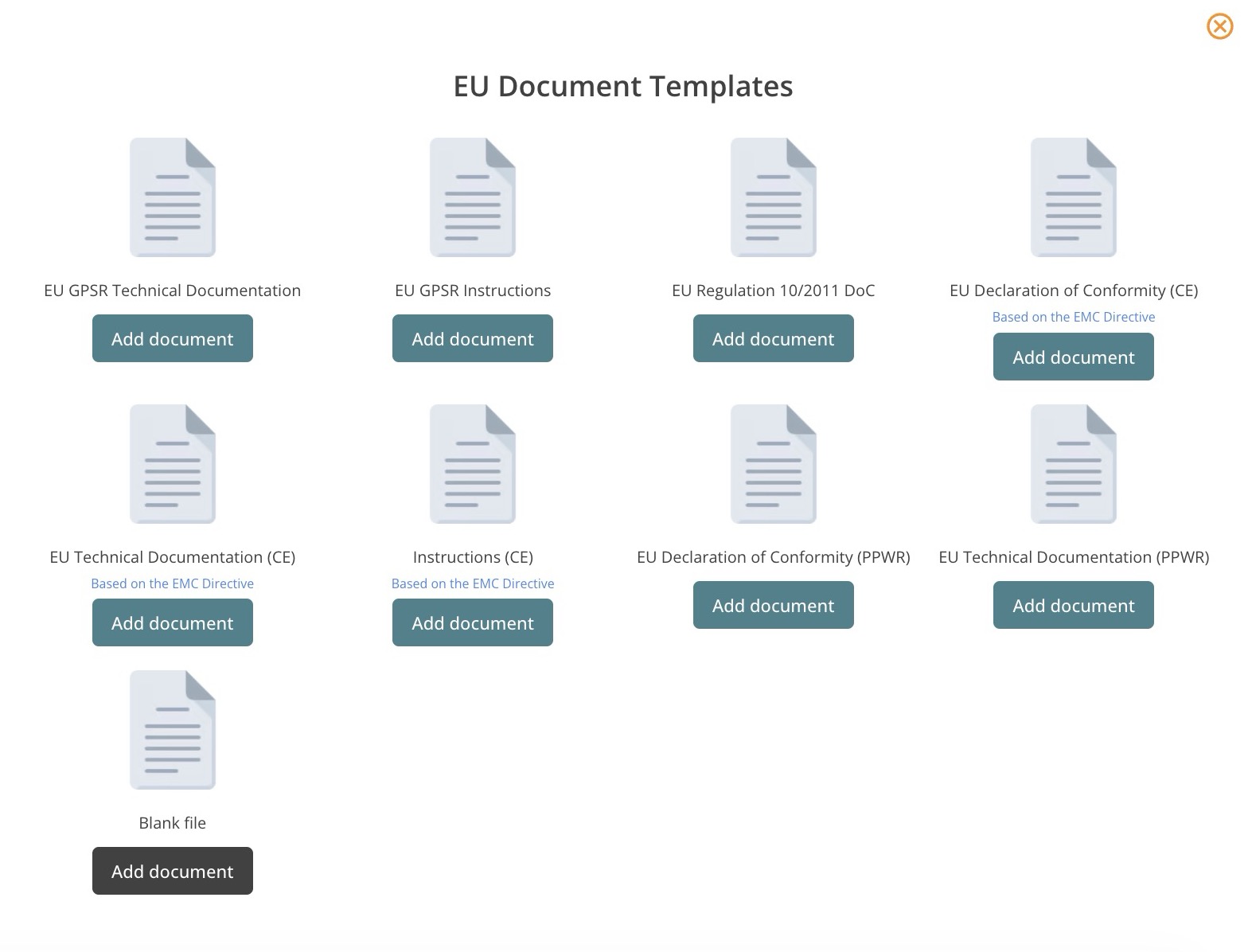
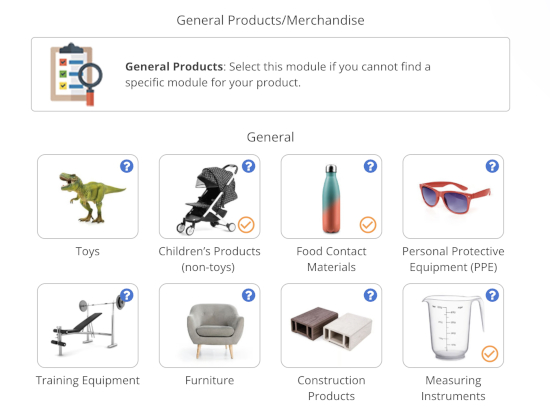
The image above only shows EU templates. There are additional templates for the US and UK.
Step 2: Fill Template Form
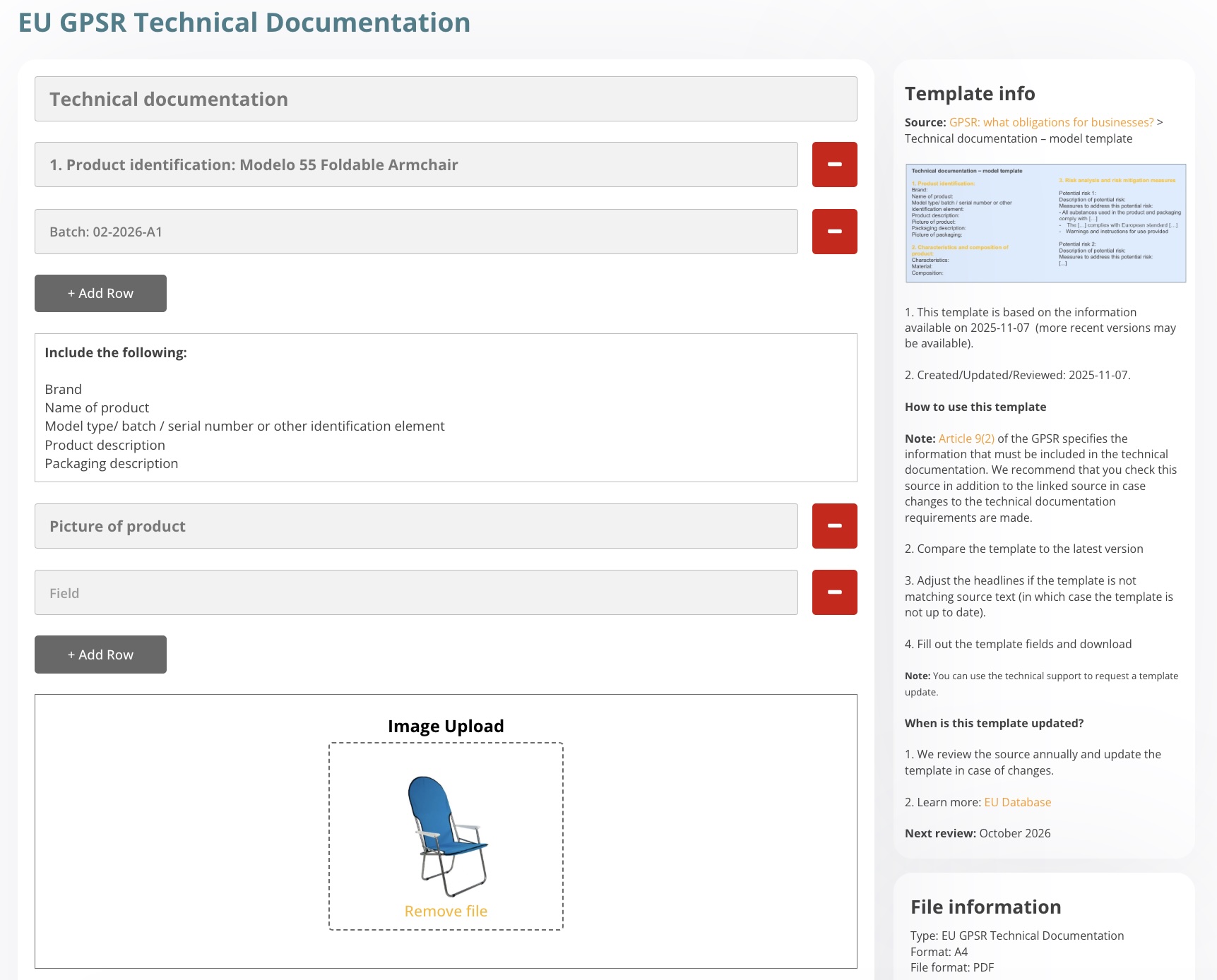
You must carefully read the instructions in the right sidebar and follow these guidelines:
- You may need to make edits to the document template headlines before adding information.
- Open the source link and select the latest version of the relevant legislation, guidance page or other source
- Ensure that you fill in a template based on the latest available version of the source/s
Note: The templates are only updated during an annual audit in October. As such, the templates may be outdated if the source (legislation or guidance document) is updated after the annual audit. It is therefore important to check the latest source version.
Step 3: Download file
What should I do with the downloaded document file?
1. Declarations and certificates can be requested by market surveillance authorities and marketplaces, including Amazon. Further, you may need to sign and/or submit the document.
2. You may need to store the document for a certain time (i.e., 10 years for EU and UK DoCs).
3. You must ultimately follow the requirements as specified in the latest version of the relevant legislation, guidance pages or other sources.
Note: Some documents can only be issued if there is other supporting documentation, such as test reports.
.png "US Document Templates")
US Certificate Templates

Children’s Product Certificate (CPC)
Relevant for children’s products covered by the CPSIA
General Certificate of Conformity (GCC)
Required for certain products covered by CPSC rules (Link)
.png "EU Document Templates")
EU Document Templates
General Product Safety Regulation Technical Documentation
Required for most consumer products
General Product Safety Regulation Instructions
Required for many consumer products
Declaration of Conformity (CE)
Required for products that must be CE marked (e.g. electronics, toys, PPE, machinery, and more)
Technical Documentation (CE)
Required for products that must be CE marked (e.g. electronics, toys, PPE, machinery, and more)
Instructions (CE)
Required for products that must be CE marked (e.g. electronics, toys, PPE, machinery, and more)
Plastic FCM Regulation (EU) 10/2011 Declaration of Compliance
Required for most plastic food contact material articles
Declaration of Conformity (PPWR)
Required for packaging
Technical Documentation (PPWR)
Required for packaging
.png "UK Document Templates")
UK Document Templates
Declaration of Conformity
Required for products that must be UKCA marked (e.g. electronics, toys, PPE, machinery, and more)
Technical Documentation (UKCA)
Required for products that must be UKCA marked (e.g. electronics, toys, PPE, machinery, and more)
Instructions (UKCA)
Required for products that must be UKCA marked (e.g. electronics, toys, PPE, machinery, and more)
UK General Product Safety Regulations 2005 Instructions
Required for many consumer products
Plastic FCM Regulation (EU) 10/2011 Declaration of Compliance
Required for most plastic food contact material articles
Other Document Templates
Blank Document Template
Need to create a document for which we don’t have a template? Use the blank document template.
You can find a list of limitations and risks related to document templates in this document. 1. Certain legislation mandates the creation of declarations, certificates, technical documentation and other documents. Such documents can be requested by national authorities and marketplaces, such as Amazon. 2. The document templates are based on specified parts of legislation and/or official guidance documents. 1. Certain legislation sets requirements concerning marking and labelling requirements. Labels can, depending on the specific placement requirements, be printed on product, packaging, and/or accompanying documents. 2. The label templates are based on specified parts of legislation and/or official guidance documents. You can find a list of templates (and the data and versions these are based on) in these documents: 1. We base document templates on what is written in legislation and/or guidance documents. 2. For example, the EU Declaration of Conformity document template is based on the EMC Directive 2014/30/EU > ANNEX IV. 3. Label templates are only based on the specified parts of a certain legislation. 1. Start by selecting a template relevant to your product. 2. You must carefully read the instructions in the right sidebar and follow these guidelines: Note: The templates are only updated during an annual audit in October. As such, the templates may be outdated if the source (legislation or guidance document) is updated after the annual audit. It is therefore important to check the latest source version. Note: You must ultimately create/affix/submit documents and labels based on the requirements in the latest version of the relevant legislation, guidance pages or other sources. Note that label placements can be conditional. Furthermore, the exact wording used in documents, instructions, warnings, and other files can be open-ended and not clearly specified in legislation or other sources. Note: Definitions in legislation may provide information about the particular economic operators and product details that may need to be present in documents and labels. 3. Add information to the fields and upload image files (when necessary). Note that some documents can only be issued if there is other supporting documentation, such as test reports. 4. Download a PDF copy of the document or label after completion and ensure that you maintain backups at all times. Document note: Certain regulations require that documents be maintained for a certain period of time (e.g., 10 years after you have placed a product on the market). Further, some documents must also be printed and signed. Label note: Further editing in other software may be necessary. We also recommend that you book a third-party label review before affixing label information on the product, packaging, or documentation. 1. Each document and label template is based on specified parts of legislation texts and/or official guidance pages/documents. 2. We primarily use data from the following sources: 3. Each document and label template entry is based on the source version available at the time of creation. 4. You can find information about the document template versions, sources, and how we manage updates in the following documents: You can find a list of limitations and risks related to the Document/Label Templates in this document. No, we only provide the templates listed here: We do not claim to provide templates for all documentation/certification/labelling requirements in existence in the mentioned markets, or that may apply to a particular product. The templates are only updated during an annual audit in October. As such, the templates may be outdated if the source (legislation or guidance document) is updated after the annual audit. It is therefore important to check the latest source version. The template must be adjusted based on the latest version of the relevant article, annex, regulations, part, or guidance document before it is filled in. Lacking the mandatory product certificates and other compliance documents can result in a recall, or that your products are removed from marketplaces such as Amazon. You can use the label templates as a starting point, but you must ultimately create label files based on the latest versions of all relevant regulations, guidance documents, and other sources. Note that a product can be subject to many regulations which all set labelling requirements.Feature Overview
What is a document template?
What is a label template?
Which templates are included?
How do you create document and label templates?
How should we use document/label templates?
Sources and versions
Limitations and risks
Do you provide templates for all documentation and labels required in the US, EU, UK, Canada, and Australia?
How do you keep the document and label templates up to date?
What can happen if I don’t have the mandatory compliance documents?
How do we make sure that the label files are correct?