




 Find US, EU, UK, CA, & AU requirements











Planning to import or manufacture children’s apparel for sale in the United States? Then you must ensure compliance with mandatory standards, chemical restrictions, certification, and labelling requirements. This guide serves as an introduction to the CPSIA, Part 1120, and other compliance requirements applicable to children’s clothing.
- You must design the garment based on applicable rules and standards
- Third-party lab testing is required for children’s clothing
- You must create a CPC and affix label information
- eFiling is required for children’s clothing starting July 8, 2026
Content Overview

FREE CONSULTATION CALL (30 MIN)
 Ask questions about compliance requirements
- Countries/markets:
.png)
.png)
.png)

- Learn how we can help your business
You will speak with:Ivan Malloci
Consumer Product Safety Improvement Act (CPSIA)
Essentially, all children’s apparel sold in the United States must be compliant with the CPSIA. This is the case for both imported and domestically manufactured infant and children’s clothing.
Ensuring compliance often involves the following steps:
- Identify relevant children’s product safety rules and ASTM standards
- Adjust your techpack based on the said rules and standards
- Only use fabrics and parts compliant with lead and phthalate restrictions
- Affix tracking label files
- Book third-party lab testing
- Create a Children’s Product Certificate (CPC)
Children’s product safety rules
The following children’s product safety rules are relevant to children’s apparel:
| Rule | Description |
| 16 CFR part 1307 – Phthalates | Restricts phthalates, such as DEHP |
| 16 CFR part 1303 – Paints and similar surface coatings containing lead | Restrictions lead and surface coatings (which can potentially be found in buttons and other garment accessories) |
| 16 CFR part 1615 – Children’s sleepwear: sizes 0 through 6X (FF 3-71) | Sets safety requirements for children’s sleepwear |
| 16 CFR part 1616 – Children’s sleepwear: sizes 7 through 14 (FF 5-74) | Sets safety requirements for children’s sleepwear |
| 16 CFR part 1610 – Wearing apparel | Sets flammability requirements |
| 15 U.S.C. § 1278a – Total lead content | Restrics total lead content |
Note that these children’s product safety rules do not cover every single risk or safety aspect relevant to children’s clothing. While these are mandatory, you should consider them as the baseline.
It is essential to ensure that you eliminate any design element or component that could pose any of the following risks:
- Choking hazard (including parts falling off)
- Sharp points
- Mechanical risks
Bear in mind that any unsafe product can be recalled, even if it complies with the mandated rules.
Testing
Third-party testing is mandatory for all children’s apparel sold in the United States. Further, only test reports issued by CPSC-accepted testing companies are valid.
The purpose of the lab test is to verify compliance with all applicable children’s product safety rules.
This results in a test report, which serves as the basis for your Children’s Product Certificate (CPC).
Children’s Product Certificate (CPC)
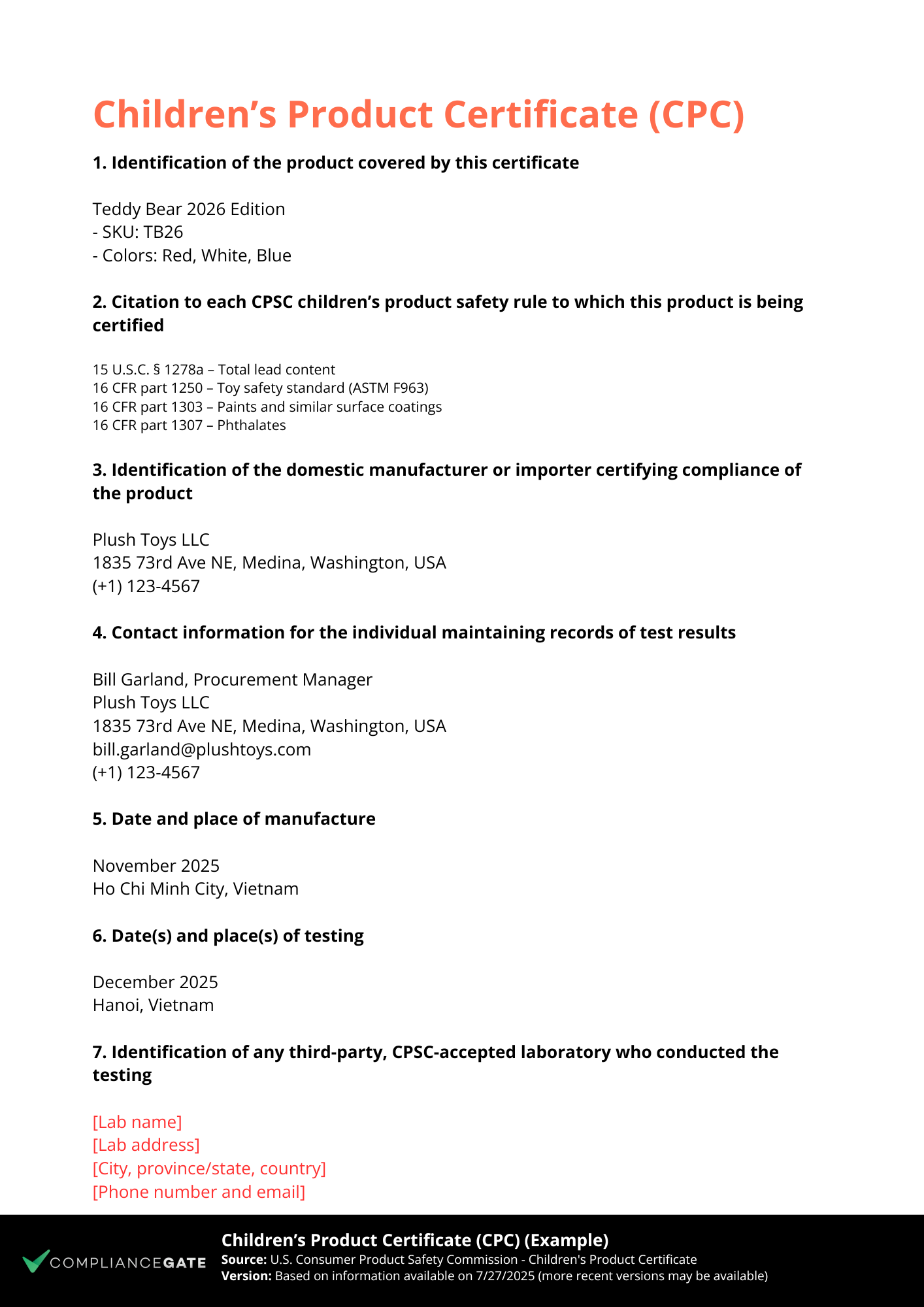
You must create a Children’s Product Certificate (CPC) for each children’s garment item you import or manufacture. This document must contain the following information:
- Product identification
- List of CPSC children’s product safety rules
- US manufacturer or importer certifying the product
- Contact details for the person maintaining records of test results
- Manufacturing date and place
- Testing date and place
- CPSC-accepted third-party testing company information
Tracking label
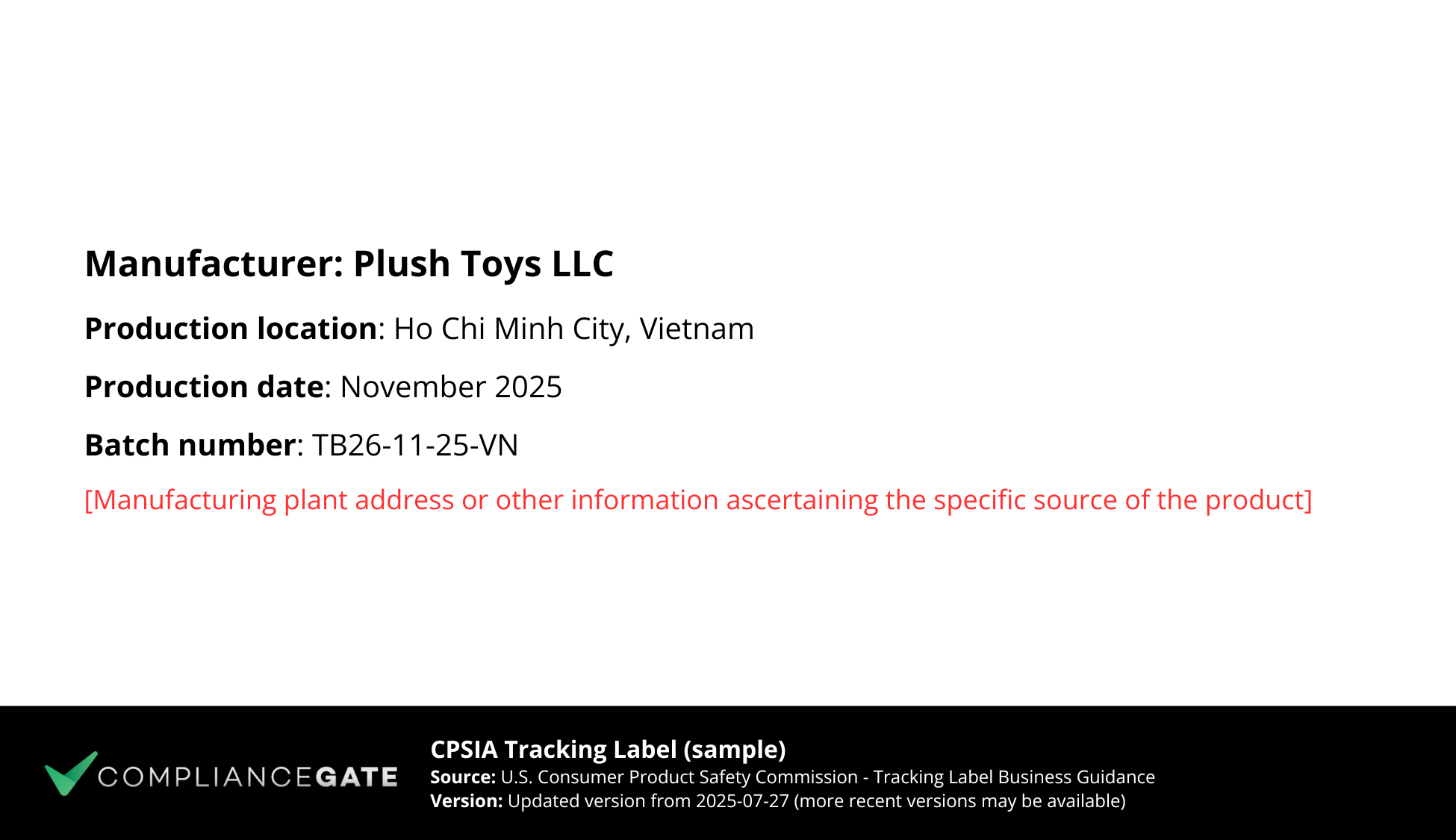
A tracking label must be affixed to the clothing item and the packaging. You must also set a batch number, which is used to trace a potentially unsafe garment to a specific production run.
eFiling
Businesses importing children’s clothing must submit certificate data via the CPSC eFiling portal. The information required is largely similar to the information contained in a CPC.
16 CFR Part 1120 – Drawstrings in Children’s Upper Outerwear
Some types of children’s upper outwear having draw strings are deemed to be substantial product hazards under 16 CFR Part 1120. Drawings are defined as the following:
a. Non-retractable cord, ribbon, or tape;
b. of any material
c. to pull together parts of upper outerwear to provide for closure.
Part 1120 prohibits outerwear in sizes 2T to 16 with one or more drawstrings that fail to comply with ASTM F 1816-97. The purpose is to reduce the risk of strangulation, which is a real concern with drawstrings.
Children’s Clothing Labelling
Children’s clothing is subject to various labelling requirements, including those listed in the table below:
| Rule | Description |
| 16 CFR Part 303 – Rules and Regulations Under the Textile Fiber Products Identification Act | It sets labeling requirements for textiles, such as fiber content, manufacturer name or registered identification number (RN), and country of origin |
| 16 CFR Part 300 – Rules and Regulations Under the Wool Products Labeling Act of 1939 | It sets labeling requirements for wool products, such as fiber content in the wool product, company name or RN, and country of origin |
| 16 CFR Part 301 – Rules and Regulations Under Fur Products Labeling Act | It sets labeling requirements for fur products, such as animal name, company name or RN, and country of origin |
| 16 CFR Part 423 – Care Labeling of Textile Wearing Apparel and Certain Piece Goods as Amended | It sets requirements for care labeling wording (e.g., Do not have commercially laundered”), and symbols |
| 19 CFR Part 134 – Country of Origin Marking | It sets requirements for country of origin marking (e.g. Made in Vietnam) |
You must create a label file that incorporates information from all applicable labelling regulations. Note that the CPSIA tracking label should also be taken into account when doing so.
Ideally, you also provide a read-made label file in .ai or .eps format, and the following information to the garment factory:
- Placement
- Dimensions
FAQ
Are drawstrings prohibited in children’s clothing?
No, but Part 1120 declares some drawstrings as substantial product hazards, which means that these are prohibited. Drawstrings that are too long can be serious safety hazards.
Which US state-level regulations apply to children’s clothing?
California Proposition 65 restricts lead, phthalates, and other substances in children’s clothing sold in California. The following US state regulations may also be relevant:
- Maine – Toxic Chemicals in Children’s Products Law
- Maryland – Lead-Containing Children’s Products
- Minnesota Toxic Free Kids Program
- North Carolina Toxic-Free Kids Act
Which chemicals are prohibited in children’s clothes?
Here are some examples of substances that are restricted or prohibited in children’s clothing:
- Lead
- Phthalates
- Cadmium
- PFAS
Is eFiling required for children’s clothing?
Yes, eFiling is required for children’s clothing starting July 8, 2026. The reason is that children’s products in general require a CPC, which in turn means that eFiling is required.
How do I know if children’s clothing sold in the US is safe?
I suggest that you carefully check the following:
1. Is a tracking label and batch number present?
2. Can the seller provide a test report or CPC?
3. Does the seller appear in any recall report on the CPSC website?
Is lab testing required for children’s clothing in the United States?
Yes, third-party testing is mandatory for all children’s clothing sold in the United States. It is not sufficient to use test reports for similar products or previous batches. Testing the actual product, with the same fabrics and components, is a requirement.
Which US requirements apply to children’s clothing for Amazon sellers?
Companies selling children’s apparel on Amazon in the United States must ensure compliance with the CPSIA and all other regulatory requirements that apply to this category. Amazon is strict when it comes to checking compliance, and even more so when it involves products for children.
In the US in particular, Amazon tends to request and verify the following when assessing children’s apparel compliance:
- Test reports
- CPC
- Tracking label files
Failing to provide this upon request results in suspension and possibly further investigation by Amazon.




Does each lot of fabric used in connection with the manufacture of newborn apparel products require the necessary testing? Once having been successfully tested if you secure the product from the same resource do subsequent lots need to be tested?
Hello,
CPSIA requires that you implement a periodic testing plan – but I don’t think there is a set testing frequency.
When there is a change to the materials or colors, or if a standard is updated, then testing is required.
The testing frequency also depends on how much control you have over the manufacturing process:
“An importer, or a manufacturer who exercises little or no control over the manufacturing process, will need to exercise due care to ensure that it has the knowledge necessary to make appropriate decisions about the frequency of testing necessary for continued production and additional batches and lots of products.”
It ultimately comes down to risk management.
What if I am making the Children’s Wear – ages 2-12 IN the UNITED States? I am Using OEKO TEX Fabrics, and making in NYC. Just Sportswear, no Sleep. But we are using GrossGrain ties and Buttons and Zippers. Where can I find the Requirements for these?
What about zipper regulation? Did I miss it? I recently learned there are rules about zippers for baby pajamas
We are directly a manufacturer of children’s pajamas and may qualify for exemption from certain tests as a Small Batch Manufacturers. To your knowledge does Amazon accept such exemptions?
I have received emails from sellers stating that Amazon did reject them even though they qualified as Small Batch Manufacturers. I don’t know if this is Amazon policy or a misunderstanding from their compliance team.
This was a detailed yet crisp list of regulations and certifications to be followed. For organic clothes you need more certifications, right?
Hi Lana,
I suggest you read this article as it covers organic cotton certification: https://www.chinaimportal.com/blog/importing-gots-organic-cotton-textiles-from-china/