



 Find US, EU, UK, CA, & AU requirements











Toys and other children’s products in Canada are subject to strict requirements concerning product safety, substances, warnings, documentation, and testing.
This guide serves as an introduction to the Canada Consumer Product Safety Act (CCPSA) and its regulations specific to toys and other types of children’s products.
Product examples
- Toys
- Children’s jewelry
- Children’s clothing
- Children’s furniture
- Playpens
- Feeding bottles
- Pacifiers
- Carriages and strollers
- Booster seats
Content Overview

FREE CONSULTATION CALL (30 MIN)
 Ask questions about compliance requirements
- Countries/markets:
.png)
.png)
.png)


- Learn how we can help your business
You will speak with:Ivan Malloci
Canada Consumer Product Safety Act (CCPSA)
The Canada Consumer Product Safety Act (CCPSA) mandates that consumer products in Canada are safe. There are also several product-specific regulations under the CCPSA which apply to toys and children’s products.
These regulations set requirements concerning the following:
- Product safety
- Standards and test methods
- Labelling
- Packaging
Product-specific regulations
Below follows an overview of CCPSA regulations for toys and children’s products:
- Carriages and Strollers Regulations (SOR/2023-101)
- Children’s Jewellery Regulations (SOR/2018-82)
- Children’s Sleepwear Regulations (SOR/2016-169)
- Consumer Products Containing Lead Regulations (SOR/2018-83)
- Expansion Gates and Expandable Enclosures Regulations (SOR/2016-179)
- Infant Feeding Bottle Nipples Regulations (SOR/2016-180)
- Pacifiers Regulations (SOR/2016-184)
- Phthalates Regulations (SOR/2016-188)
- Playpens Regulations (SOR/2018-186)
- Science Education Sets Regulations (SOR/2016-192)
- Surface Coating Materials Regulations (SOR/2016-193)
- Toys Regulations (SOR/2011-17)
These regulations are covered in further detail in this article.
Further, note that regulations that are not specific to children’s products can still apply.
Prohibited products
Schedule 2 of the CCPSA lists prohibited products. Here are some children’s products subject to prohibitions:
1. Certain types of baby walkers
2. Teethers, pacifiers and baby bottle nipples that contain a filling that has in it a viable micro-organism
3. Baby bottle holders for self-feeding
4. Certain types of kits
5. Baby bottles containing bisphenol A
6. Products that are made of or contain polyurethane foam that contains tris (2-chloroethyl) phosphate and that are intended for a child under three years of age
Note that such products are not subject to safety requirements, but are outright banned.
Toys
Toys are covered by the Toys Regulations (SOR/2011-17), which define toys as follows:
Toy means a product that is intended for use by a child under 14 years of age in learning or play. (jouet)
General principles
1. Certain requirements apply to all toys sold in Canada
2. Other requirements apply to toys that belong to certain categories or under specific circumstances:
- Materials
- Risks
- Substances
- Age groups
- Product types
General safety requirements
The Toys Regulations set safety requirements in the following areas:
| Hazards | Examples |
| Packaging | Requirements concerning opening size, materials, and warnings apply to toys that come in flexible film bags |
| Electrical hazards | 1. Electrical toys must meet C22.2 No. 149-1972
2. Electrical toys with a wood-burning tool must meet C22.2 No. 122-M1989 |
| Mechanical hazards |
|
| Auditory hazards | The noise limit for toys is set to 100 dB (at the distance the toy is used |
| Flammability | 1. Certain toys must comply with thermal and labelling requirements in C22.2 No. 149-1972
2. Toys cannot be made of impregnated with celluloid or cellulose nitrate (excluding ping pong balls) |
| Toxicological | 1. Certain substances are prohibited
2. Restrictions apply to lead, mercury, antimony, arsenic, cadmium, selenium, and barium 3. Toxic substances must be the requirements set under section 25 4. Restrictions apply to substances that can be an irritant, corrosive or sensitizing 5. Plastic materials in toys likely to be used by a child of less than three years are subject to additional restrictions |
Product-specific requirements
Certain toys are also subject to product-specific requirements listed under section 28:
- Dolls
- Plush toys and soft toys
- Plant seeds
- Pull and push toys
- Toy steam engines
- Finger paints
- Rattles
- Elastics
- Yo-yo balls
- Magnetic toys
- Toys that can be entered by a child
Such products are subject to specific requirements concerning mechanical safety, substances, labelling, test methods, and other aspects.
2. In addition to the requirements under the Toys Regulations, some toys must also comply with referenced standards. For example, electrical toys must comply with C22.2 No. 149-1972.
Toy safety standards
In addition to the requirements under the Toys Regulations, some toys must also comply with referenced standards. For example, electrical toys must comply with C22.2 No. 149-1972.
Warnings and labelling
Certain toys are subject to specific warning requirements. Here is an example of warning labelling required for magnetic toys:
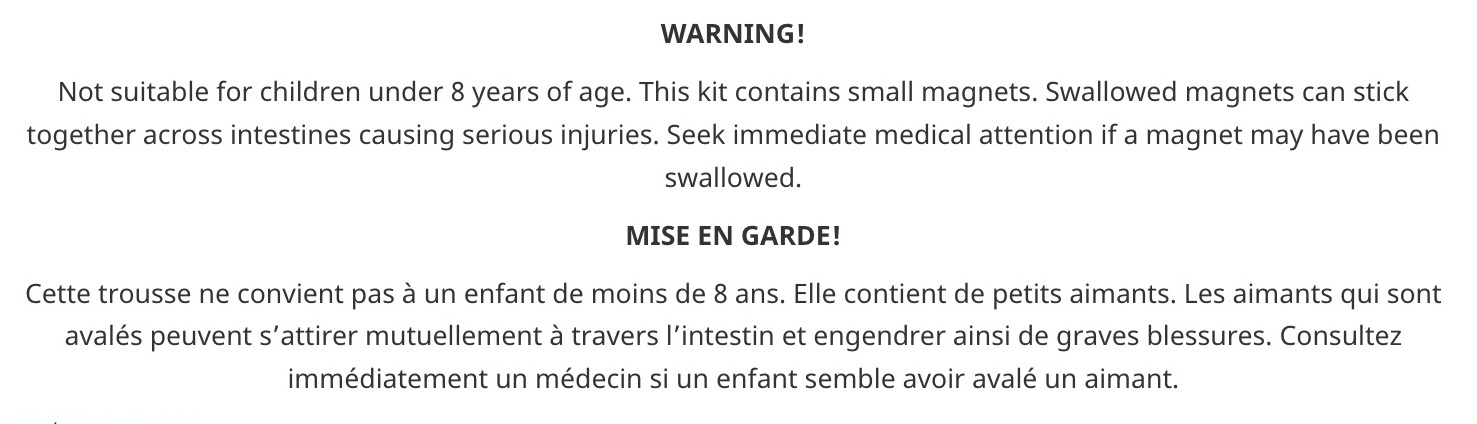
Note that standards can also set labelling requirements for toys.
Testing
Testing is necessary to verify compliance with the requirements under the Toys Regulations. It also references specific test methods that must be followed.
Note that some toys must also be tested according to the requirements set by referenced product standards.
Children’s Products (non-toys)

There are several regulations applicable to other types of children’s products under the CCPSA. Below follows an overview:
- Carriages and Strollers Regulations (SOR/2023-101)
- Children’s Jewellery Regulations (SOR/2018-82)
- Children’s Sleepwear Regulations (SOR/2016-169)
- Cribs, Cradles and Bassinets Regulations (SOR/2016-152)
- Expansion Gates and Expandable Enclosures Regulations (SOR/2016-179)
- Infant Feeding Bottle Nipples Regulations (SOR/2016-180)
- Pacifiers Regulations (SOR/2016-184)
- Playpens Regulations (SOR/2018-186)
- Restraint Systems and Booster Seats for Motor Vehicles Regulations (SOR/2016-191)
- Science Education Sets Regulations (SOR/2016-192)
Requirements
Specific requirements in the following areas apply to many children’s products:
- Substance restrictions
- Safety requirements
- Warnings and labelling
- Instructions and other documentation
- Test methods
Examples
| Product | Requirements |
| Children’s jewellery | 1. Must not contain more than 90 mg/kg of lead
2. Must not contain more than 130 mg/kg of cadmium (for certain jewellery item sizes) |
| Carriages and strollers | 1. Must meet specified parts of ASTM F833 and/or ISO 31110
2. Substance restrictions 3. Labelling requirements 4. User instructions 5. Warnings |
Testing
Testing is required to verify compliance with the applicable children’s product safety and substance restrictions. This must be done according to the test methods referenced in the regulations.
Chemical Regulations
Toys and children’s product regulations under the CCPSA set product, material and age group-specific substance restrictions. That said, the following regulations also set substance restrictions:
- Consumer Products Containing Lead Regulations (SOR/2018-83)
- Phthalates Regulations (SOR/2016-188)
- Surface Coating Materials Regulations (SOR/2016-193)
Note that these are regulations under the CCPSA. These are not necessarily the only substance regulations relevant. Below follows an overview of other Canadian substance regulations that can apply:
- Prohibition of Certain Toxic Substances Regulations, 2012 (SOR/2012-285)
- Prohibition of Asbestos and Products Containing Asbestos Regulations (SOR/2018-196)
- Products Containing Mercury Regulations (SOR/2014-254)
- Volatile Organic Compound Concentration Limits for Certain Products Regulations (SOR/2021-268)
It can be hard to determine which specific substance restrictions apply. We normally work with labs that help us assess what substances to test for.
FAQ
Is safety testing mandatory for toys sold in Canada?
Yes, product safety testing is mandatory for toys sold in Canada to determine that a product complies with the requirements under the Toys Regulations and applicable standards.
Further, the authorities can request test reports to verify compliance. This is also the case when selling on Amazon in Canada.
Is safety testing mandatory for other children’s products sold in Canada?
Yes, it is necessary to test children’s products to verify compliance with applicable CCPSA regulations and reference product standards. Without testing, you cannot be certain that the product is compliant.
Are CE-marked toys accepted in Canada?
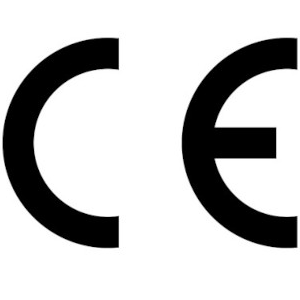
No, CE marking is an EU compliance mark and is not referenced anywhere in either the CCPSA or the Toys Regulations.
Toys sold in Canada must comply with the requirements set out under the CCPSA and the Toys Regulations. That said, a toy that is correctly CE marked and thus compliant with EU requirements is more likely to also comply with Canadian requirements, compared to one that is not.
However, CE marking is not recognized in Canada, and therefore, it cannot be used to demonstrate compliance with the Toys Regulations or other Canadian compliance requirements.
Can we sell toys that are compliant with US requirements in Canada?
No, compliance with US toy and children’s product requirements (such as the CPISA or ASTM F963) is not a substitute for compliance with the Toys Regulations or other CCPSA regulations for children’s products.
That said, some ASTM standards are referenced in children’s products regulations. However, compliance with standards is only part of the process.