


 Find US, EU, UK, CA, & AU requirements









eFiling is required for toys and children’s products imported to the United States, starting on July 8th, 2026. This guide explains how you can get your toy or children’s product ready for eFiling, and the information you need to register and submit as part of the CPSC eFiling submission.
Content Overview

FREE CONSULTATION CALL (30 MIN)
 Ask questions about compliance requirements
- Countries/markets:
.png)
.png)
.png)


- Learn how we can help your business
You will speak with:Ivan Malloci
Part I: eFiling Preparations
You must ensure that your toy or children’s product is safety tested and certified before you can submit data via eFiling. This section explains how that process can work.
Step 1: Identify children’s product safety rules
The first step of the process is to identify the applicable children’s product safety rule. Some apply to specific types of children’s products, such as toys or bunk beds. However, certain rules apply to substances and components, including batteries and magnets.
Part 1199 – Children’s Toys and Child Care Articles Containing Phthalates: Guidance on Inaccessible Component Parts
Part 1250 – Safety Standard for Toys
Part 1251 – Toys: Determinations Regarding Heavy Elements Limits for Certain Materials
Part 1262 – Safety Standard for Magnets
Part 1263 – Safety Standard for Button Cell or Coin Batteries and Consumer Products Containing Such Batteries
Bear in mind that a single product can be subject to more than one children’s product safety rule. A toy containing button cell batteries would, for example, need to comply with both Part 1250 and Part 1263 (among others).
eFiling note: You must cite the children’s product safety rules that the product complies with as part of the eFiling submission.
Step 2: Design for compliance
Children’s product safety rules set design constraints that products must meet in terms of design, constructjon and mechanical safety. It is therefore essential that you implement the technical requirements set by all applicable children’s product safety standards into your product design.
Failing to do so can result in a product that is inherently unsafe and, by design, unable to pass mandatory safety testing in the following stage.
Note that children’s product safety rules can also set requirements in the following areas:
- Chemicals and heavy metals
- Instructions
- Warnings
- Test methods
Step 3: Product testing
Third-party testing is mandatory for children’s products sold in the United States. Further, only test reports issued by CPSC-accepted labs are valid.
✅ Contact a CPSC-accepted testing company and request a quotation
✅ Submit product samples with the final design and materials
✅ The lab will test the product according to the applicable product safety rules
- Substance testing
- Mechanical safety testing
- Flammability testing
- Electrical safety testing
- Warnings/instructions
✅ The testing process normally takes 2 to 3 weeks
✅ You will receive a test report once the process is completed
eFiling note: You must submit information about the testing company and when and where the testing took place as part of the eFiling process.
Step 4: Create tracking labels
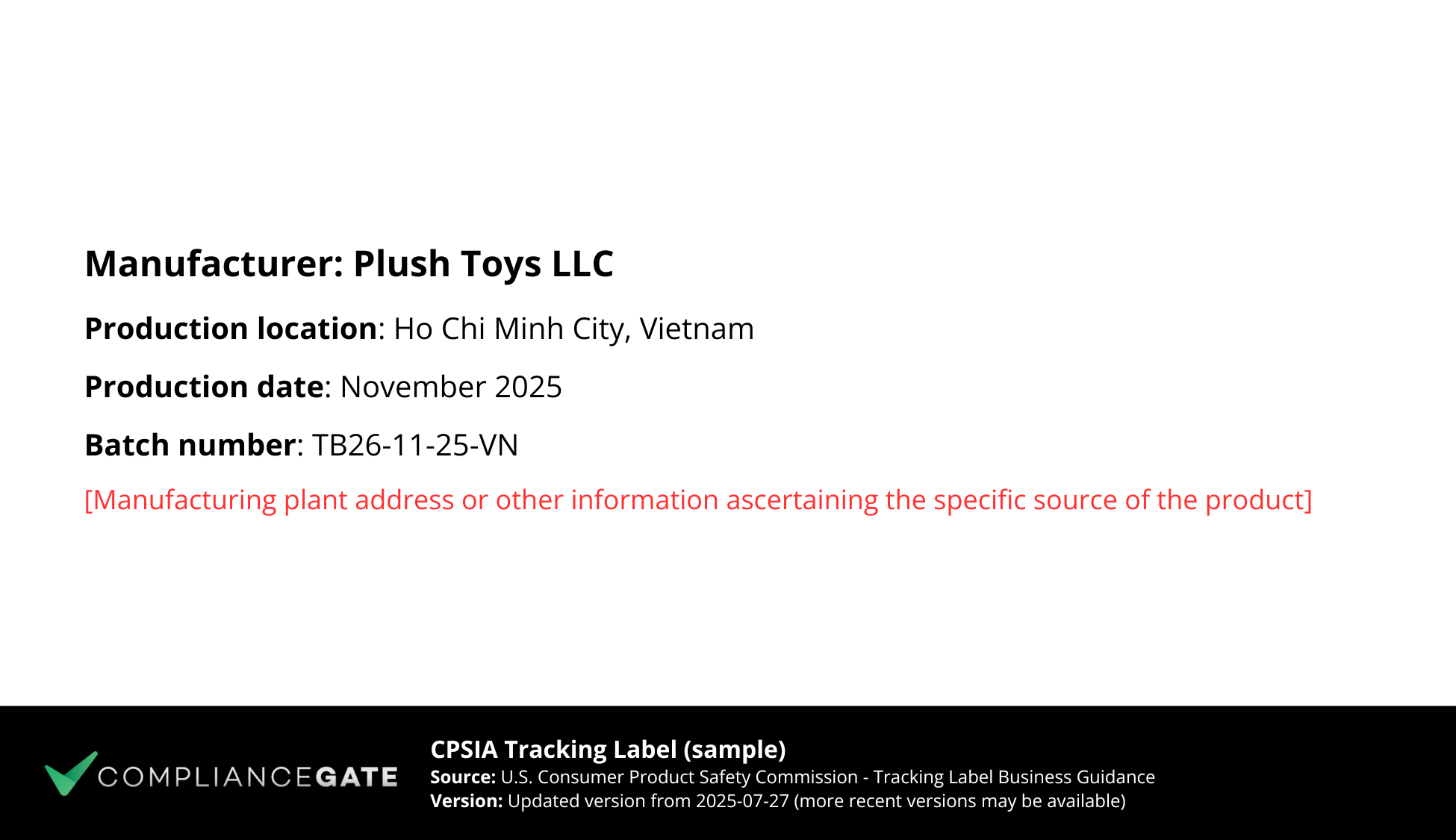
Tracking labelling requirements apply to toys and children’s products sold in the United States. Below follows a summary:
- Company name (Manufacturer, importer, or private labeller)
- Production location
- Production date
- Batch or run number or other identifying manufacturing process characteristics
- Any other information to facilitate ascertaining the specific source of the product (e.g., address of the manufacturing plant)
Additional labelling requirements apply to products defined as durable infant and toddler products.
Example
Step 5: Create Children’s Product Certificate (CPC)
eFiling is required for products requiring certification. In the context of children’s products, this refers to a Children’s Product Certificate (CPC).
Example
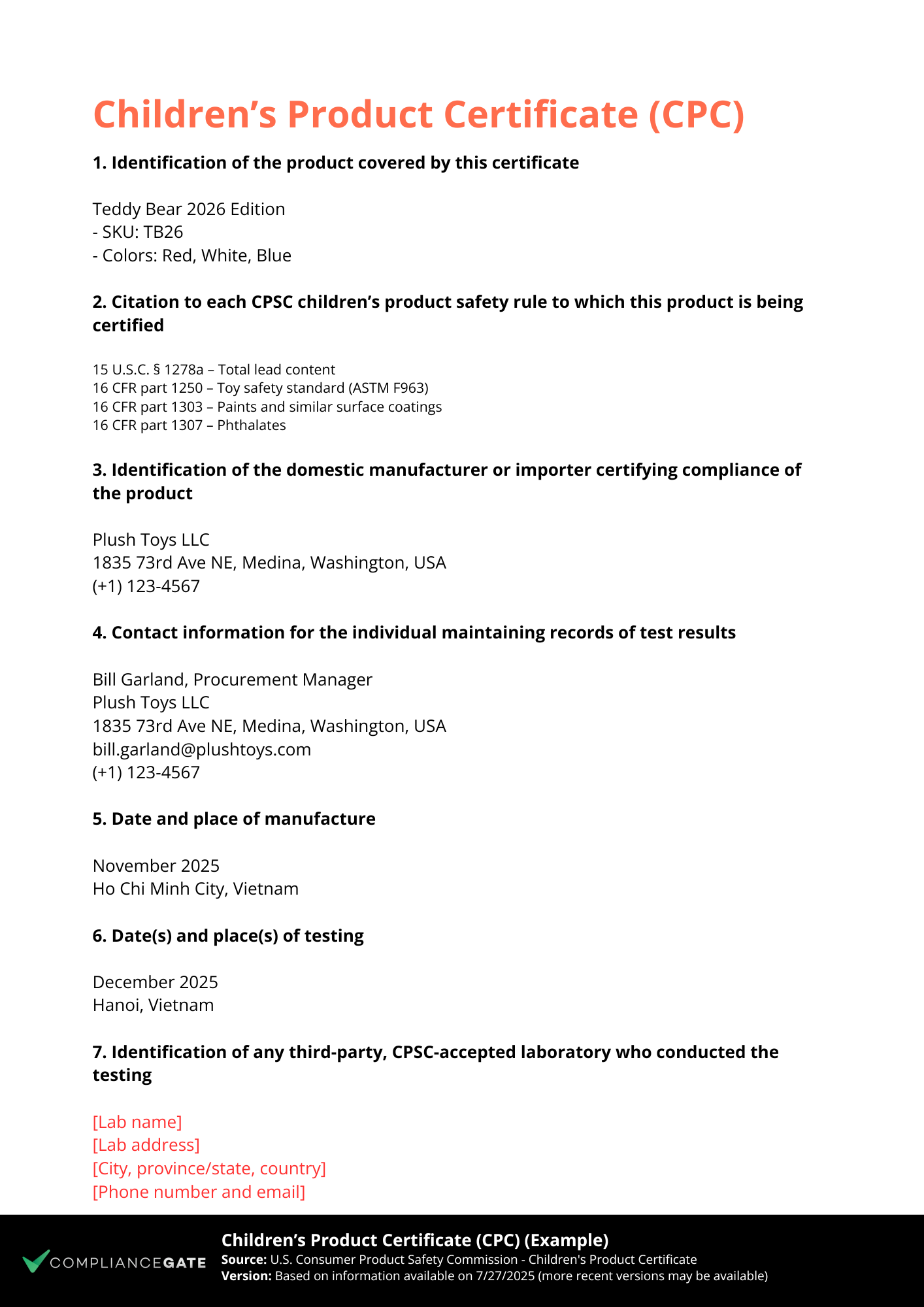
eFiling note: The information you must submit via eFiling is largely based on the information that must be present in a Children’s Product Certificate (CPC).
Part II: CPSC eFiling
Now that your product is tested and certified, we can finally proceed to the eFiling stage.
Step 6: eFiling registration
Before you can submit data, you need to register via the CPSC eFiling portal. Doing so is free and requires the following information:
- Business email address
- Company name
- Import of Record (IOR) number
Note that it is the company importing the products or an authorised customs broker that must register.
Step 7: eFiling submission
Now that your account is set up, you can proceed to submit the eFiling for your next shipment. Below follows an overview of the information required (based on the CPSC bulk upload CSV template):
Product
- Product ID
- ID type
- GTIN, UPC, or SKU
- Model Number
- Serial Number
- Registered Number
- Alternate Identifier
- Product Name (Model)
- Trade/Brand Name
- Product/Model Description
- Product/Model Color
- Product/Model Style
Note: Not all fields are necessarily relevant to every product
Certificate Type
Specify CPC or Children’s Product Certificate for toys and other children’s products.
Manufacturer information
- New manufacturer: Yes / No
- GLN
- Alternate ID
- Company name
- Small batch ID
- Address
- Apt/Suite
- State/province
- Zip/postal code
- Country
- Phone and email
Production information
- Manufacturer date
- Prosecution start and end dates
- Lot/batch number
- Lot number assigned by: Manufacturer or seller
Lab information
- Type
- New lab: Yes / No
- Lab CPSC ID
- Lab GLN
- Address
- Apt/Suite
- State/province
- Zip/postal code
- Country
- Phone and email
Test report data
- Citation codes (i.e., children’s product safety rules)
- Test report ID
- Test report URL
- Access key (if any)
- Lab test date
Point of Contact (POC) for Test Result Records
- POC New: Yes / No
- ID
- GLN
- Name
- Address
- Apt/Suite
- State/province
- Zip/postal code
- Country
- Phone and email