





 Find US, EU, UK, CA, & AU requirements














The Restriction of Hazardous Substances (RoHS) Directive restricts chemicals and heavy metals in electronic products imported or manufactured for sales in the European Union. In some cases, you can obtain RoHS test reports from your component suppliers.
That said, not all suppliers can provide RoHS test reports that can be traced and validated for a particular component. In such cases, RoHS testing is often necessary.
Content Overview

FREE CONSULTATION CALL (30 MIN)
 Ask questions about compliance requirements
- Countries/markets:
.png)
.png)
.png)


- Learn how we can help your business
You will speak with:Ivan Malloci
What is RoHS testing?
The purpose of RoHS testing is to verify if an electronic component contains excessive amounts of restricted heavy metals, flame retardants, and phthalates.
| Substance | Limit |
| Lead | 0.1% |
| Mercury | 0.1% |
| Cadmium | 0.01% |
| Hexavalent chromium | 0.1% |
| Polybrominated biphenyls (PBB) | 0.1% |
| Polybrominated diphenyl ethers (PBDE) | 0.1% |
| Bis(2-ethylhexyl) phthalate (DEHP) | 0.1% |
| Butyl benzyl phthalate (BBP) | 0.1% |
| Dibutyl phthalate (DBP) | 0.1% |
| Diisobutyl phthalate (DIBP) | 0.1% |
Passed RoHS testing means that the detected substance content is below the set limit.
If above, then the component is non-compliant and cannot be sold in the EU.
Which products require RoHS lab testing?
The RoHS Directive is applicable to electronic equipment, including consumer electronics and devices made for industrial or medical use. Here are some examples of products that can be subject to RoHS testing:
- Consumer electronics
- Household appliances
- Machinery
- Quartz watch movements
- Electronic toys
- AC adapters
- Powertools
That being said, RoHS testing is applied at a component and material level. Here are some examples of components and materials that may be sent to a lab for RoHS testing:
- CPUs
- ICs
- Connectors
- PCBs
- Solder
- Wires
- Casing materials
- Coatings
- Other electronic components
Is RoHS lab testing mandatory?
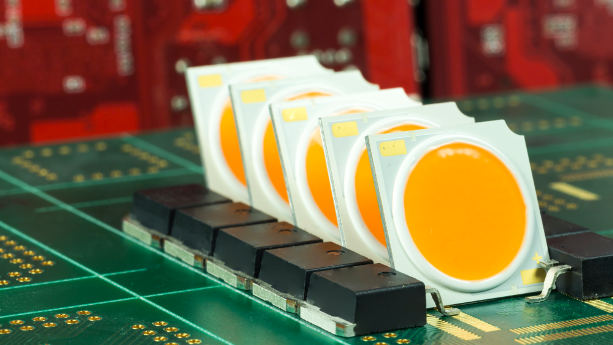
Yes, RoHS testing is generally necessary at some point in the supply chain.
For starters, the RoHS Directive is not voluntary. Compliance with the limits under the RoHS Directive applies to most electronic products sold in the EU. Without testing, it cannot be determined whether the components contain restricted substances below the set limits.
The most straightforward way to verify RoHS compliance is therefore by sending component samples to a lab like QIMA and Intertek and have them arrange RoHS testing.
That said, a large share of the electronic components and materials on the market are already RoHS compliant. Hence, it may not be necessary to arrange (and pay for) third-party testing if your supplier can provide existing RoHS test reports.
RoHS Test Cost Examples
So, how much does RoHS testing cost? That depends entirely on the number of components subject to RoHS testing. Below follows an example for an electronic toy one of our customers submitted for RoHS testing a few years ago:
RoHS XRF Screening & Chemical Testing (1-50 Components): 280 USD
RoHS Phthalate Testing: 200 USD
Note that the XRF and chemical testing quotation covers up to 50 components. Ultimately, the more components your products consist of, the higher the RoHS lab testing fee.
You can potentially reduce the testing fees by obtaining existing RoHS test reports for as many components as possible.
RoHS Test Report Sample
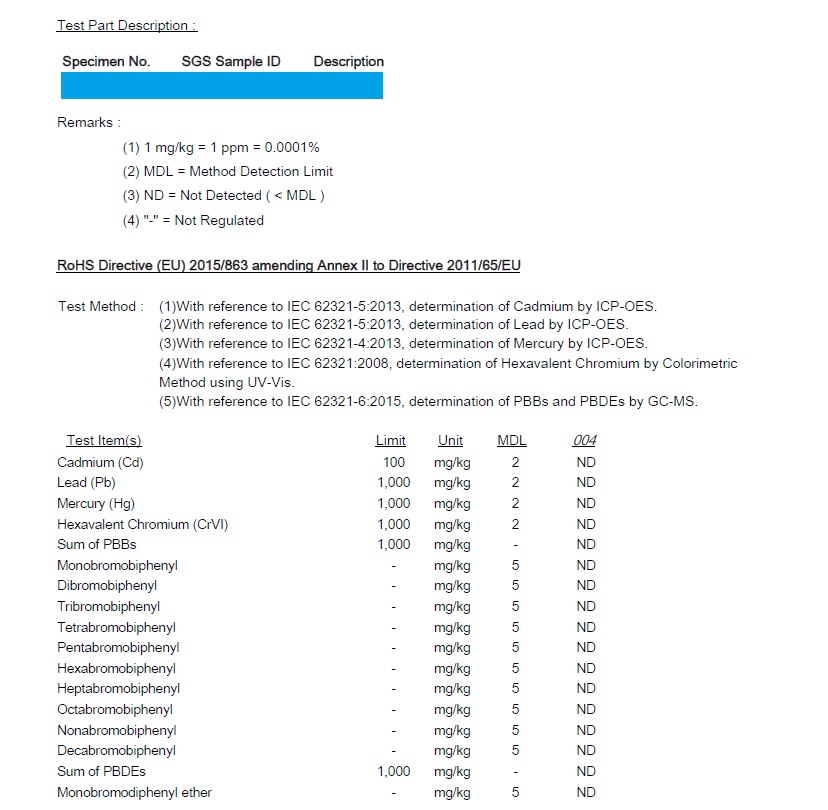
The image above shows a RoHS test report issued by SGS. ND indicates that the substances listed under test items were not detected.
FAQ
Is RoHS testing voluntary?
No, RoHS testing is not voluntary in the sense that it can be skipped. Compliance with the RoHS Directive is mandatory, and testing is needed to verify.
You must either obtain test reports or arrange third-party RoHS testing.
Without test reports, you simply cannot know if a component contains substances above or below the set limits. If the above, then your product can be subject to a recall.
How long does the RoHS testing process take?
RoHS testing takes somewhere between 1 and 2 weeks, from the day the lab receives your component samples.
Who can request a RoHS test report?
Market surveillance authorities in the EU can and often do request RoHS test reports when validating if products are correctly CE marked.
Failing to provide sufficient test reports and other compliance documentation can result in your products being subject to a recall or sent for destruction.
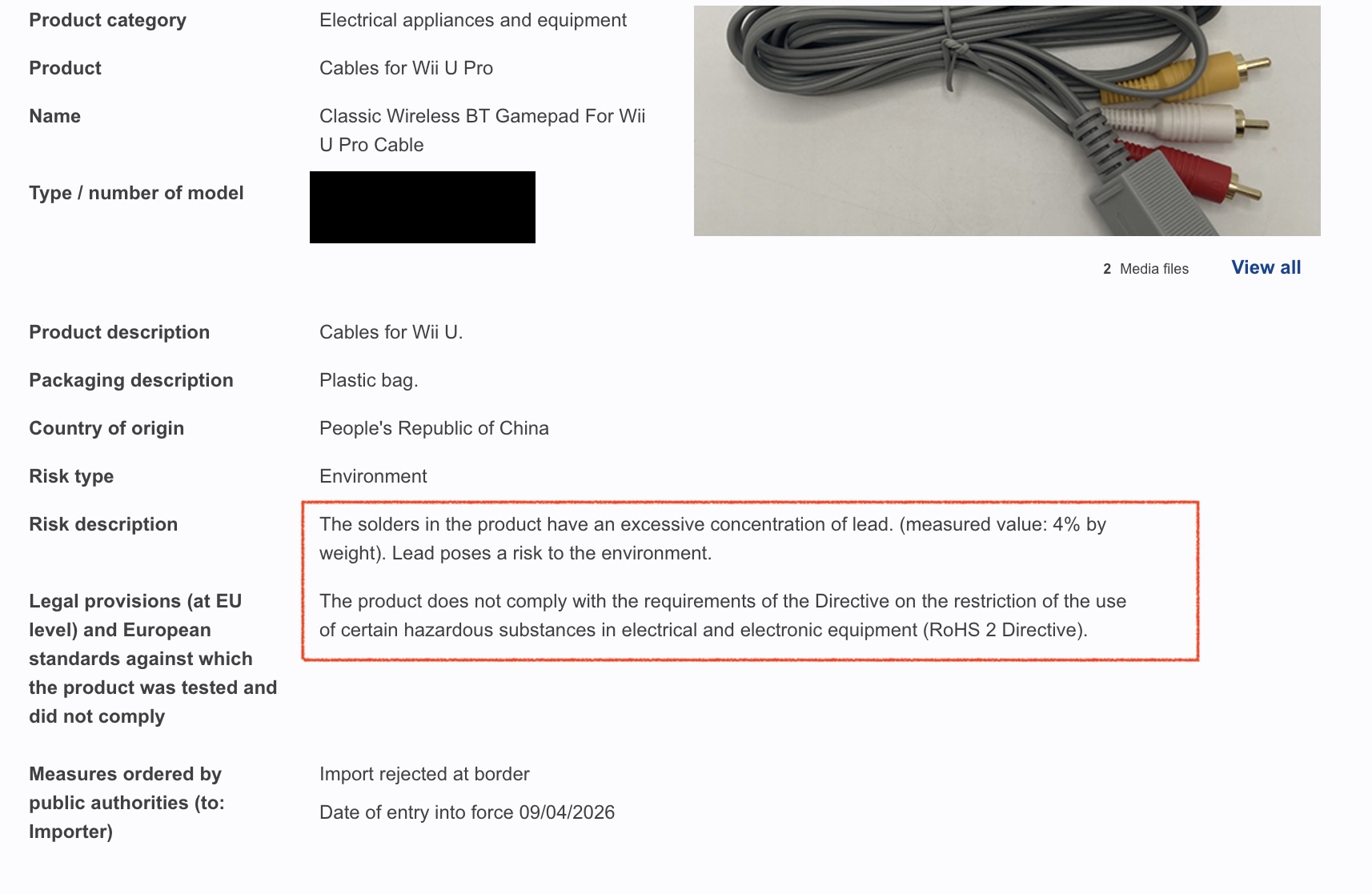
Example of a product recalled due to RoHS non-compliance
Do we need to arrange RoHS testing for each order?
No, you do not necessarily need to test every single batch. That said, you should arrange testing in the following scenarios:
1. When new substances are added to the RoHS list (thus, becoming restricted)
2. If any of the substance limits are changed
3. If you change component types or suppliers
Some companies also arrange periodic testing for surveillance purposes, even if none of the above occurs.
How do I know which RoHS tests are required?
My recommendation is that you leave this assessment to a reputable testing company, such as QIMA, Intertek, or TUV Rheinland. Third-party testing companies keep track of updates to the list of restricted substances and changes to the limits.
Can I use RoHS test reports from our suppliers?
Yes, as long as you can be reasonably certain that the test report is valid for the actual components you are using.
This ultimately comes down to component traceability, which requires an analysis of your RoHS test reports.
| Test report | Traceable | Not traceable |
| Supplier name | Matching your manufacturer | Not matching |
| Component name | Matching | Not matching |
| Component image | Matching | Not matching |
In short, you need to know:
a. Which supplier you buying the component from
b. The model/SKU for that particular component
If you buy components directly from suppliers, then this is relatively straightforward. If I, for example, buy AC adapters directly from the factory, then I can validate the test reports with relative ease.
However, doing so is more difficult (sometimes impossible) when buying from OEM factories that, in turn, gather RoHS test reports from their subcontractors.
They may be truthful and provide valid documents, but you will likely never be certain. It’s not unheard of that suppliers gather whatever RoHS test reports they can get their hands on, even if not relevant to your particular components.
In these situations, it comes down to risk management. You will either need to pay for third-party RoHS testing or trust the test reports sent from subcontractors that are beyond your supply chain visibility.
The risk you are taking in the latter case is a potential recall if it turns out that the RoHS test reports are not valid for your components.
What can I do if the supplier does not have a RoHS test report?
In that case your only option is to arrange third-party testing.
How do I ensure that our supplier only procures RoHS-compliant components?
The first step is to instruct your supplier to exclusively procure RoHS-compliant components. Some component suppliers may offer the same components as both RoHS and non-RoHS compliant.
Don’t take it for granted that the supplier always procures RoHS-compliant components based on the assumption that your supplier should be aware of the RoHS Directive in the European Union.
There are a few methods to assess that your supplier actually has procured RoHS-compliant components:
1. Request component supplier test reports
2. Request component receipts from your supplier
3. Send an inspector to check if the component cartons are RoHS labelled. This is not an official compliance mark, but used to ensure that RoHS and non-RoHS components don’t get mixed up.
4. Inform your supplier that all components will be RoHS tested prior to balance payment and shipment (this puts pressure on the supplier to actually purchase RoHS components).
You may also want to manage component purchases directly with the component suppliers, rather than going through an OEM manufacturer. This setup gives you more control of the process and allows you to check test reports provided directly by component suppliers, while you can also be sure that the OEM manufacturer ultimately uses their RoHS-compliant components.
What can happen if I don’t have a RoHS test report?
Here are two examples:
1. The customs authorities may reject clearing your product for importation. I am aware of one case in which the German customs authorities rejected an inbound shipment of wristwatches from China on the basis that the importer could not provide a RoHS test report.
2. Market surveillance authorities may investigate your product at some point. While non-RoHs components don’t represent an immediate safety risk, they can still request test reports or even send your product for testing.
Is RoHS testing required for Amazon sellers?
RoHS testing is required in the sense that:
a. Products sold on Amazon must comply with EU regulations and directives
b. Electronic products sold on Amazon in the EU are generally covered by the RoHS Directive
c. Testing is needed to verify RoHS compliance
Amazon can, and often do, request test reports to verify compliance. This includes requesting a RoHS test report for electronics. Failing to provide one can result in product removals.
Is an EU RoHS test report valid in the UK or other markets?
Yes, I don’t see why it would not be valid under the following conditions:
a. The EU RoHS restricted substances and limits match (or exceed that of the target market)
b. The EU RoHS test methods are accepted in both markets
That said, this must be assessed on a case-by-case basis. The UK RoHS Regulation is based on the RoHS Directive, but it should not be taken for granted that they will evolve in the same direction.
Likewise, the US has various RoHS regulations at a state level in place that share the same principles, but have different substance lists, limits, and scopes.





Dear Sir,
We have a few refrigerator samples that require testing as per RoHS 3 (2015/863/EU). We would like to understand the procedure for testing such large-sized products.
Could you please advise whether you require the entire product for testing, or only specific components? Sending complete units would be logistically difficult and cost-intensive.
Additionally, kindly share the testing charges and the estimated time required to complete the analysis.
We look forward to your response.
Thank you.
Best regards,
Ali Ashraf
Is RoHS testing is mandatory for packing material??
If it true that US has set a condition for the ROSH II test to be done on the homogeneous component, not finished good itself?
E.g. Carton box (consist of board material and printing ink)