





 Product assessments in 2 minutes

















Making certain claims in Amazon product descriptions or other marketing materials can have disastrous consequences for sellers. I’ve seen situations where Amazon removed products that had been sold for years based on a single sentence.
In this guide, we explain why Amazon removes products based on claims about product features or functionality, and what you can do to avoid this from happening.
Content Overview

Find Requirements for Your Product Free
Estimated time: 2 to 3 minutes
 Step 1: Select market
.png)
.png)
.png)


- Step 2: Select product/material modules
- Step 3: Compliance Requirements List Created View Sample >
 Data: Primarily based on data from official legislation databases (Learn >)
Why does Amazon remove products based on a claim?
I am aware of two scenarios in which claims in product descriptions or other marketing materials can result in removals or suspensions:
A. Product claims resulting in category change
Making certain claims can result in a certain product being considered to belong to a particular category, which in turn triggers additional compliance requirements. Here are some situations where this can happen:
| Claim | Result |
| i. Claims related to diagnosis, prevention, monitoring, prediction, prognosis, treatment or alleviation | The product is deemed to be a medical device |
| ii. The product is presented as a children’s product or suited for children | The product is deemed to be a toy or other children’s product |
| iii. Claims about organic or recyclability content | Supporting documentation may be requested |
| iv. Claims related to protective properties | The product is deemed to be personal protective equipment (PPE) |
Note that none of these claims are necessarily prohibited. The issue is that making such claims can result in additional requirements even if this is unintended.
B. Making prohibited claims
Amazon also prohibits certain product claims or requires that these be supported by evidence when made.
Which claims are prohibited on Amazon?
Here are some examples of claims that are prohibited or subject to some restriction:
1. False claims that a product is approved or certified
2. False claims about the country of origin
3. False or unsubstantiated claims about organic or recyclable contents (that cannot be proven)
4. False or unsubstantiated environmental claims
5. False or unsubstantiated claims about cures or treatments
6. Using logos from government bodies, such as the FDA, CPSC or European Commission
Prohibiting such claims is not merely a matter of Amazon policy, but various US, EU and UK regulations concerning marketing practices and consumer rights.
Case Study: Medical Device Claim
A few years ago, we dealt with a situation in which a company had a certain wearable removed by Amazon. The product had been sold for several years, but suddenly Amazon decided that the product was a medical device and requested the following documents related to the EU Medical Devices Regulation:
- EU MDR Declaration of Conformity
- Test report
- Label files
- Instructions
Unfortunately, the seller never deemed this to be a medical device, and therefore, they did not have any of the documentation and files requested.
Why did this happen?
We investigated the matter, and found that the seller had made claims that the wearable product had properties suitable for treatments.
We looked into the definition of a medical device in the EU and found the following:
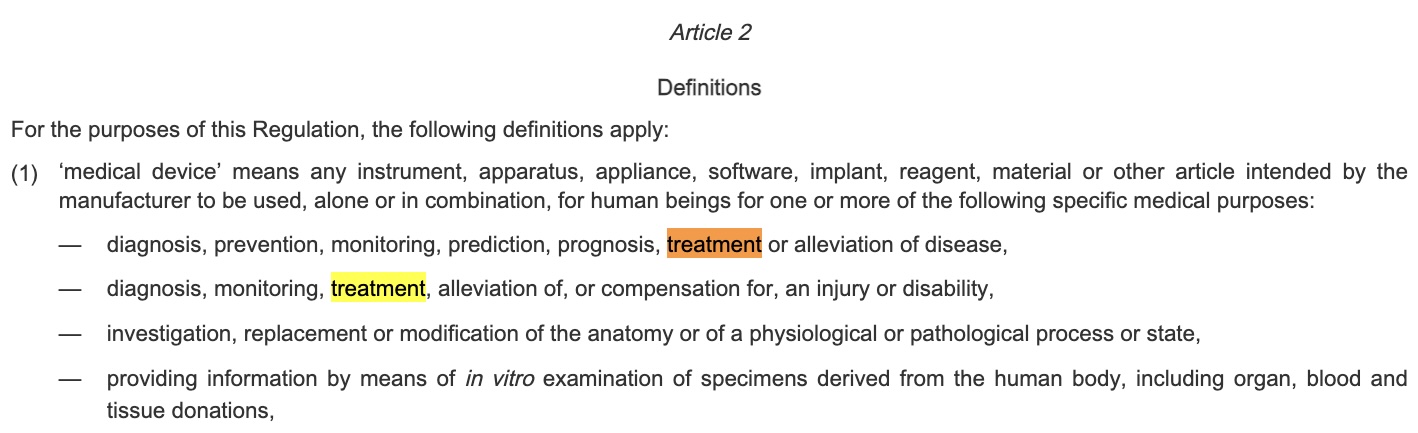
Our assessment was that their product claims had resulted in Amazon “moving” this product to the medical devices category, which resulted in additional documentation and labels being requested.
Result
The seller attempted to argue that the product was not a medical device. However, Amazon did not relent as they had made a documented claim (for many years). The product was ultimately removed as the customer could not submit the required compliance files.
FAQ
How can sellers ensure that they do not make such claims?
As an Amazon seller, you must absolutely ensure that your product descriptions or marketing materials do not contain unintended or prohibited claims.
1. Do not claim that your product has certain properties, features or functionality
2. Do not make claims that cannot be backed up by evidence (if ever requested)
3. Avoid any claim that is prohibited by Amazon
It is crucial that product features or prohibited claims are not present in your product descriptions. It is of particular importance that you check all product descriptions when these are outsourced to a freelancer or an LLM.
Can I claim that a product is not suited for children or is not a medical device?
On the flipside, what if you could avoid requirements by making negative claims?
For example, let’s say that you could avoid having your product classified as a toy or medical device by making the following claims:
“This is not a children’s product”
“This is not a medical device”
This does not work, as the definition of a toy, children’s product or medical device is determined by legislation if your product is defined as, for example, a toy due to its design and functionality then it is a toy no matter what you claim.
How can I appeal product removals caused by claims?
This guide explains how you can appeal product removals by Amazon.
As mentioned, it can be hard to walk back on product claims once these have been made.