





 Find US, EU, UK, CA, & AU requirements











Product warnings are required for various products sold in the European Union, including consumer products, electronics, PPE and machinery. Such warnings can take the form of warning labels or be included in user instructions.
This guide explains when you need to affix warnings and the conditions that apply when doing so.
Content Overview

FREE CONSULTATION CALL (30 MIN)
 Ask questions about compliance requirements
- Countries/markets:
.png)
.png)
.png)


- Learn how we can help your business
You will speak with:Ivan Malloci
Why are warning labels required in the EU?
All products sold in the EU must be fundamentally safe. That said, there are limits to how safe a product can be made by design. As such, certain EU regulations, directives, and standards require that warnings be present to inform consumers and other end users about remaining risks.
Which products require warnings in the EU?
Warnings can be applied to consumer products covered by the GPSR, and products covered by CE marking regulations and directives. Examples of such products are listed below:
- Children’s products
- Furniture
- Toys
- Electronics
- Batteries
- Machinery
- Medical devices
- PPE
- Gas appliances
Note that warnings are not required for all products that belong to the listed categories.
How do I know if a product requires warning labelling in the EU?
Warning labelling is required in the following cases:
✅ Your product is covered by the GPSR, and the remaining risks must be alleviated by providing warnings
✅ Your product is covered by an EU regulation or directive mandating warning labelling
✅ Your product is covered by EN standards mandating warning labelling
Note that the following is generally prohibited:
❌ Warning labels are not a substitute for meeting product safety requirements
❌ Warning labels cannot contradict the intended use of the product
Consumer products
The General Product Safety Regulation (GPSR) mandates that consumer products sold in the EU are essentially safe. In practice, this often means that you must ensure that your product meets certain safety standards.
That said, not all risks can be entirely eliminated by implementing safety standards. That is also where warnings come in, as stated in the following section:
Under the general safety requirement laid down in this Regulation, economic operators should be obliged to place only safe products on the market. Such a high level of safety should be primarily achieved through the design and the features of the product, taking into account the intended and foreseeable use and conditions of use of the product. The remaining risks, if any, should be alleviated by means of certain safeguards, such as warnings and instructions.
For example, a baby carrier must be designed to meet the safety requirements under EN 13209-1. However, even the safest baby carrier can be a safety hazard if:
a. It is not correctly affixed
b. It is overloaded
As such, warnings are necessary to explain that a certain maximum weight limit applies, while pictograms can demonstrate how to correctly wear the baby carrier.
Note that the GPSR often leaves the specific warnings for the manufacturer to decide, unless specified in the relevant EN standards.
Learn more: GPSR Warnings and Safety Information – A Practical Guide
Toys
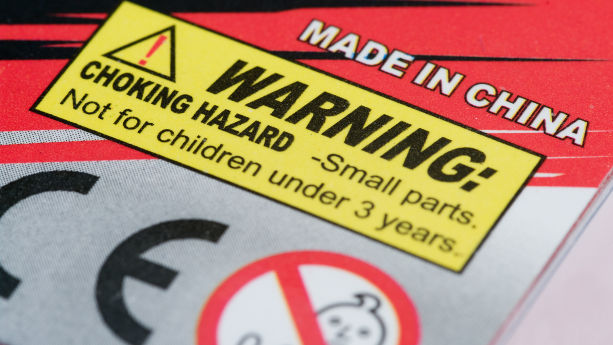
The Toy Safety Directive set warning labelling requirements for toys sold in the EU. Unlike the GPSR, it contains specific warnings required for particular age groups and types of toys.
These can be found in Annex V of the Toy Safety Directive.
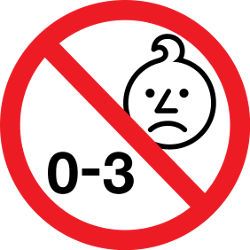
Symbol
The following symbol is required for “toys not intended for use by children under 36 months”:
Product-specific warnings
Specific warnings apply to the following types of toys:
- Activity toys
- Functional toys
- Chemical toys
- Skates, roller skates, online skates, skateboards, scooters and toy bicycles for children
- Aquatic toys
- Toys in food
- Imitations of protective masks and helmets
- Toys intended to be strung across a cradle, cot or perambulator by means of strings, cords, elastics or straps
- Packaging for fragrances in olfactory board games, cosmetic kits and gustative games
Learn more
Warning Labelling Requirements for Toys & Other Children’s Products in the EU
Small Parts Regulations and Warnings in the European Union: An Overview
Electronics

Electronic products sold in the EU are subject to several regulations and directives, some of which set requirements related to warning labels. For example, the EMC Directive requires that products be accompanied by information on specific precautions concerning the following areas:
- Assembly
- Installation
- Maintenance
- Use
Such precautions can take the form of warnings, but it is of equal importance to guide the user to correctly install, maintain and use the product.
Machinery
The Machinery Regulation requires that visual or written warnings be provided when necessary:
1.7.1. Information and warnings on the machinery or related product
Information and warnings on the machinery or related product shall preferably be provided in the form of readily understandable symbols or pictograms.
Any written or verbal information and warnings must be expressed in a language which can be easily understood by users, as determined by the Member State concerned.
Such warnings shall generally explain how a machine should not be used. It is therefore essential that you carry out a risk assessment that can help you identify what could potentially go wrong, and also take incorrect use into account.
Other Products
The table below lists additional products which can be subject to warning labelling requirements in the EU:
| Product | Regulation |
| Medical Devices | Medical Devices Regulation |
| Construction Products | Construction Products Regulation 2024 |
| Chemicals | CLP Regulation |
| Gas Appliances | Gas Appliances Regulation |
| Cosmetic Products | Cosmetic Products Regulation |
FAQ
Do EN standards set warning labelling requirements?
Yes, certain EN standards also set warning requirements. Note that such warnings can also be mandatory, in case the standard is harmonised under a certain regulation or directive.
Can we use warnings if our product does not meet safety standards?
No, using warnings is not a substitute for ensuring that your product is safe. EU regulations and directives generally require warnings for “remaining risks”.
In this context, remaining risks refer to risks that cannot be entirely avoided even if you implement relevant safety standards.
Do we need written or graphical warning labels?
That depends on the product and what is written in the applicable regulations and directives. Some regulations and directives mandate warnings in the form of pictograms or symbols, while others require written warnings (or a combination of the two).
Where should the warning labels be placed?
The exact placement is not always set in stone by EU regulations and directives. That said, warnings can often be affixed in the following places:
- Product
- Packaging
- User instructions
Can we provide warning labels on our website instead of on the product?
The GPSR states that warnings printed on the product or packaging must also be present on your website. That said, warnings must still be provided on the product and packaging as consumers may not have constant internet access (or in case the manufacturer disappears).
Which European languages should the warnings be written in?
Warnings and other related information must generally be written in the languages of the EU member states where you are selling the product. It is not sufficient to only provide warnings written in English, unless you sell in English-speaking countries like Ireland.