



 Find US, EU, UK, CA, & AU requirements











Planning to sell underwear, socks, bras, or other types of undergarments in the United States? Then you need to ensure compliance with various regulations concerning labeling, chemicals, and other aspects.
This guide serves as an introduction to US compliance requirements for various types of undergarments, including:
- Socks
- Underwear
- Lingerie
- Bras
- Stockings
- Tops
Content Overview

FREE CONSULTATION CALL (30 MIN)
 Ask questions about compliance requirements
- Countries/markets:
.png)
.png)
.png)

- Learn how we can help your business
You will speak with:Ivan Malloci
Labeling Requirements
This section breaks down various labelling requirements for undergarments sold in the United States.
16 CFR PART 303 – RULES AND REGULATIONS UNDER THE TEXTILE FIBER PRODUCTS IDENTIFICATION ACT
16 CFR PART 303 sets labelling requirements for textile products, including undergarments. Specifically, it sets the following requirements:
a. Textile fiber composition (e.g., 90% cotton, 10% spandex)
b. Company name or registered identification number of the manufacturer
c. Country of origin.
We searched for specific requirements concerning different types of undergarments in 16 CFR PART 303, and we found the following:
| Product | Covered | Notes |
| Underwear | Yes | We did not find any special requirement or exemption. |
| Socks | Yes | Certain socks that fall under the subheadings of the Harmonized Tariff Schedule of the United States as listed in Part 303.15 should be marked with the name of the country of origin (in English).
This information should also appear in the front of the package, near the size information. |
| Hosiery | Yes | It is not required to affix labeling information in hosiery, as long as the information is provided in the packaging that is intended for the ultimate consumer. |
| Bras | Yes | We did not find any special requirement or exemption. |
| Stockings | Yes | We did not find any special requirement or exemption. |
| Tops | Yes | We did not find any special requirement or exemption. |
16 CFR PART 423 – CARE LABELING OF TEXTILE WEARING APPAREL AND CERTAIN PIECE GOODS AS AMENDED
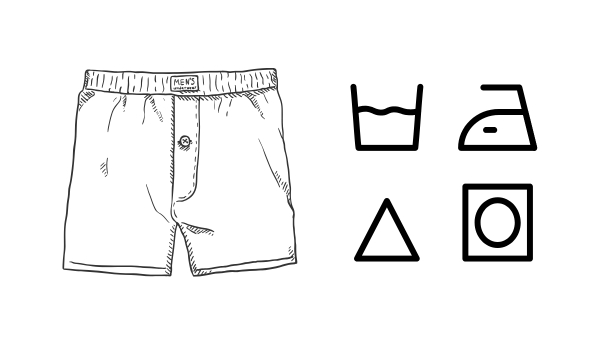
This part sets requirements for care labeling information for wearing apparel and certain other textiles. Wearing apparel means any article of clothing made in textile that is used to cover or protect the body, including hosiery.
We could not find any exemptions or special requirements for undergarments, even though we searched for terms such as underwear, socks, bras, and others
In general, care labels should state what type of regular is needed for your product. The instruction and warning requirements for the different types of care (such as washing or dry cleaning) are provided in Part 423.6.
Besides that, the part also provides the terminology that should be used, in Part 423.2 and Appendix A. Here are some examples:
- “Delicate cycle” or “gentle cycle”
- “Cold rinse”
- “No spin” or “Do not spin”
Note that the care symbols set in ASTM Standard D5489–96c may be used “in lieu” of the above-mentioned terms as long as they fulfill the requirements of 16 CFR Part 423.
19 CFR Part 134 – Country of Origin Marking
Country of origin marking is required for most products sold in the United States, including undergarments. The country of origin should generally indicate the manufacturing country.
Examples
- Made in China
- Made in Vietnam
- Made in Mexico
Flammable Fabrics Act
This section provides a breakdown of various parts under the flammable fabrics act and how these relate to undergarments.
| Part | Scope / General Requirements | Specific Requirements / Exemptions |
| 16 CFR Part 1610 – Standard for the Flammability of Clothing Textiles | This part covers clothing and textiles intended to be used for clothing.
It sets:
|
According to Part 1610.34, only uncovered or exposed parts of wearing apparel should be tested, in order to determine if an article is so flammable that it becomes dangerous when worn.
The “outer surface” of an undergarment is deemed an uncovered or exposed part and, as such, is subject to the requirements of this part. |
| 16 CFR Part 1611 – Standard for the Flammability of Vinyl Plastic Film | This part covers wearing apparel that contains vinyl plastic film
It sets:
|
The “outer surface” of undergarments is deemed an uncovered or exposed part. Thus, it is subject to the requirements of this part. |
| 16 CFR Part 1615 – Standard for the Flammability of Children’s Sleepwear: Sizes 0 Through 6X (FF 3-71) | This part covers children’s sleepwear up to size 6X (FF 3-71).
It sets:
|
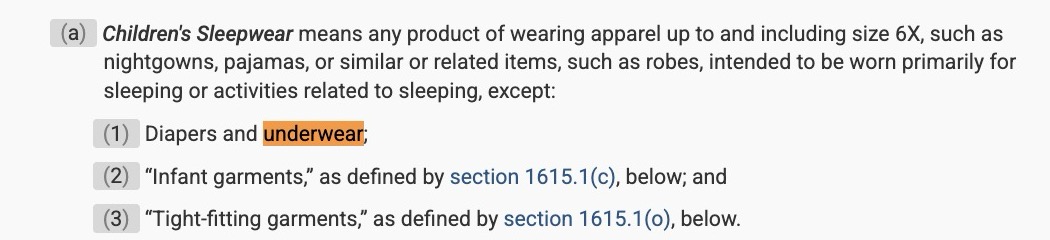
Underwear is excluded by the definition of children’s sleepwear.
However, this part may still be relevant to different types of undergarments. |
| 16 CFR Part 1616 – Standard for the Flammability of Children’s Sleepwear: Sizes 7 Through 14 (FF 5-74) | This part covers children’s sleepwear from size 7 through 14 (FF 5-74)
It sets:
|
As for Part 1615, underwear is excluded. However, other types undergarments may still be covered. |
CPSIA – Children’s Undergarments
The CPSIA sets requirements for all children’s products, including underwear, socks and other undergarments for children under the age of 12. Ensuring compliance with CPSIA requires that your products comply with all applicable children’s product safety rules.
These rules generally cover the following areas:
- Textile flammability
- Substance restrictions
- Small parts
Overview
Here are some rules that may be relevant:
- Part 1610 – Standard for the Flammability of Clothing Textiles
- Part 1611 – Standard for the Flammability of Vinyl Plastic Film
- 15 U.S.C. § 1278a – Total lead content
- 16 CFR part 1307 – Phthalates
- 16 CFR part 1501 – Small parts
Note that Part 1615 and 1616 apply to children’s sleepwear, but explicitly exclude underwear. That said, these two parts could still be relevant to other types of undergarments for children.
Requirements
✅ Children’s undergarments must be tested by a CPSC accepted third-party lab, such as:
- QIMA
- Intertek
- TUV Rheinland
✅ You must create a Children’s Product Certificate (CPC)
✅ You must affix a tracking label containing information about your company and the product
✅ eFiling is required for each shipment
Chemical Regulations
Undergarment fabrics and accessories (i.e., buttons) are subject to federal and state regulations concerning chemicals.
Toxic Substances Control Act (TSCA)
The Toxic Substances Control Act sets reporting, record-keeping, restrictions, and testing requirements for substances, mixtures, and some types of articles, including textiles.
For example, we found:
a. Reporting and record-keeping requirements for certain PFAS, including in textiles and apparel
b. Reporting requirements for the use of hexabromocyclododecane and 1,2,5,6,9,10-hexabromocyclododecane (HBCD) as flame retardants in consumer textiles
Note that requirements concerning other substances may also exist.
California Proposition 65
California Proposition 65 sets restrictions and warning requirements for many substances in California, including substances that can be found in textiles.
By searching the fact sheets provided on www.p65warnings.ca.gov for substances restricted by California Proposition 65, we found that textile products could contain some of these substances, for example:
- PFOA
- PFOS
- Antimony trioxide
- Chlorinated tris
- Tetrabromobisphenol A (TBBPA)
Also, it is possible to search for California Proposition 65 60-day notices on the State of California website.
Companies that receive 60-day notice must either correct the alleged violation by providing the appropriate warning on the product or discontinuing the sale, or pay a fine.
For example, we found several notices concerning socks due to violations that regarded the following substances:
- Di(2-ethylhexyl)phthalate (DEHP)
- PFOA
- Bisphenol A (BPA)
FAQ
Do underwear and socks require textile fibre labels in the US?
Yes, underwear and socks require a textile fibre label in the United States. Besides that, there are specific labeling requirements for socks and hosiery.
Do underwear require care labels in the US?
Yes, a care label is required for any type of clothing article that is made in textile and is used to cover or protect the body. While 16 CFR Part 423, which sets care labeling requirements for textile wearing apparel, does not explicitly mention underwear, it does mention hosiery.
Do socks require care labels in the US?
16 CFR Part 423 does not mention socks. However, it covers any type of wearing apparel that is made in textile and is meant to cover or protect the body. Given the definition, socks should also be covered.
Is eFiling required for underwear and socks?
Yes, efiling is required for products covered by general use product safety rules or children’s product safety rules. This requirement also applies to underwear, socks, and other undergarments.
Note that you must register before you can submit certificate data via eFiling.