




 Find US, EU, UK, CA, & AU requirements












Most products sold in Canada must comply with specific product and packaging labelling requirements. In this guide, we explain what manufacturers and importers must know about labelling requirements for consumer products, toys, children’s products, textiles, and other products.
Content Overview

FREE CONSULTATION CALL (30 MIN)
 Ask questions about compliance requirements
- Countries/markets:
.png)
.png)
.png)


- Learn how we can help your business
You will speak with:Ivan Malloci
Bilingual Labelling (English and French)
Providing label information in both English and French is required by several Canadian acts and regulations. Here are some examples of information that must be presented in both official languages:
- Packaging labels
- Warnings
- Instructions
- Statements
In some cases, specific terms or phrases in English and French must be present. You can find examples of bilingual labels under the toy section of this guide.
Learn more: Guide to Bilingual Language Requirements for Products Sold in Canada
Consumer Product Labelling
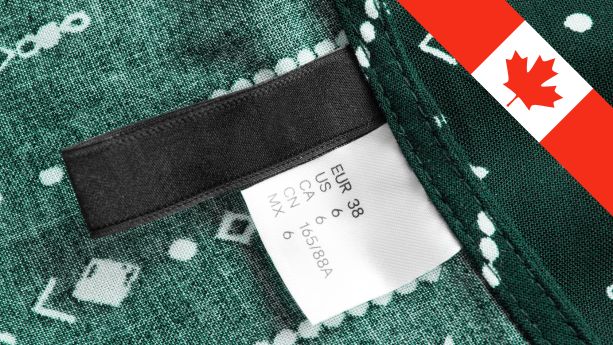
The Canada Consumer Product Safety Act sets requirements for all consumer products sold in Canada. It explicitly prohibits any labelling that is:
- False, misleading or deceptive
- Incorrect or insufficient, and that could result in death or injury
There is also a fairly extensive list of product-specific regulations under the CCPSA setting labelling requirements for particular product types. We cover some of these in subsequent sections.
Learn more: Canada Consumer Product Safety Act (CCPSA): Quick Guide
Toy Labelling
The Toys Regulations (SOR/2011-17) set warning labelling requirements for toys sold in Canada. These are generally applicable to specific types of toys.
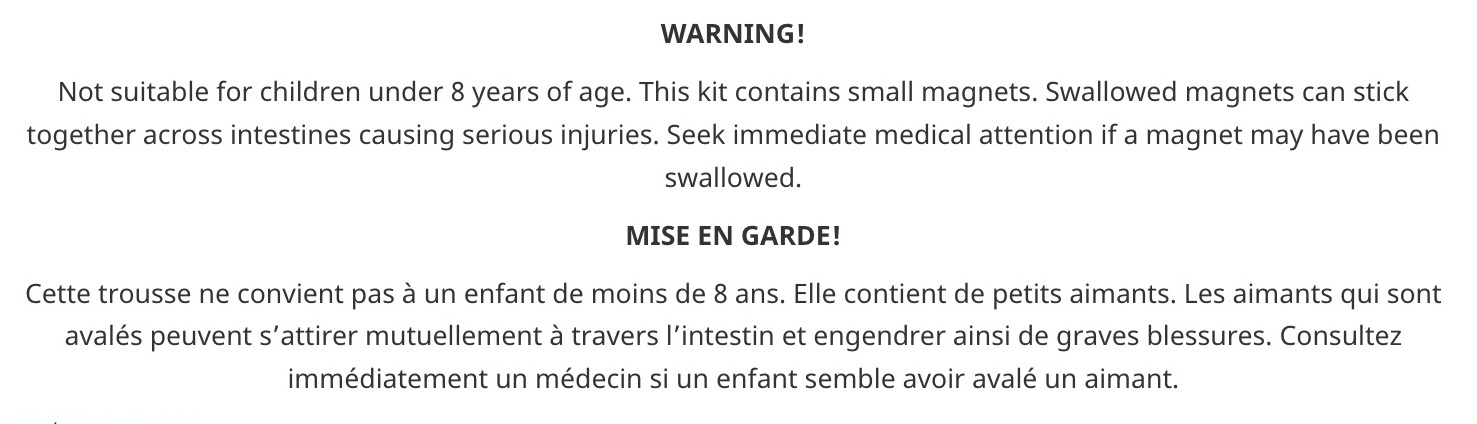
Further, warnings and other label information must be provided in English and French.
Toy intended to be entered
| Symbol | Text |
 |
WARNING: KEEP AWAY FROM HEAT AND OPEN FLAME / MISE EN GARDE : TENIR LOIN DES SOURCES DE CHALEUR ET DES FLAMMES NUES |
Flexible film bags
“PLASTIC BAGS CAN BE DANGEROUS. TO AVOID DANGER OF SUFFOCATION, KEEP THIS BAG AWAY FROM BABIES AND CHILDREN.
LES SACS DE PLASTIQUE PEUVENT ÊTRE DANGEREUX. POUR ÉVITER LE DANGER DE SUFFOCATION, NE LAISSEZ PAS CE SAC À LA PORTÉE DES BÉBÉS NI DES ENFANTS.”
Magnetic toys
Children’s Product Labelling
Several regulations under the CCPSA set requirements for specific types of children’s products:
- Carriages and Strollers Regulations (SOR/2023-101)
- Children’s Jewellery Regulations (SOR/2018-82)
- Children’s Sleepwear Regulations (SOR/2016-169)
- Cribs, Cradles and Bassinets Regulations (SOR/2016-152)
- Expansion Gates and Expandable Enclosures Regulations (SOR/2016-179)
- Infant Feeding Bottle Nipples Regulations (SOR/2016-180)
- Pacifiers Regulations (SOR/2016-184)
- Playpens Regulations (SOR/2018-186)
Some of these also set labelling requirements. The table below includes examples.
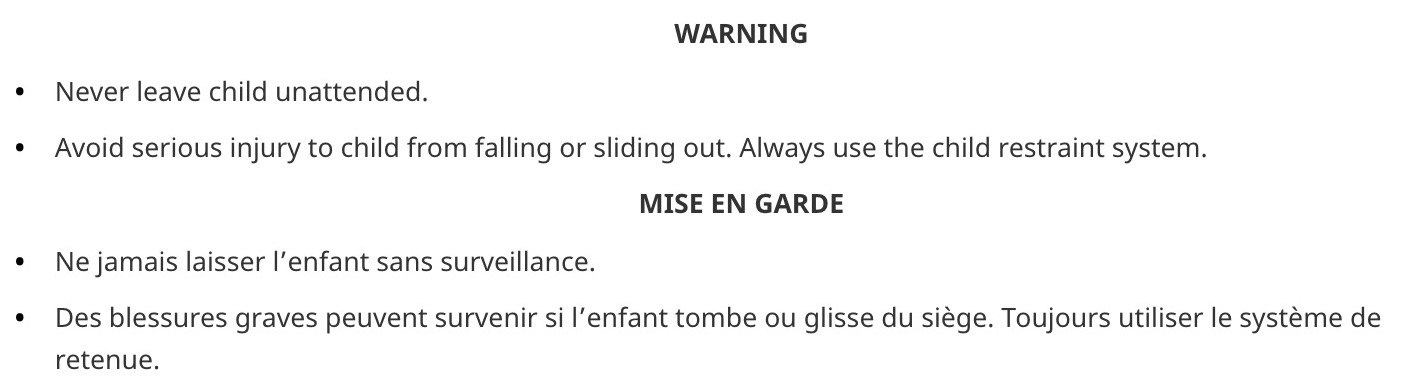
Carriages and Strollers
Loose-fitting sleepwear (treated with a flame retardant)
- The words “flame retardant” and “ignifugeant”
- Care instructions in English and French
Learn more: Children’s Product and Toy Safety Regulations in Canada: A Quick Guide
Textiles Labelling
The following set clothing and other textiles labelling requirements:
- Textile Labelling Act
- Textile Labelling and Advertising Regulations
The Regulations set detailed textiles labelling requirements, including the following:
Here are some key areas covered by the regulations:
1. Textile label information
- Name and postal address of the dealer (or use an identification number)
- Textile fibre content
- Name of the country of origin
- English and French languages
2. Textile label format and placement
3. Textile fibre names
More detailed information can be found in Part I and Part III.
Learn more: Clothing and Textiles Regulations in Canada: A Quick Guide
Packaging Labelling
The following applies to the packaging of prepackaged consumer products:
- Consumer Packaging and Labelling Act
- Consumer Packaging and Labelling Regulations
Consumer Packaging and Labelling Act
The Consumer Packaging and Labelling Act lists the following labelling requirements:
1. Net quantity
2. Company identity and principal place of business
3. Product identity (common or generic name, or functionality)
4. Information related to the following (as may be prescribed):
- Nature
- Quality
- Age
- Size
- Material content
- Composition
- Geographic origin
- Performance
- Use
- Method of manufacture
Consumer Packaging and Labelling Regulations
More detailed requirements about units, label placements, and formats can be found in the Consumer Packaging and Labelling Regulations.
Learn more: Product Packaging Regulations in Canada: A Quick Guide
Product Standards
Product standards can also set labelling requirements for particular products. For example, the Ice Hockey Helmet Regulations SOR/2016-186 mandate compliance with CAN/CSA-Z262.1-M90 – Ice Hockey Helmet.
This standard, in turn, sets requirements for labels, tags, and markings.
Country of Origin Marking
Memorandum D11-3-1 sets requirements for the marking of imported goods. In short, certain goods should be marked with information that clearly indicates the country in which the goods were made.
According to the memorandum, this is the list of product categories that require marking:
- Goods for personal or household use
- Hardware
- Novelties and sporting goods
- Paper products
- Apparel
- Horticultural products
- Goods made of steel or aluminum
Note that other regulations may also set country of origin marking requirements.
FAQ
Is country of origin marking required in Canada?
The country of origin marking is required for certain categories of goods, which are listed in the:
a. Determination of Country of Origin for the Purpose of Marking Goods (CUSMA Countries) Regulations
b. Determination of Country of Origin for the Purpose of Marking Goods (Non-CUSMA Countries) Regulations
This includes, for example, apparel and goods for personal or household use. Other regulations may also mandate such requirements.
Is CE marking accepted in Canada?
No, CE marking is an EU compliance mark and cannot be used to demonstrate compliance with Canadian acts, regulations and standards. That being said, many products are designed and manufactured to comply with both EU and Canadian requirements, which results in the CE mark being visible on products sold in Canada as well.
Is it sufficient to comply with US labelling requirements?
No. Canada has its own set of labelling regulations that differ from labelling requirements in the United States. Products sold in both countries must comply with labelling requirements in both Canada and the United States.