




 Find US, EU, UK, CA, & AU requirements











If you’re reading this article, you’re likely a dropshipping seller concerned about the prospect of unknowingly selling unsafe and non-compliant products. If you ask me, you have reason to be.
There are more questions than answers when it comes to product safety and compliance when it comes to dropshipping. As such, I wrote this article as a reflection on my experience with both sellers and suppliers in the dropshipping world.
Note: This article is not aimed at any particular dropshipping supplier, online marketplace, or service. This article only raises broad and general issues related to product compliance and dropshipping. Further, this guide does not cover issues related to VAT or import duties.
Content Overview

FREE CONSULTATION CALL (30 MIN)
 Ask questions about compliance requirements
- Countries/markets:
.png)
.png)
.png)


- Learn how we can help your business
You will speak with:Ivan Malloci
What is dropshipping?
Dropshipping is an e-commerce model in which the store owner sells products without actually having any stock. This is how it works:
1. The customer purchased Widget A from the seller’s online store
2. The dropshipping seller orders Widget A from their dropshipper supplier to be sent directly to the customer’s address
3. The customer receives the product directly from the dropshipping supplier
This allows the seller to ‘offer’ a wide range of products without investing in physical stock. Instead, the stock is held in a warehouse operated by the dropshipping supplier, which sends out individual parcels on a per-order basis.
The dropshipping supplier, in turn, likely procures products from local manufacturers and wholesalers. As such, the dropshipping supplier is usually not the actual manufacturer.
Are dropshipping products safe and compliant?
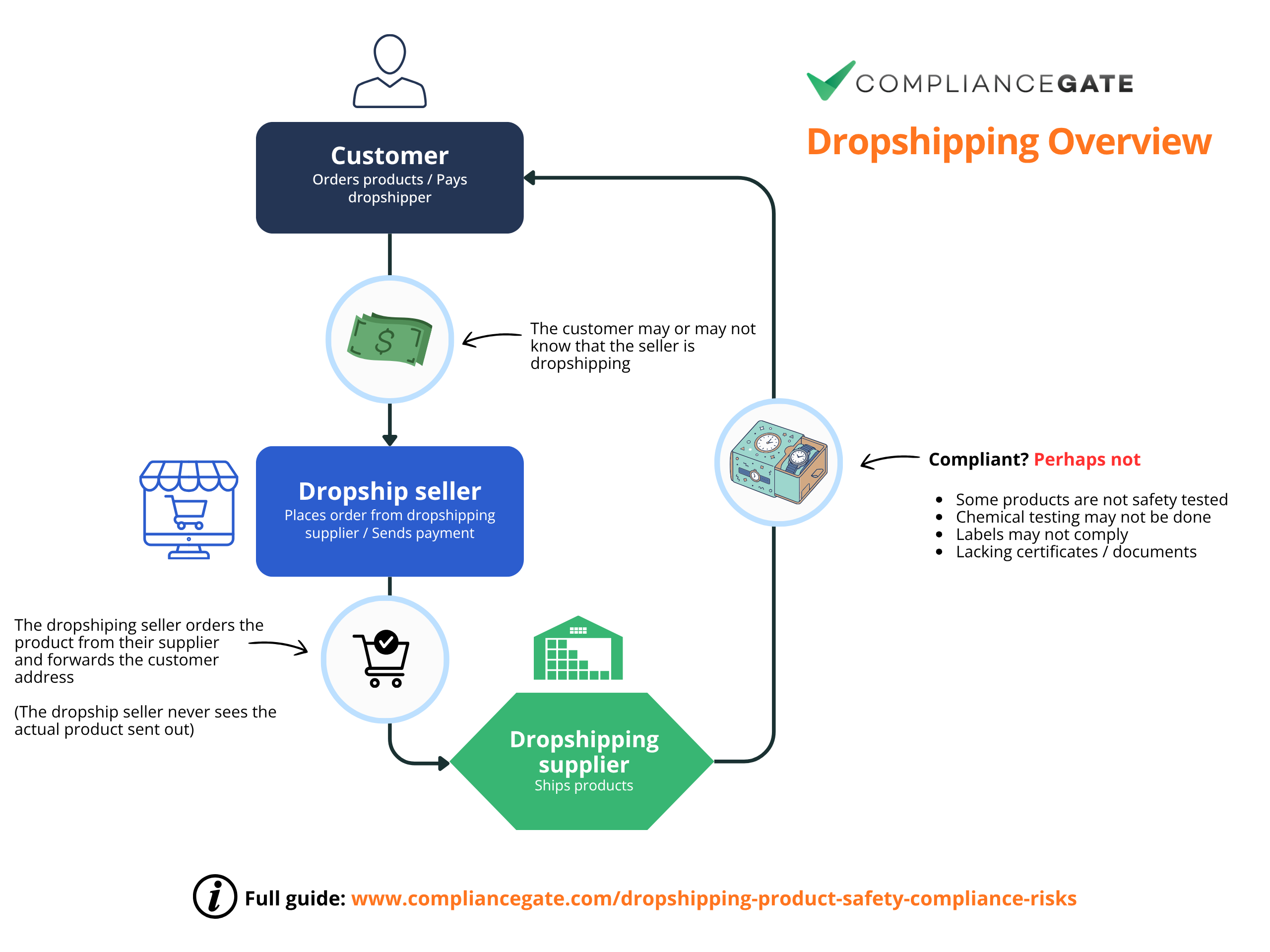
Products sold via dropshipping suppliers or marketplaces are, in many cases, not designed to comply with EU, US or UK compliance requirements. This has the following implications:
Non-compliance with safety standards
Many products sold in the US and EU are subject to strict safety standards. These relate to toy safety, battery safety, electrical safety, and other aspects. Here are a few examples:
- EN 71-1
- EN 71-3
- ASTM F963
Ensuring compliance with such standards requires that products be designed to be in compliance. It is not something that (usually) happens by accident.
Dropshipping products often fall in the category of goods that are not specifically designed to meet EN and ASTM standards. Often, because they were not specifically designed to meet US and EU requirements in the first place.
Chemicals and heavy metals
Products sold in the US, EU and other countries are subject to strict substance restrictions. Many dropshipping products have not been tested, and therefore, compliance is not verified.
As such, you may be dropshipping products containing excessive amounts of DEHP, lead, cadmium and other restricted substances.
Incorrect labelling
Products and packaging are subject to various labelling requirements in the EU, UK and US. This includes:
- CE marking
- UKCA marking
- Batch numbers
- Manufacturer information
- Importer information
- Warnings
Products do not become correctly labelled by accident. Doing so requires an understanding of applicable regulatory requirements. Many dropshipping products are simply not designed to comply with such labelling requirements in the first place.
Certification and documentation
Many products require product certificates, declarations, technical information, user instructions, and other documents. Here are a few examples:
- Children’s Product Certificate (CPC)
- General Certificate of Conformity (GCC)
- Declaration of Conformity (DoC)
- User instructions
Why are dropshipping products often non-compliant?
Many products that end up on dropshipping websites were never originally designed for export to the United States, the European Union, or other markets.
As such, it’s wrong to assume that all products are somehow by default labelled, documented, and tested according to requirements in markets the product was never even intended for in the first place.
It’s also related to costs.
Dropshipping products are generally extremely low-cost items. Dropshipping suppliers would price themselves out of the market if they had to arrange lab testing for products that may, at some point, be ordered.
It would also require the dropshipper to arrange periodical testing as regulations and standards are amended. Doing so for thousands of products would be extremely expensive.
Are dropshippers responsible for product safety?
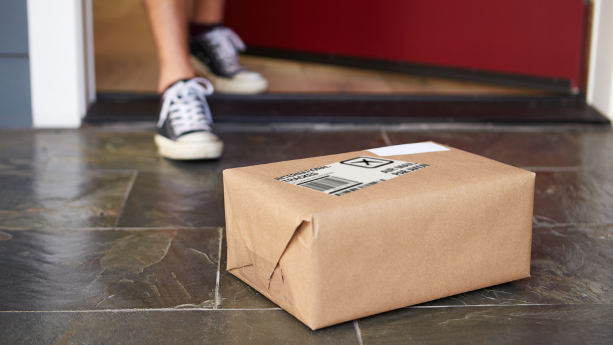
Dropshipping sellers often fall outside of the definitions found in product regulations in the US, EU and other markets. In the European Union, for example, the responsibility is often placed on the company that designs and brands the products.
Importers are also responsible for verifying product compliance by checking test reports, labels, and other items.
But, dropshipping sellers are usually not:
i. Responsible for designing or branding products
ii. Listed as the importer of record, as it is their customer’s details written on the parcel
As such, dropshippers are not clearly defined as manufacturers or importers.
Where does this place dropshipping sellers?
In the end, dropshipping sellers are primarily marketers. Their role is generally not clearly defined in product regulations, which can likely be explained by regulators not taking into account the existence of dropshippers when drafting legislation.
Does this mean that they can walk away scot-free if someone is injured by a product sold by them?
Not at all. I am aware of cases, at least in the EU, where national market surveillance authorities have targeted dropshipping sellers on the basis that they marketed and sold products that failed to meet applicable compliance requirements.
In the cases I am aware of, the market surveillance authorities did not focus on the overseas dropshipping supplier but targeted the dropshipping seller within EU borders.
How can dropshippers verify if their products are safe and compliant?
In theory, you could contact your dropshipping supplier and request the following:
- Lab test reports
- Product and packaging label images
- Product certification and documents (if required)
- User manual (if required)
That being said, it’s highly unlikely that your dropshipping supplier can actually provide any of these files.
In fact, I am not aware of a single instance in which a dropshipping supplier or platform has been able to provide compliance documents for the EU or the US.
FAQ
Is eFiling required for dropshipped products in the US?
eFiling is required in the United States for children’s products and general-use products subject to product safety rules. This is also the case for products sent by dropshipping suppliers.
Note that the importer is responsible for dropshipping. It is unclear to me if dropshipping sellers or suppliers are even eligible to register for eFiling via the CPSC portal in the first place. Doing so requires a US Importer of Record (IOR) Number.
Can we dropship products that are CE marked to the EU?
No, not based on the presence of a CE mark alone. You must also validate the following:
- Test reports demonstrating compliance with EN standards
- Declaration of Conformity
- User instructions
- Technical documentation
- Traceability labelling
Can dropshipped products become CE marked?
Yes, at least in theory. That said, affixing CE marking to a dropshipping product would require that you arrange testing, affix labelling and create the required documentation.
Even if you achieve this, you will likely not be able to verify if the dropshipping supplier makes changes to the materials or components, which could invalidate the CE marking.
CE marking dropshipping products is, at best, extremely impractical. If that’s a path you consider going down, then you might as well work directly with a manufacturer.
Can dropshippers get product liability insurance?
It is theoretically possible for dropshippers to get product liability insurance. That said, insurance providers often need to review test reports, certificates and other compliance documents.
Documents that most dropshipping sellers cannot obtain, because they do not exist.
Are dropshippers liable for unsafe and non-compliant products?
As mentioned above, I am aware of cases where EU market surveillance authorities did go after dropshipping sellers on the basis that they were found to be marketing and selling non-compliant products.
They were subject to investigations and had to issue recalls. I do not know if they faced consequences beyond that. However, a recall alone can be devastating.
Can dropshippers get their products tested and certified?
You could buy a single product from your dropshipping supplier and submit it for lab testing. The problem is that this will cost you anything from 500 to 3000 USD or EUR (or more) per product.
Doing so is prohibitively expensive for almost any dropshipping seller, as the entire point of dropshipping is to offer a wide range of products while also testing new SKUs without any upfront cost.
Another problem is that the seller doesn’t have any control over the product supply chain. The dropshipping supplier could change materials, design, or factory at any given moment without the seller ever knowing.
This makes it questionable as to whether or not it’s worth considering in the first place.
A better option would almost always be to work directly with a factory, which gives you more control over the design and materials.
Can I check if my dropshipping products are correctly labelled?
You can request product and packaging label images as a way to confirm if the product is correctly labelled, assuming your dropshipping supplier will even respond to such a request in the first place.
Can I affix new labels to dropshipping products?
This is also theoretically possible, as long as your dropshipping supplier is willing to do so. That said, unpacking and relabelling products already in a warehouse is often not possible.
Bear in mind that certain compliance marks and symbols must be present on the actual product. Affixing a sticker on the box or parcel may not be sufficient.
What should dropshippers do to reduce their compliance risks?
At the very least, avoid ‘high-risk’ dropshipping products that belong to the following categories:
- Electronics
- Batteries
- Toys
- Other children’s products
- Cosmetics
- Medical devices
- Food contact materials
If I have to choose, I’d rather ship t-shirts without the correct care labelling than a power bank that could potentially explode in my customer’s pocket.
Further, request compliance documents and label images to assess if your dropshipping supplier is able to prove compliance. If not, perhaps they’re willing to take certain steps to improve the situation.
Ultimately, there is no simple solution or silver bullet when it comes to dropshipping and product compliance.




Hi, do you know if there is any type of insurance I can take out to protect myself should a problem arise. I am based in the UK dropshipping to UK and USA. Thanks
Hello Yasmin,
I have never heard of any company providing product liability insurance for dropshippers.
Hi Fredrik,
I have two questions regards dropship business models requirments outside EU.
As an example , a company that is called XX wants to work with this business model outside EU,
In this case I want to know that if:
1- Supplier for cosmetic or chemical products is located in UK and a consumer from Sweden will place an order online via XX company online website, So UK Supplier will send the product directly to outside of UK (e.g. Sweden), my question is that in this scenario for cosmetic and chemical products: who is the importer? XX company? and who must be for example: REACH reporter, poison center reporter, ingredients reporter etc.? XX company?
2- If Supplier of chemical or cosmetic products is located within EU (e.g. Sweden) and UK consumer place an order on XX company online website, so in this case, Swedish supplier will send the product directly to UK consumer, in this scenario: what is XX company role in the supply chain ?who is the importer and who must be for example: REACH reporter, ingredients reporter, poison center reporter etc.? Does XX company need to have local representative in UK to do all regulatory and compliance related things?
Hi Bana,
1. Sounds to me like the consumer is the importer in that case
2. I have no idea and I doubt REACH even addresses dropshipping supply chains, to begin with. Further, you need to comply with cosmetics product regulations in addition to REACH.
Do you know how to find a testing company in China with an inspection agency? I need to verify if the products I want to dropship are safe and compliant. My niche is beauty devices for home use.
Hi Josefina,
Inspection companies usually don’t provide lab testing services. I suggest you contact QIMA, Intertek or SGS. Testxchange is another option.