




 Find US, EU & UK requirements











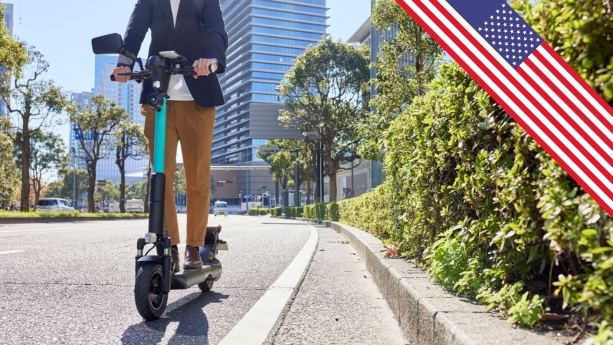
Electric scooters manufactured or imported in the United States are subject to various compliance requirements, including labelling, documentation, and substance restrictions, at both the federal and state levels.
In this guide, we take a look at FCC requirements under 49 CFR Part 15, CPSIA requirements, and other key requirements that are relevant to electric scooters in the United States.
We also explain why product safety standards, such as UL 2272, are relevant to the manufacturing and importation of electric scooters in the United States.
Note: We do not list requirements that apply to products in general or packaging. Also, this guide does not cover all possible US regulations that apply to electric scooters.
Content Overview

FREE CONSULTATION CALL (30 MIN)
 Ask questions about compliance requirements
- Countries/markets:
.png)
.png)
.png)
- Learn how we can help your business
You will speak with:Ivan Malloci or John Vinod Khiatani
Which US regulations apply to electric scooters?
Below follows a list of selected compliance requirements for electric scooters in the US. Note that additional requirements can apply. Further, the listed requirements are relevant to the following items:
- Electric scooters
- Batteries
- Chargers
47 CFR PART 15 – RADIO FREQUENCY DEVICES – Unintentional Radiators
| Overview | Information |
| Relevancy | 1. 47 CFR Part 15 sets requirements for products that unintentionally generate radio frequency energy to ensure that they do not cause harmful interference with the operation of other devices, including radio communications.
2. Electric scooters are likely to unintentionally emit radio frequency energy due to their electronic and electrical parts. |
| General requirements | 1. Follow the Supplier’s Declaration of Conformity (SDoC) Authorization Procedure
2. Comply with the relevant technical requirements (e.g., radiated emission limits) 3. Apply relevant standards |
| Documentation | 1. SDoC Compliance Information Statement
2. Information to the user |
| Labeling requirements | 1. Product identification information
2. Compliance statement 3. FCC Logo (optional) |
47 CFR PART 15 – RADIO FREQUENCY DEVICES – Intentional Radiators
| Overview | Information |
| Relevancy | 1. 47 CFR PART 15 also sets requirements for products that are designed to emit radio frequency energy. The requirements are there to ensure that the intentional release of radio frequencies does not harmfully interfere with other devices, including radio communications.
2. The requirements apply to electric scooters that intentionally emit radio frequency energies, like those that can connect to a network via wifi technologies or connect to other devices via Bluetooth technologies. |
| General requirements | 1. Follow the Certification Authorization Procedure
2. Comply with the relevant technical requirements (e.g., restricted bands of operation, or radiated emission limits) 3. Comply with relevant standards |
| Documentation | 1. Technical report
2. Application for certification 3. Information to the user |
| Labeling requirements | 1. FCC identifier
2. Compliance statement |
47 CFR Part 8 Subpart B – Cybersecurity Labeling Program for IoT Products
| Overview | Information |
| Relevancy | 47 CFR Part 8 Subpart B establishes a voluntary labeling program for consumer IoT products to address the risks of harmful interference to and from other internet-connected devices.
It applies to electric scooters that are capable of connecting to the internet and to other devices (e.g., due to having wifi capabilities) |
| General requirements | 1. Follow the application requirements for the cybersecurity labeling authorization
2. Have the product tested by an accredited CyberLABs |
| Documentation | 1. Comply with record-keeping requirements |
| Labeling requirements | 1. Use the FCC IoT Label |
Consumer Product Safety Improvement Act (CPSIA)
| Overview | Information |
| Relevancy | 1. The CPSIA applies to products that are designed for children aged 12 years and below. Its requirements ensure that such products are safe for use.
2. As such, CPSIA requirements apply to electric scooters that are designed to be used by children. |
| General requirements | 1. Comply with relevant CPSIA requirements, including safety rules, standards, and substance restrictions |
| Documentation | 1. Children’s product certificate
2. Instructions |
| Labeling requirements | 1. Tracking label
2. Warnings 3. Instructions |
National Highway Traffic Safety Administration requirements
| Overview | Information |
| Relevancy | 1. The National Highway Traffic Safety Administration requirements are contained in 49 CFR Chapter V. We found that they have requirements for motor vehicles, like motorcycles and scooters.
2. For example, 49 CFR Part 571- Federal Motor Vehicles Safety Standards sets requirements for motor vehicles powered by an electric motor drawing current from rechargeable storage batteries, or similar sources of energy. |
| General requirements | Comply with the applicable National Highway Traffic Safety Administration requirements |
49 CFR Subtitle B Chapter I Subchapter C – Hazardous Materials Regulations
| Overview | Information |
| Relevancy | 1. The Hazardous Materials Regulations set requirements for the safe and secure transportation of hazardous materials in commerce. They cover certain batteries, like lithium-ion batteries and lithium-metal batteries.
2. These regulations cover batteries that may be contained or used in electric scooters. |
| General requirements | 1. The regulations contain a Hazardous Materials Table found in 49 CFR Part 172.101 that can be used as a starting point to find requirements for your products, such as a specific battery. This includes requirements such as:
a. Packaging requirements b. Documentation requirements c. Labeling requirements d. 38.3 of the UN Manual of Tests and Criteria requirements e. Quantity limitations |
Mercury-Containing and Rechargeable Battery Management Act
| Overview | Information |
| Relevancy | 1. This Act establishes requirements for regulated batteries and rechargeable consumer products. Additionally, it contains substance restrictions for batteries containing mercury.
2. Regulated batteries are defined in the Act. The definition includes batteries containing cadmium and/or lead electrode(s). 3. The Act’s requirements would cover the batteries of electric scooters that contain regulated or rechargeable batteries. |
| General requirements | 1. Substance restrictions
2. Comply with the collection, storage, and transportation requirements of regulated batteries 3. Ensure that regulated batteries can be removed easily or are sold separately |
| Documentation | 1. Comply with record-keeping requirements
2. Comply with reporting requirements |
| Labeling requirements | 1. Comply with labelling requirements for regulated batteries and rechargeable consumer products that contain batteries that are not easily removable. |
10 CFR PART 430 – ENERGY CONSERVATION PROGRAM FOR CONSUMER PRODUCTS
| Overview | Information |
| Relevancy | 10 CFR Part 430 establishes requirements for certain appliances and equipment to ensure they are energy-efficient. It covers products such as lighting fixtures and battery chargers.
It may apply to lighting products used on electric scooters and battery chargers of scooters. |
| General requirements | Comply with applicable energy conservation standards and test procedures |
10 CFR PART 429 – CERTIFICATION, COMPLIANCE, AND ENFORCEMENT FOR CONSUMER PRODUCTS AND COMMERCIAL AND INDUSTRIAL EQUIPMENT
| Overview | Information |
| Relevancy | 1. 10 CFR Part 429 sets certification and other procedural requirements for products covered by 10 CFR Part 430.
2. Its requirements are relevant to electric scooters that must comply with 10 CFR Part 430. |
| General requirements | 1. Comply with the certification procedural requirements
2. Comply with filing requirements for the certification report |
| Documentation | 1. Certification report |
Note: We only list requirements directly related to electric scooters. We do not list requirements that apply to products in general or packaging.
UL standards for electric scooters
UL Solutions publishes standards that contain performance and safety requirements for many products, including electric scooters and their components. Some US regulations require that products meet the requirements of a particular UL standard.
However, even the application of UL standards that are not incorporated under a specific regulation is generally necessary, as you are ultimately required to provide a safe product. Additionally, some marketplaces, like Amazon, distributors, and retailers, may also require compliance with specific UL standards.
This is of particular importance for high-risk products like electric scooters. The frame, breaks, battery, and charger are all potential safety hazards.
Here are some examples of UL standards that are relevant to e-scooters, chargers, and batteries:
UL 2272 – Electrical Systems for Personal E-Mobility Devices
UL 2850 – UL LLC Outline of Investigation for Vehicle Systems of Electric Scooters and Motorcycles
UL 1236 – Battery Chargers for Charging Engine-Starter Batteries
UL 2271 – Batteries for Use In Light Electric Vehicle (LEV) Applications
UL 1642 – Lithium Batteries
Note that more standards may exist.
CPSC’s recommended voluntary standards related to batteries
The Consumer Product Safety Commission (CPSC) published a page listing several standards for batteries in consumer products, which may also include electric scooter batteries. Their recommendations are a reaction to the number of product recalls involving batteries and battery chargers used in various electronic products, including hoverboards.
Here are some examples of voluntary standards that are listed on the CPSC’s page:
ANSI/CAN/UL 2272 – Electrical Systems for Personal E-Mobility Devices
ANSI/NEMA C18 – Safety Standards for Primary, Secondary and Lithium Batteries
ASTM F963 – Standard Consumer Safety Specification for Toy Safety
UL 1642 – Standard for Safety for Lithium Batteries
UL 2595 – Standard for Safety for General Requirements for Battery-Powered Appliances
Note that the CPSC recommends complying with the applicable listed standards, even though they may be voluntary. As mentioned, high-capacity lithium batteries used in electric scooters are potential safety hazards. It is in your interest to comply with applicable standards recognised in the US, even if doing so is voluntary.
Testing requirements
Testing is typically required to comply with the performance and safety requirements of the applicable US regulations. To have the product tested, you should generally approach a lab testing company.
Here are some examples of tests that can be applied to electric scooters:
- Physical property testing (frame, breaks)
- Chemical testing
- Battery, battery charger, and battery pack testing
- Software testing
- Electrical safety
- Energy usage
After the electric scooter has been tested, you can expect to receive test reports from the lab testing company. The test reports can be used to demonstrate that you have met the requirements of a US regulation or standard.
US State Regulation
At the state level, there may be additional requirements that apply to electric scooters. Here are some examples of US state-level requirements that may be applicable to electric scooters:
- US RoHS
- California Proposition 65
- Specific electric scooter state laws
Note that there can be more US state-level requirements that apply to electric scooters, and that individual states may have different requirements.
FAQ
Which UL standards apply to electric scooters?
Here are some examples of UL standards that apply to electric scooters:
UL 2850 – UL LLC Outline of Investigation for Vehicle Systems of Electric Scooters and Motorcycles
UL 2272 – Electrical Systems for Personal E-Mobility Devices
Note that standards for components such as batteries, chargers, lightings, and more may also be applicable, even though “electrical scooter” is not mentioned.
Does 47 CFR Part 15 apply to electric scooters?
Yes, 47 CFR Part 15 contains FCC rules that apply to electric scooters that intentionally or unintentionally emit radio frequencies through their electronic components. Note that the requirements for “intentional radiators” only apply to electric scooters that contain Wi-fi, Bluetooth, or other components that intentionally emit radiation.
Hence, an electric scooter that can be unlocked via Bluetooth could likely be considered an intentional radiator.
Which companies provide safety testing for electric scooters in the US?
Here are some US lab testing companies that offer testing services for electric scooters:
- SGS
- Act Lab
- Intertek
Note that Underwriter Laboratories (UL) may also be able to provide testing services.