




 Find US, EU, UK, CA, & AU requirements










Home textile products imported or manufactured for sale in the United States are subject to various regulations and standards. The requirements range from chemical restrictions, to labeling and certification requirements.
In this guide, we take a closer look at home textile compliance requirements and related products:
- Carpets
- Rugs
- Mattress pads
- Curtains
- Window coverings
- Home textiles with filling materials
- Home textiles for children
- Beddings
- Pillow cases
Some regulations and standards apply to components that are often incorporated in home textile products, such as operating cords.
Content Overview

FREE CONSULTATION CALL (30 MIN)
 Ask questions about compliance requirements
- Countries/markets:
.png)
.png)
.png)

- Learn how we can help your business
You will speak with:Ivan Malloci
Are home textiles regulated in the United States?
Yes, home textile products sold in the United States are subject to various regulations, standards, and other requirements. The applicable regulations and standards generally depend on the following factors:
a. Product type
b. Materials
c. Components
d. Age group
e. US States
General-use products
Certain home textile products are subject to product safety rules. Such products must meet the technical requirements outlined in the product safety rule and comply with certification and testing requirements.
Process
✅ Ensure that your product is designed to meet the technical requirements in the applicable product safety rule/s.
✅ Ensure that you also comply with referenced ASTM standards (if any).
✅ Create a General Certificate of Conformity (GCC)
✅ Arrange product testing based on a “reasonable” testing plan
✅ eFiling is required when importing general use products
Overview
| Rule | Product scope |
| Part 1630 – Standard for the Surface Flammability of Carpets and Rugs (FF 1-70) | a. Carpets and rugs with one dimension greater than 1.83 m. (6 ft.) and a surface area greater than 2.23 m.2 (24 sq. ft.)
b. Some types of “carpet squares” |
| Part 1631 – Standard for the Surface Flammability of Small Carpets and Rugs (FF 2-70) | Carpets and rugs that have no dimension greater than 1.83 m. (6 ft.) and an area not greater than 2.23 m.2 (24 sq. ft.) |
| Part 1632 – Standard for the Flammability of Mattresses and Mattress Pads (FF 4-72, Amended) | a. Mattresses
b. Mattresses pads |
| Part 1633 – Standard for the Flammability (Open Flame) of Mattress Sets | Mattresses sets |
Home textile products for children
Home textiles intended for children are subject to mandatory product safety requirements under the CPSIA. Note that a children’s product can be any product intended for children between the ages of 0 to 12.
Process
✅ Ensure that your product is designed to meet the technical requirements in the applicable children’s product safety rule/s.
✅ Ensure that you also comply with referenced ASTM standards (if any).
✅ Create a Children’s Product Certificate
✅ Affix a tracking label to the product and the packaging
✅ Arrange third-party testing with a CPSC-accepted lab (mandatory)
✅ eFiling is required when importing children’s products
Overview
| Rule | Product scope | Ref standard |
| Part 1236 – Safety Standard for Infant Sleep Products | Infant sleep products, including inclined and flat sleep surfaces | ASTM F3118-17a |
| Part 1241 – Safety Standard for Crib Mattresses | Crib mattresses | ASTM F2933-25 |
| Part 1242 – Safety Standard for Nursing Pillows | Nursing pillows | ASTM D3359-23
ANSI Z535.4-2011 |
| Part 1243 – Safety Standard for Infant Support Cushions | Infant support cushions, such as infant positioners, infant loungers, and more | ASTM D3359-23
ANSI Z535.4-2011 |
| Part 1632 – Standard for the Flammability of Mattresses and Mattress Pads (FF 4-72, Amended) | Mattresses
Mattresses pads |
/ |
| Part 1633 – Standard for the Flammability (Open Flame) of Mattress Sets | Mattresses sets | / |
Substance restrictions
Home textile products for children that are not subject to the parts listed above must still comply with substance restrictions for lead and phthalates:
Part 1303 – Ban of Lead-Containing Paint and Certain Consumer Products Bearing Lead-Containing Paint
Part 1199 – Children’s Toys and Child Care Articles Containing Phthalates: Guidance on Inaccessible Component Parts
Other products
It’s also worth noting that all children’s products that are deemed to be unsafe can be subject to recalls ordered by the CPSC or other US government agencies. It is therefore in your best interest as a manufacturer or importer to ensure that your home textile product is safe, even when no product-specific safety rules or standards exist.
16 CFR Part 1120 – Substantial Product Hazard List
Part 1120 prohibits certain products that are deemed to be of particular danger. Some of these bans are related to home textiles, namely the following:
- Extension cord (also known as a cord set)
- Stock window covering (also known as a stock blind, shade, or shading)
- Custom window covering (also known as a custom blind, shade, or shading)
The table below provides a summary of key requirements.
| Product | What is a product hazard? |
| Extension cord (also known as a cord set) | Extension cords that are not in compliance with the listed sections of UL 817 |
| Stock window covering (also known as a stock blind, shade, or shading) | Stock window coverings that are not compliant with the listed requirements of ANSI/WCMA A100.1—2018 |
| Custom window covering (also known as a custom blind, shade, or shading) | Custom window coverings that are not compliant with the listed requirements of ANSI/WCMA A100.1—2018 |
You can find an example of a recalled home textile product on the CPSC website.
Home textiles labelling
16 CFR Part 303 sets labeling requirements for textile products in the United States, including various textile products that are generally considered to be home textiles. That said, certain product types are exempted.
Textile fiber examples
100% cotton
100% polyester
90% cotton 2% polyester
Other labelling requirements
Company name or registered identification number
Country of origin
Overview
The following home textile products are listed under part 303.45:
| Covered home textiles | Exempted if |
| Beddings | Any of the conditions a., b., c., d., e. listed below the table apply |
| Curtains and casements | Made principally of slats, rods, or strips, composed of wood, metal, plastic, or leather
Any of the conditions a., b., c., d., e. listed below the table apply |
| Draperies | Same as above |
| Tablecloths, napkins, and doilies | Any of the conditions a., b., c., d., e. listed below the table apply |
| Table place mats |
Made principally of slats, rods, or strips, composed of wood, metal, plastic, or leather
Any of the conditions a., b., c., d., e. listed below the table apply |
| Floor coverings | Some types of hand-woven rugs made by Navajo Indians
Any of the conditions a., b., c., d., e. listed below the table apply |
| Towels | Any of the conditions a., b., c., d., e. listed below the table apply |
| Wash cloths and dish cloths | Same as above |
| Ironing board covers and pads | Same as above |
| Cushions | Same as above |
| Furniture slip covers and other covers or coverlets for furniture | Same as above |
| Afghans and throws | Same as above |
| Antimacassars and tidies | Same as above |
| Dresser and other furniture scarf | Same as above |
According to Part 303.45(b), all textile fiber products that are not listed in the above table are excluded.
Also, the home textile products listed in the above table that have one or more of these characteristics are excluded:
a. Products sold exclusively to the employees of the manufacturer
b. Coated fabrics, and portions of textile fiber products made of coated fabrics
c. Some types of secondhand household textile articles
d. Disposable non-woven products that are designed to be used only once
e. Some type of products intended to be sold to the military services of the United States
Law Labels
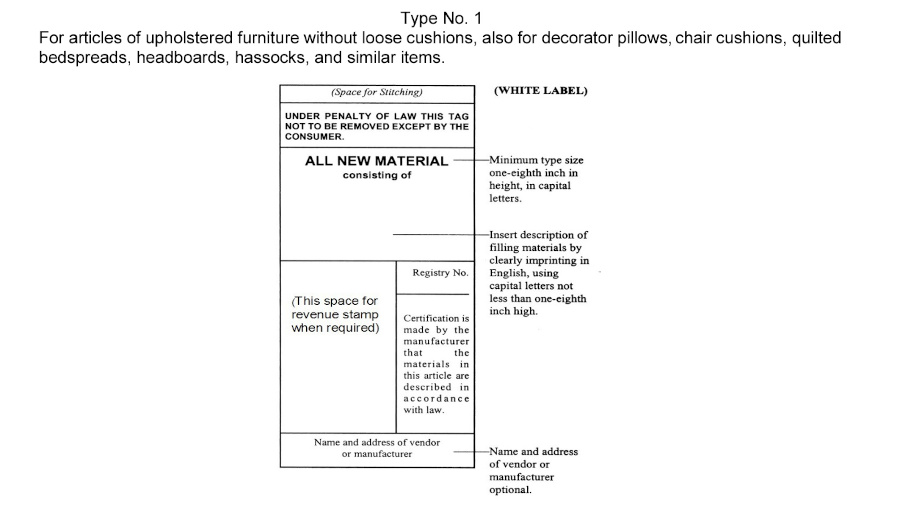
Example: Type No. 1 in California’s HFTI Laws and Regulations
Law labels sold in most US states require a law label, which indicates the filling materials used. Here are some examples of home products which may require law labels:
- Beddings
- Pillows
- Quilts
- Mattress pads
- Cushions
You can learn more about US law label requirements in this guide.
California Proposition 65
California Proposition 65 restricts chemicals and heavy metals in consumer products sold in California. Here are some examples of substance restrictions which are relevant to textiles:
- Formaldehyde
- Lead
- DEHP and other phthalates
- Some types of flame retardants (e.g. PFOA)
Such substances are not only found in textile fibers, but also dyes, coatings, or materials used to treat home textile materials.
Note that companies have the option to verify compliance through testing, or affix warning labels. Note that some companies are also exempt from such requirements.
Country of origin marking
Country of origin marking is mandatory for most products imported to the United States, including home textiles. The specified country of origin must reflect the actual manufacturing country.
Examples
Made in Mexico
Made in China
Made in Spain
Made in USA
Note that additional requirements apply under 16 CFR Part 323 if you intend to claim that your product is made in the USA. Virtually all materials or components of the home textile product must be made and sourced in the United States.
Home Textile Flammability Standards
Standards are often voluntary. That said, any home textile product that is deemed to be unsafe can be subject to recalls. As such, flammability standards can serve as a useful reference point for testing when it comes to ensuring that your product is as safe as it can be.
D4720 – Standard Performance Specification for Soft Window Covering Fabrics for Household Use
D6663 – Standard Specification for Woven and Knitted Comforter and Accessory Products for Institutional and Household Use
D7023 – Standard Terminology Relating to Home Furnishings
D7016/D7016M – Standard Test Method to Evaluate Edge Binding Components Used in Mattresses After Exposure to An Open Flame
D4151 – Standard Test Method for Flammability of Blankets
D3691/D3691M – Standard Performance Specification for Woven, Lace, and Knit Household Curtain and Drapery Fabrics
D5432 – Standard Performance Specification for Blanket Products for Institutional and Household Use
NFPA 701 – Standard Methods of Fire Tests for Flame Propagation of Textiles and Films