





 Find US, EU, UK, CA, & AU requirements













All children’s products manufactured or imported in the US are covered by the CPSIA. However, additional requirements apply to certain types of children’s furniture, baby walkers, play yards, and other products classified as durable infant and toddler products.
In this guide, we explain what these additional requirements are and how they impact manufacturers, importers and Amazon sellers.
Content Overview

FREE CONSULTATION CALL (30 MIN)
 Ask questions about compliance requirements
- Countries/markets:
.png)
.png)
.png)


- Learn how we can help your business
You will speak with:Ivan Malloci
What are durable infant and toddler products?
Certain products are listed as durable infant and toddler products under 16 CFR Part 1130. The following list can be found under the definitions:
- Full-size cribs and non-full-size cribs
- Toddler beds
- High chairs, booster seats, and hook-on chairs
- Bath seats
- Gates and other enclosures for confining a child
- Play yards
- Stationary activity centers
- Infant carrier, including soft infant and toddler carriers, hand-held infant carriers, sling carriers, and frame child carriers
- Strollers
- Walkers
- Swings
- Bassinets and cradles, including bedside sleepers and infant sleep products
- Children’s folding chairs and children’s folding stools
- Baby changing products
- Infant bouncers
- Infant bathtubs
- Bed rails
- Crib mattresses
- Nursing pillows
- Infant support cushions
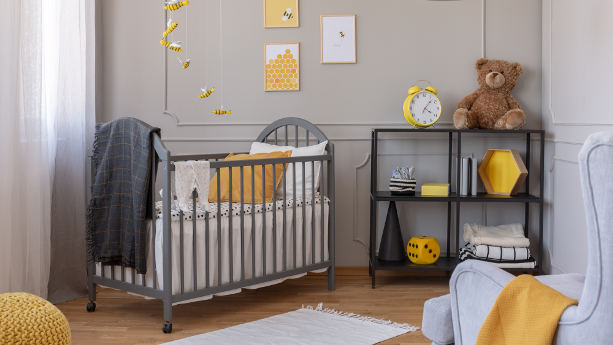
Durable infant and toddler product requirements
Children’s products are covered by the CPSIA, which sets requirements for all children’s products in the United States. What makes durable infant and toddler products different is that such products are subject to additional CPSIA requirements.
1. Children’s Product Safety Rules
Durable infant and toddler products must comply with all applicable children’s product safety rules. Some are specific to particular product types, while other rules apply to certain substances or risks.
Here are a few examples specific to durable infant and toddler products:
- PART 1221 – SAFETY STANDARD FOR PLAY YARDS
- PART 1222 – SAFETY STANDARD FOR BEDSIDE SLEEPERS
- PART 1230 – SAFETY STANDARD FOR FRAME CHILD CARRIERS
Note that many of these children’s product safety rules incorporate other product standards by reference. For example, PART 1221 mandates compliance with ASTM F406-24 – Standard Consumer Safety Specification for Non-Full-Size Baby Cribs/Play Yards.
As such, you must access ASTM F406-24 to find the actual technical requirements that must be met to comply with PART 1221.
It is essential that you read the entire standard text and implement the requirements into your product design.
2. Product testing
Third-party testing with a CPSC-accepted lab is mandatory for children’s products, including those defined as durable infant and toddler products.
You will receive a test report that can be used to issue a Children’s Product Certificate (CPC) once the testing process is complete.
3. Children’s Product Certificate (CPC)
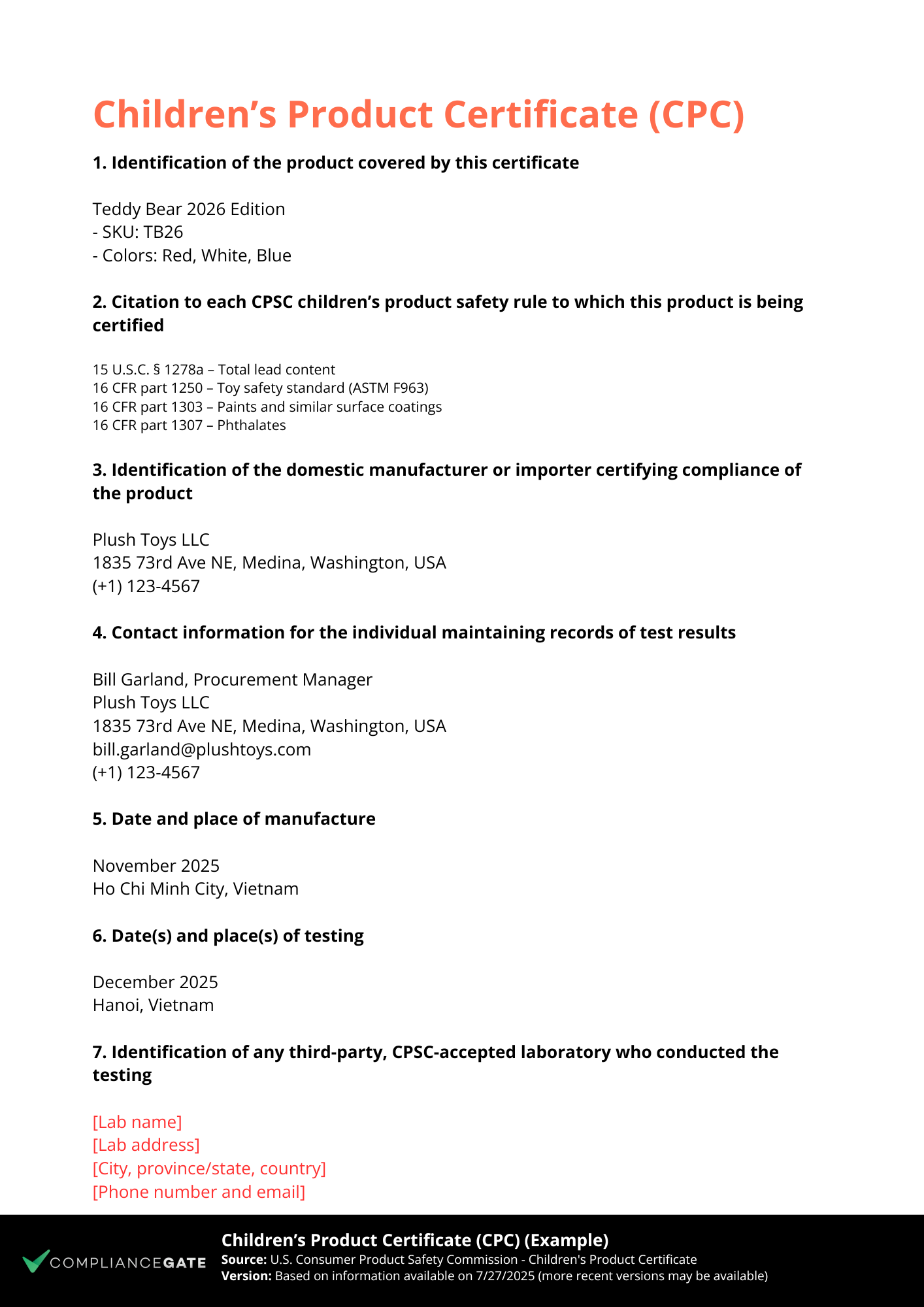
You must issue a Children’s Product Certificate (CPC) for each children’s product you import or manufacture for sale in the United States. The sample above is based on a CPSC template available in 2025.
4. Labeling Requirements
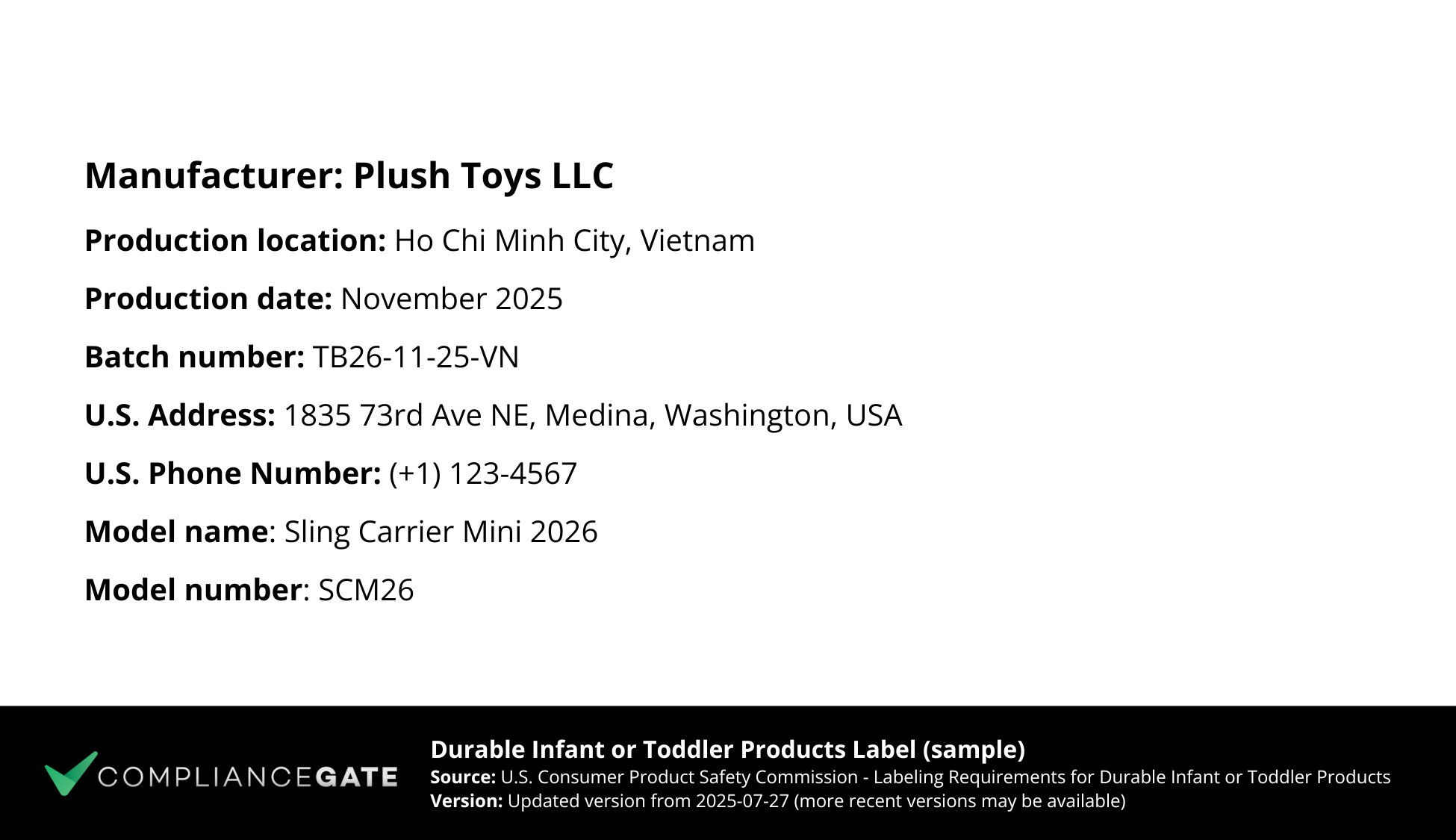
Durable infant and toddler products are subject to additional labeling requirements that go beyond the “standard” CPSIA tracking labeling requirements.
The following must be included:
- Manufacturer or private labeler name*
- Manufacturing location*
- Manufacturing date*
- Batch or run number
- Manufacturer contact information (U.S. address and telephone number, toll-free if available)
- Model name
- Model number/SKU
*Must be permanently affixed to the packaging. All other items (including these three) must be permanently affixed to the product.
5. Registration Cards
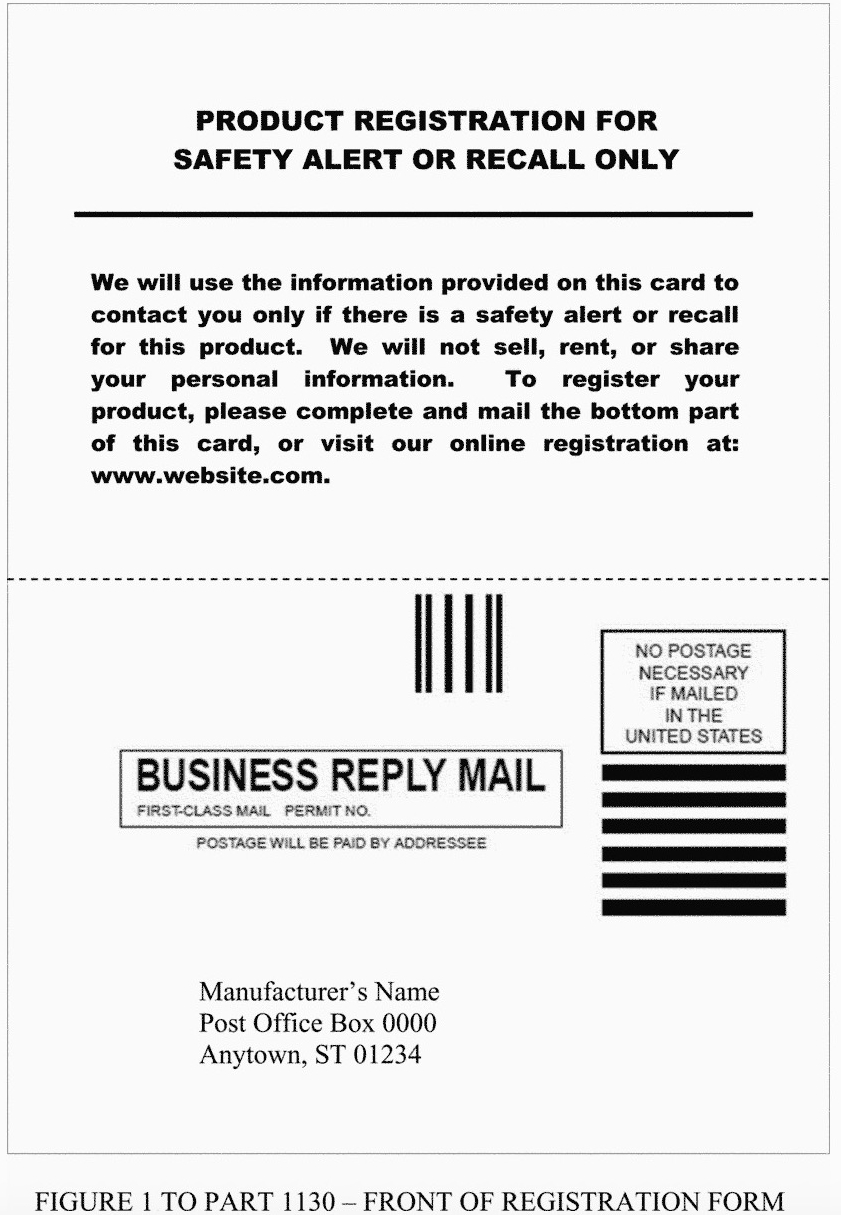
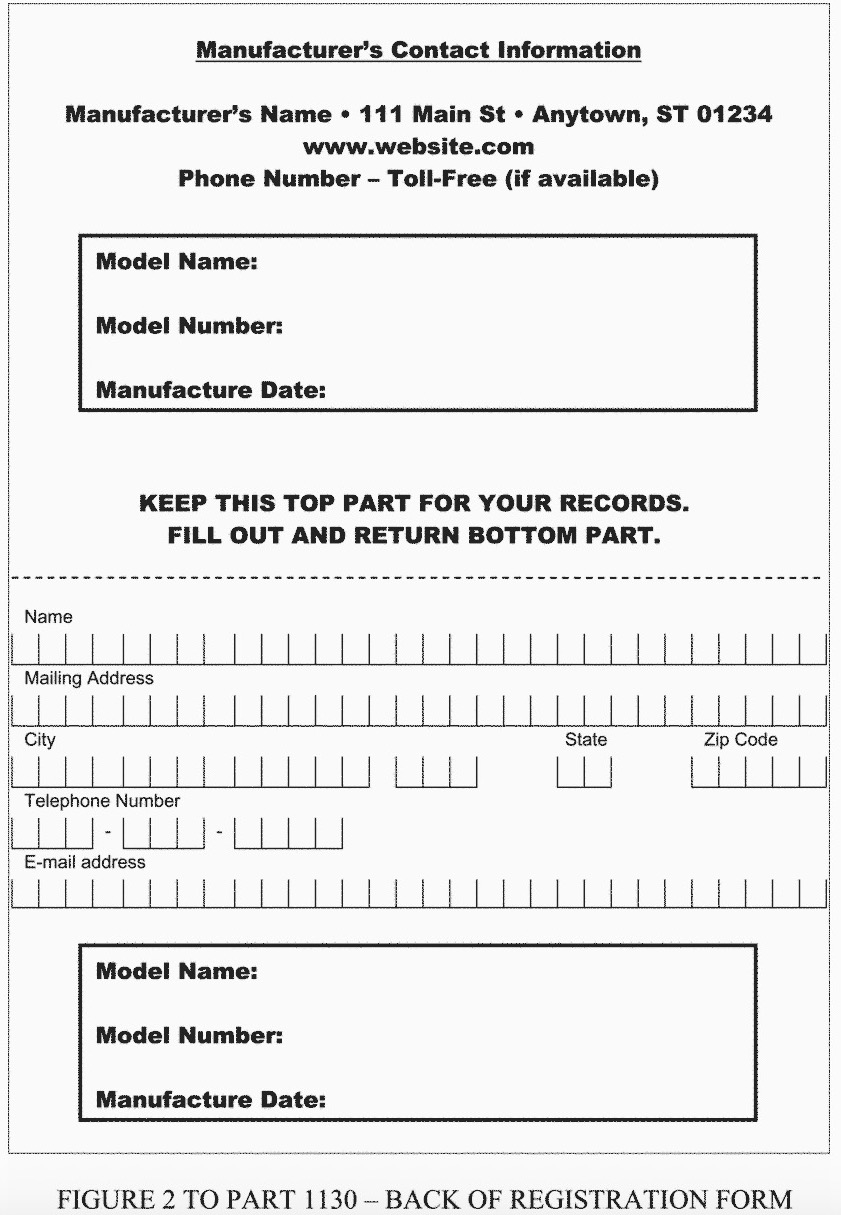
The images above show the front and back of the registration card sample in 16 CFR Part 1130
Unlike other children’s products, durable infant and toddler products must come with a registration card.
The consumer can then choose to fill out the card and return it to your address. Notice that the card must be postage-paid to a US address. Postage-paid means that the sender has already prepaid the return cost.
Online registration
Note that you must also allow customers to register via:
- Your website
That said, online registration is not a replacement for a printed registration card. Specific information can be found under 16 CFR Part 1130.7.
Card size and format
You can find specific information about the size and format in 16 CFR Part 1130.6.
FAQ
How do I know if a product is a durable infant or toddler product?
You need to see if your product is listed under definitions in 16 CFR Part 1130. If that is the case, then your product is likely deemed to be a durable infant or toddler product and therefore subject to additional requirements.
Is testing required for durable infant or toddler products?
Yes, third-party testing is required for children’s products sold in the United States, including durable infant or toddler products.
Note that you must only book testing via a CPSC-accepted lab
How do I get postage-paid cards?
USPS and other companies offer postage prepaid envelopes. You can find one example here.
Can I get the registration card printed by the manufacturer?
Yes, most manufacturers have local subcontractors for print materials. For example, the registration cards can be printed in China and Vietnam. The challenge here, I imagine, is that the postage prepaid envelopes must be sent to the supplier.
The alternative is to print the registration cards in the United States and then place the cards in the postage-prepaid envelopes.
Do these requirements also apply to Amazon sellers?
Yes, the same requirements apply to Amazon sellers. Note that Amazon is generally strict when it comes to enforcing compliance with requirements for children’s products in the United States.




We are interested in the CPSIA, about the registration card part. We have our own manufacturer and company in China. Meanwhile, we have a return address in the US. Now, there are 3 products which are ready to show up. Baby carrier, bassinet and high chair. There are 3 things that we want to know.
(1) What kind of CPSIA registration card information do you need?
(2) Can the three products share one CPSIA?
(3) All registrations of our products are completed in China. Will this have an influence on my certification of CPSIA? If it will, how can I solve it?