






 Find US, EU, UK, CA, & AU requirements













Certain electronic devices can only be sold in the European Union if they are USB-Type C compatible. Further, compliance with EN IEC 62680-1-3:2022 and EN IEC 62680-1-2:2022 is required.
This guide provides a summary of the USB Type-C requirements outlined in Annex Ia of the Radio Equipment Directive 2014/53/EU.
Content Overview

FREE CONSULTATION CALL (30 MIN)
 Ask questions about compliance requirements
- Countries/markets:
.png)
.png)
.png)


- Learn how we can help your business
You will speak with:Ivan Malloci
Which products require USB Type-C?
The following products must be USB Type-C compatible:
- Mobile phones
- Tablet computers
- Digital cameras
- Headphones
- Headsets
- Handheld video game consoles
- Portable speakers
- E-readers
- Keyboards
- Portable navigation systems
- Earbuds
- Laptops
Note that this requirement applies to devices that are capable of wired charging.
As such, USB Type-C has become standard on most electronic devices sold in the EU and other markets (as a result of brands preferring to avoid having multiple variants of the same models).
Is USB Type-C mandatory for products sold in the EU?
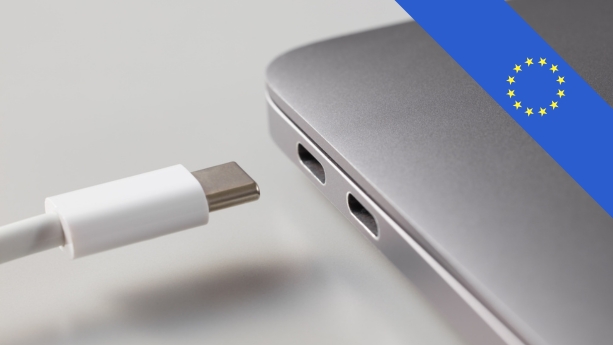
Yes, USB Type-C is mandatory if your product is listed under Annex Ia of the Radio Equipment Directive 2014/53/EU. Covered products that are not USB Type-C compatible are non-compliant with the RED and can therefore not be CE marked.
This makes it illegal to manufacture and import such devices for sale in the European Union.
Note that the following requirements apply to covered products:
a. USB Type-C receptacle required
b. Must comply with requirements set by EN IEC 62680-1-3:2022 and EN IEC 62680-1-2:2022
Note that compliance with EN IEC 62680-1 may require testing to be validated. In other words, it may not be sufficient to merely determine that your device is compliant on the basis that it has USB Type-C ports.
Are any devices exempt from USB Type-C requirements?
Annex Ia of the Radio Equipment Directive 2014/53/EU does not list exempted products. Instead, the annex Ia only lists products for which USB Type-C is mandatory.
Products that are not listed are not subject to the USB Type-C requirement. For example, the Sony PlayStation 5 has USB Type-A ports used to charge controllers and plug in accessories. Note that Annex Ia specifically lists handheld game consoles, not all game consoles.
That being said, the following products are listed as exempt under the Radio Equipment Directive 2014/53/EU as a whole:
Devices listed in Annex I
- Radio equipment used by radio amateurs
- Radio kits for assembly and use by radio amateurs
- Radio equipment modified by and for the use of radio amateurs
- Equipment constructed by individual radio amateurs for experimental and scientific purposes related to amateur radio
- Marine equipment falling within the scope of Council Directive 96/98/EC
- Aircraft, other than unmanned aircraft, as well as associated engines, propellers, parts and non-installed equipment
- Unmanned aircraft, as well as associated engines, propellers, parts and non-installed equipment (if certified)
Other exempt devices
Radio equipment exclusively used for activities concerning
- Public security
- Defence
- State security
What is EN IEC 62680-1?
EN IEC 62680-1 sets technical requirements for USB-Type C devices. The RED sets the following requirements in relation to EN IEC 62680-1:
USB Ports
Devices must be equipped with a USB port in compliance with EN IEC 62680-1-3:2022.
Charging
It must be possible to charge the device with cables that are compliant with EN IEC 62680-1-3:2022.
Power Delivery
Devices that are capable of charging higher than 5V, 3A, or 15W must incorporate USB power delivery as defined in EN IEC 62680-1-2:2022.
Is USB Type-C testing required?
As mentioned, having physical USB Type-C ports is not sufficient. The device must comply with EN IEC 62680-1-3 and EN IEC 62680-1-2 before it can be sold in the EU.
Verifying compliance with EN IEC 62680-1 often requires testing.
Which EU directives mandate USB Type C compatibility?
USB Type-C is mandated under the Radio Equipment Directive 2014/53/EU, which applies to products defined as radio equipment. The following definition can be found in the directive:
‘Radio equipment’ means an electrical or electronic product, which intentionally emits and/or receives radio waves for the purpose of radio communication and/or radiodetermination, or an electrical or electronic product which must be completed with an accessory, such as antenna, so as to intentionally emit and/or receive radio waves for the purpose of radio communication and/or radiodetermination;
Examples of covered products include Bluetooth speakers, smartphones and other devices with the following wireless communications:
- WiFi
- Bluetooth
- 5G
- LTE
- GPS
What can happen if we do not use USB Type-C?
USB Type-C is required for covered devices in order to comply with the Radio Equipment Directive. Failing to comply with the RED means that your product cannot be CE marked and therefore cannot be sold in the European Union.
In practice, this means that non-compliant devices can be subject to recalls or removals.
Amazon and other marketplaces can also remove your products.