





 Find US, EU, UK, CA, & AU requirements












Harmonised standards in the European Union refer to standards referenced under certain directives and regulations, such as the Toy Safety Directive or the Personal Protective Equipment Regulation.
Whereas the directives and regulations provide more general compliance requirements on safety, labelling, and documentation, harmonised standards serve as practical ‘blueprints’ that can be followed to implement said compliance requirements for specific products or aspects.
In this guide, we explain how to identify relevant harmonised standards and how the implementation can work. We also list some examples of such standards for toys, electronics, PPE, and many other product categories.
Content Overview

FREE CONSULTATION CALL (30 MIN)
 Ask questions about compliance requirements
- Countries/markets:
.png)
.png)
.png)


- Learn how we can help your business
You will speak with:Ivan Malloci
What are harmonised standards?
Harmonised standards are standards recognised as demonstrating compliance with the requirements set by certain regulations and directives.
Let’s take the Toy Safety Directive as an example. This Directive requires that all toys meet essential safety requirements. However, the Toy Safety Directive does not contain detailed specifications defining how a safe toy must be designed or what chemicals it cannot contain.
To find this information, you need to look at EN 71-1 and EN 71-3, which are harmonised standards under the Toy Safety Directive.
In other words, EN 71-1 and EN 71-3 can help manufacturers comply with the overall objectives of the Toy Safety Directive. EU regulations and directives often refer to this principle as “presumption of conformity”: A product compliant with applicable harmonised standards is “presumed to comply” with the relevant EU regulation or directive.
How do we use harmonised standards?
Harmonised standards provide pathways to compliance with regulatory requirements. In practice, harmonised standards are often used in the following ways:
1. Implement elements from the harmonised standard into your product specification and other files
2. Arrange lab testing to verify compliance with the harmonised standard
3. The harmonised standards applied must be specified in your Declaration of Conformity and technical documentation
Further, EU market surveillance authorities may also contact you to request test reports and other evidence to check if your product is compliant with the applicable harmonised standards.
How to find harmonised standards
This section explains how you can find harmonised standards for your products.
Step 1: Go to the European Commission website
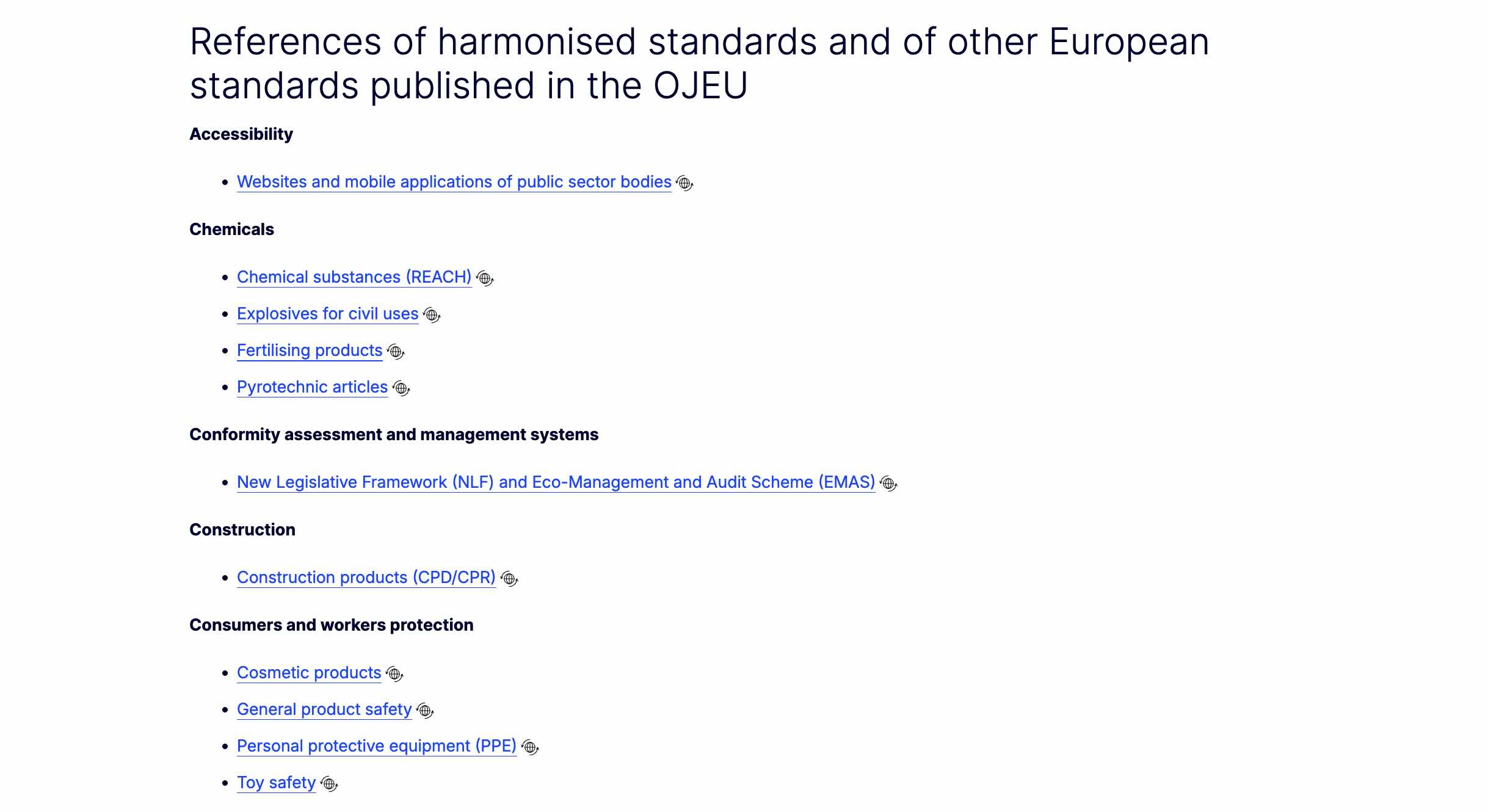
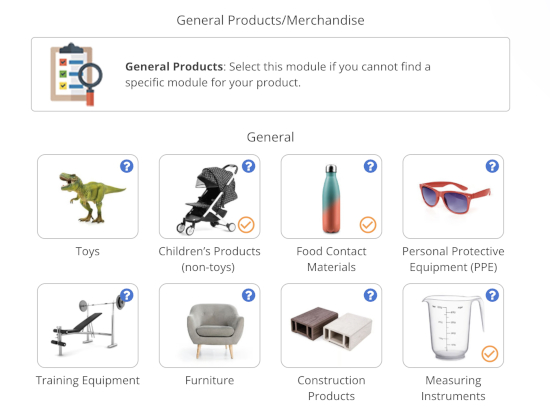
You can find lists of harmonised standards grouped under certain categories on the European Commission website. Note that a product can belong to more than one category.
For example, an electronic toy is likely subject to harmonised standards for both toys and electronics.
Step 2: Product page
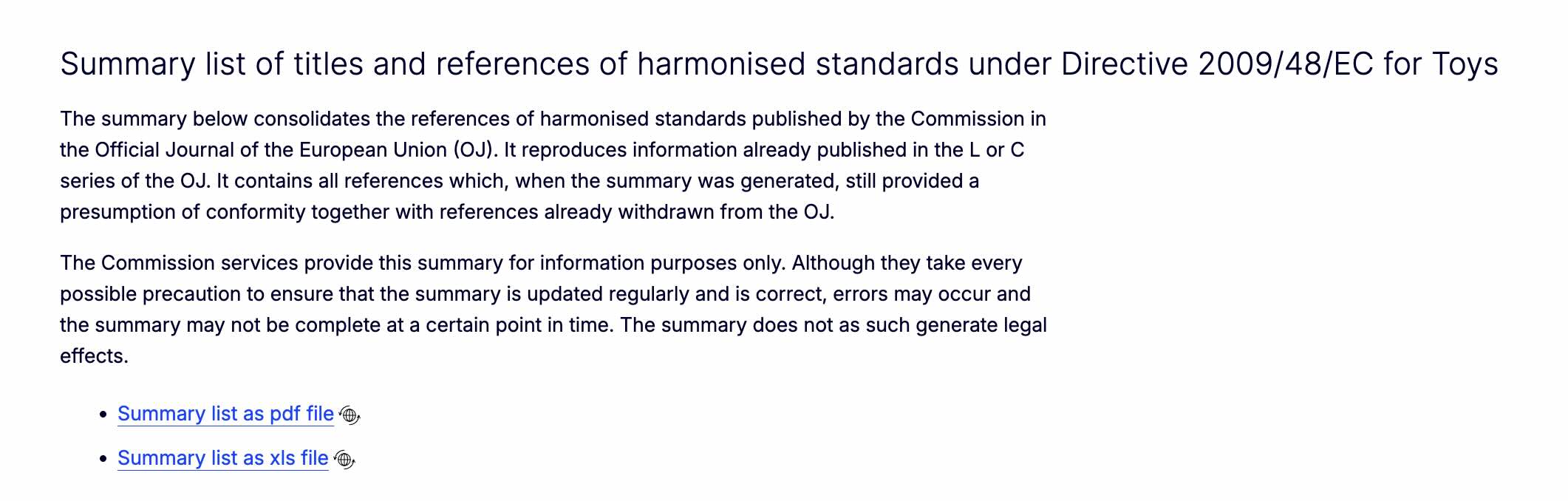
Select one of the listed categories and scroll down to the bottom of the page to find downloadable lists of harmonised standards.
Step 3: Download PDF
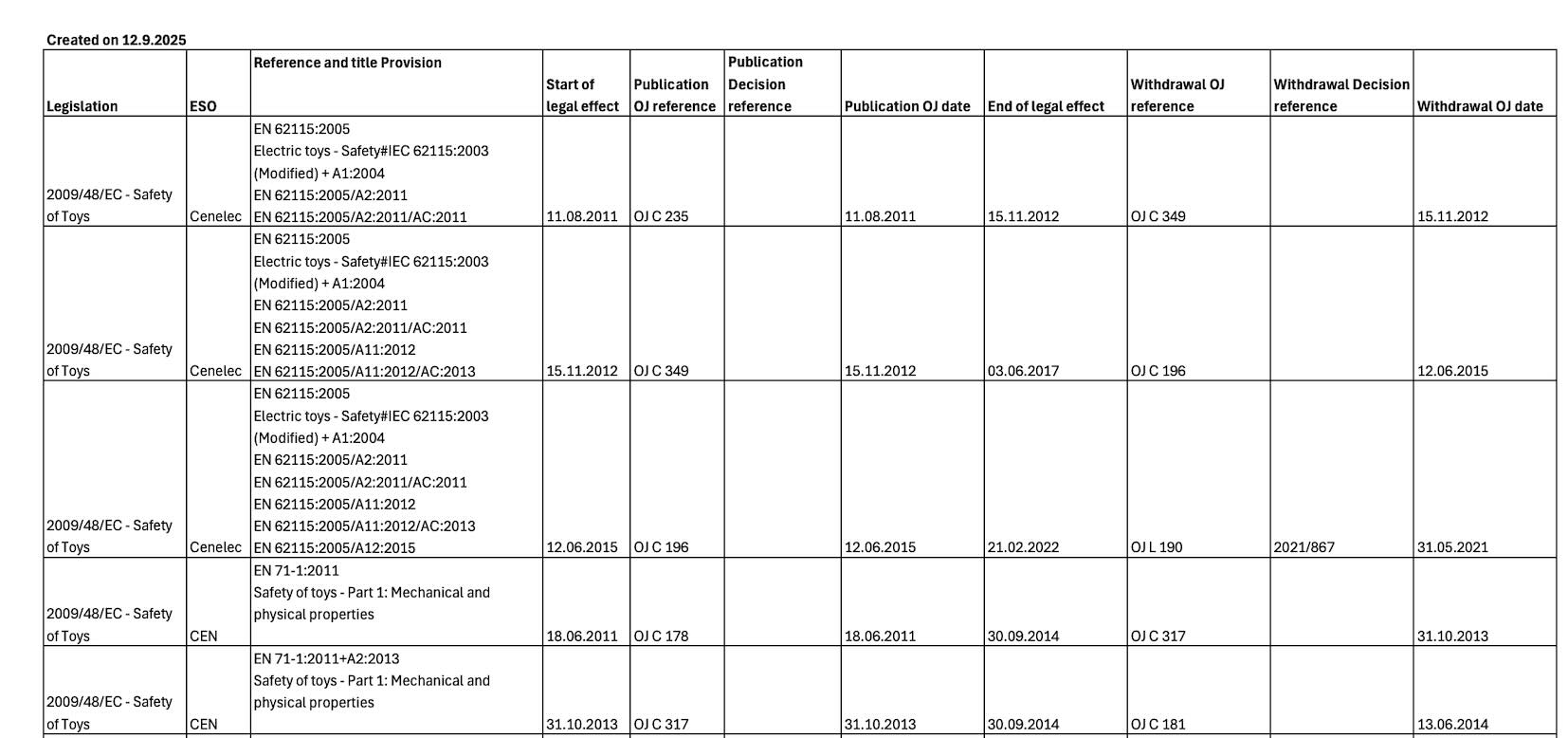
The list contains the titles of versions of harmonised standards that belong to a certain category.
Step 4: Buy harmonised standards
You cannot access the contents of the harmonised standards via the European Commission website. To do so, you must purchase the relevant harmonised standards via CENELEC or national vendors.
FAQ
What does presumption of conformity mean?
Products that comply with harmonised standards are generally “presumed” to comply with the requirements set by the applicable regulation or directive.
For example, the General Product Safety Regulation mandates that all products are safe. However, it does not provide product-specific requirements explaining how I can design, say, a baby carrier in a way that it is deemed safe in the EU.
To achieve that, I must comply with one of the following standards:
EN 13209-1 – Child use and care articles – Baby carriers – Safety requirements and test methods – Framed back carriers
EN 13209-2 – Child use and care articles – Baby carriers – Safety requirements and test methods – Soft carrier
EN 13209-1 and 2 are harmonised standards under the GPSR. As such, a baby carrier compliant with EN 13209-1 and 2 is therefore presumed to be compliant.
Are EU harmonised standards recognised in the UK?
The United Kingdom remains involved in CEN and CELENEC, the organisations developing European standards. That said, harmonised standards are recognised as such through legislation. It is therefore up to the United Kingdom to determine which standards it accepts.
This is sometimes the case, but you should not assume that a harmonised standard in the EU has the same status in the UK, or vice versa.
Which EU regulations and directives have harmonised standards?
Here are some examples of EU regulations and directives for which harmonised standards exist:
- General Product Safety Regulation
- Toy Safety Directive
- Toy Safety Regulation
- RoHS Directive
- Low Voltage Directive (LVD)
- Electromagnetic Compatibility (EMC) Directive
- Radio Equipment Directive (RED)
- Personal Protective Equipment (PPE) Regulation
- Medical Devices Regulation
- Machinery Regulation
- Construction Products Regulation
How do we know which harmonised standard applies to a product?
Here are the methods we use to identify harmonised standards in the EU:
1. Search the European Commission website and check the lists under all categories that your product belongs to.
2. Search the CENELEC website
3. Ask a qualified testing company to assess applicable harmonised standards for you
The latter is often done as part of the testing process. However, it is essential that you provide detailed product information to the testing company to help them make an informed decision.
Are harmonised standards mandatory?
Harmonised standards are not always mandatory in the sense that they must be followed no matter what. However, not following harmonised standards can trigger additional requirements.
For example, the Toy Safety Directive provides two options:
1. Ensure that your product complies with harmonised standards
2. Develop your own standards and have your product certified by a Notified Body
The second option is far more costly and time-consuming than the former. As such, not following a harmonised standard is likely to make the process more complicated.
In practice, harmonised standards often provide the most cost-effective and fast way to make a product compliant.
Are harmonised standards voluntary?
Yes, harmonised standards can be voluntary. That said, not following a harmonised standard often results in stricter requirements and can even force you to develop your own standards.
Do harmonised standards require lab testing?
You will need to demonstrate why your product is compliant with a certain harmonised standard. That in turn often requires that your product undergo lab testing.
This is the case even if this is not explicitly stated in many EU regulations and directives.
In practice, lab testing is often a requirement to demonstrate that your product complies with applicable harmonised standards.
What can happen if we don’t comply with harmonised standards?
If your product does not comply with harmonised standards, you will likely need to identify other standards that can be used to ensure product safety.
What is the difference between harmonised standards and EN standards?
Harmonised standards are, in most cases, EN standards that have been published in the Official Journal of the European Union. These standards are recognised in the sense that they are deemed to provide a pathway to compliance for a certain regulation or directive.
That said, there are many EN standards that are not harmonised. These can still be useful in case you cannot find an applicable harmonised standard for your product.
How often are harmonised standards updated?
Harmonised standards are often updated every few years. I suggest that you download the lists of harmonised standards periodically from the European Commission website.
You can also subscribe to updates on the Official Journal of the European Union.
Are new harmonised standards being developed?
Yes, entirely new harmonised standards can be developed and published. There are two scenarios to be aware of here:
1. New standards are developed and subsequently harmonised
2. Existing standards are (after a certain period of time) harmonised
Can harmonised standards be accessed for free?
The Court of Justice of the European Union (CJEU) ruled in 2024 that harmonised standards should be available free of charge. As of 2025, hEN standards are available for free in Slovenia.
I have yet to see this be the case in all EU member states.
It would make sense as compliance with EU regulations depends on compliance with harmonised standards in many cases.
Can more than one harmonised standard apply to the same product?
Yes, one product can be subject to more than one harmonised standard belonging to the same or different categories. For instance, toys are often subject to EN 71-1, EN 71-2 and EN 71-3.
This is due to the fact that the three EN 71 parts cover different areas of product compliance.
What if there are no harmonised standards for our product?
Importers and manufacturers are responsible for choosing another technical solution to demonstrate compliance if there are no suitable harmonised standards for the products.
For example, baby strollers are not covered by any harmonised standard under the GPSR. But there is a non-harmonised standard that can be applied to baby strollers.
You can take advantage of the following standards:
- Non-harmonised EN standards
- IEC standards
- ISO standards
- National standards
These standards might not fit all the technical requirements that concern a given directive or regulation, but they still serve as a good starting point to achieve compliance.
As mentioned, not following a harmonised standard may also mandate the involvement of a notified body. In some situations, you may also need to develop your own standard.
Where can I buy harmonised standards?
You can buy European harmonised standards via CENELEC or national vendors. This guide provides a list of such vendors in the European Union.
Examples of harmonised standards
General consumer products
EN 13209-1 – Child use and care articles – Baby carriers – Safety requirements and test methods – Part 1: Framed back Carriers
EN 957-1 – Stationary training equipment – Part 1: General safety requirements and test methods
EN ISO 4210-1 – Cycles – Safety requirements for bicycles – Part 1: Terms and definitions
EN 1272 – Child care articles – Table mounted chairs – Safety requirements and test methods
Electronics
EN 55015 – Limits and methods of measurement of radio disturbance characteristics of electrical lighting and similar equipment
EN 55022 – Information technology equipment – Radio disturbance characteristics – Limits and methods of measurement
EN 55103-2 – Electromagnetic compatibility – Product family standard for audio, video, audio-visual and entertainment lighting control apparatus
EN 50106 – Safety of household and similar electrical appliances – Particular rules for routine tests referring to appliances under the scope of EN 60335-1
EN 60065 – Audio, video and similar electronic apparatus – Safety requirements
EN 60155 – Glow-starters for fluorescent lamps
EN 300 422-1 V2.1.2 – Wireless Microphones; Audio PMSE up to 3 GHz; Part 1: Class A Receivers; Harmonised Standard covering the essential requirements of Article 3(2) of Directive 2014/53/EU
EN 301 893 V2.2.1 – 5 GHz WAS/RLAN; Harmonised Standard for access to radio spectrum
EN 302 567 V2.2.1 – Multiple-Gigabit/s radio equipment operating in the 60 GHz band; Harmonised Standard for access to radio spectrum
Toys
EN 71-1 – Safety of toys – Part 1: Mechanical and physical properties
EN 71-2 – Safety of toys – Part 2: Flammability
EN 71-3 – Safety of toys – Part 3: Migration of certain elements
EN 71-4 – Safety of toys – Part 4: Experimental sets for chemistry and related activities
EN 71-5 – Safety of toys – Part 5: Chemical toys (sets) other than experimental sets
EN 71-7 – Safety of toys – Part 7: Finger paints – Requirements and test methods
EN 71-8 – Safety of toys – Part 8: Activity toys for domestic use
EN 71-12 – Safety of toys – Part 12: N-Nitrosamines and Nnitrosatable substances
EN 71-13 – Safety of toys – Part 13: Olfactory board games, cosmetic kits and gustative games
EN 71-14 – Safety of toys – Part 14: Trampolines for domestic use
Machinery
EN 15194 – Cycles – Electrically power assisted cycles – EPAC Bicycles
EN 15503 – Garden equipment – Garden blowers, vacuums and blower/vacuums – Safety
EN 1870-6 – Safety of woodworking machines – Circular sawing machines – Part 6: Circular sawing machines for fire wood
EN 1012-1 – Compressors and vacuum pumps – Safety requirements – Part 1: Air compressors
PPE
EN ISO 12312-1 – Eye and face protection – Sunglasses and related eyewear – Part 1: Sunglasses for general use
EN 13634 – Protective footwear for motorcycle riders – Requirements and test Methods
EN 13594 – Protective gloves for motorcycle riders – Requirements and test methods
EN 342 – Protective clothing – Ensembles and garments for protection against cold
Medical Devices
EN 455-1 – Medical gloves for single use – Part 1: Requirements and testing for freedom of holes
EN 13795-1 – Surgical clothing and drapes – Requirements and test methods – Part 1: Surgical drapes and gowns
EN 14683 – Medical face masks – Requirements and test methods
EN ISO 15223-1 – Medical devices – Symbols to be used with information to be supplied by the manufacturer – Part 1: General requirements