




 Find US, EU, UK, CA, & AU requirements











Children’s clothing imported or manufactured for sale in the EU is subject to strict safety, chemical, labelling, and documentation requirements. In this guide, I explain how the GPSR, EN standards, REACH and other compliance requirements relate to children’s clothing.
- Children’s clothing must be safe by design
- Chemical restrictions apply to fabrics, zippers, and other materials
- Labelling requirements apply to children’s clothing
Product examples
- Baby rompers
- Bodysuits
- Sleepsuits
- Swaddles and wearable blankets
- Children’s swimwear
- Children’s t-shirts
- Children’s hats and caps
- Children’s pants
- Children’s outerwear
Note: The video was recorded a few years ago. The written article has since been updated and is more relevant to current requirements.
Content Overview

FREE CONSULTATION CALL (30 MIN)
 Ask questions about compliance requirements
- Countries/markets:
.png)
.png)
.png)

- Learn how we can help your business
You will speak with:Ivan Malloci
General Product Safety Regulation (GPSR)
The General Product Safety Regulation (GPSR) requires that all consumer products, including children’s garments, sold in the European Union are safe. Compliance with the GPSR is often achieved by:
- Ensuring that your children’s clothing items are safe by design
- Design to comply with applicable EN standards
- Provide sufficient instructions and safety information
- Affix product, manufacturer and importer labelling
- Create technical documentation
- Arrange testing
Note that additional requirements under the PPE Regulation apply to protective children’s clothing, such as safety vests.
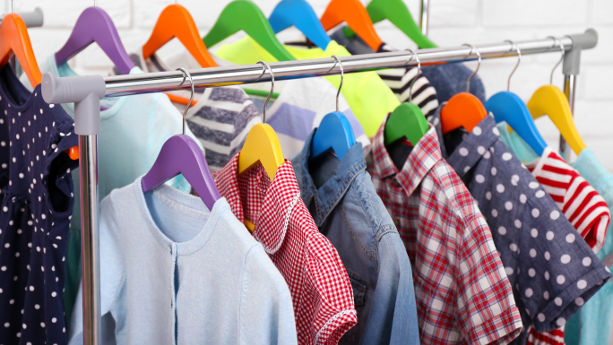
Children’s clothing safety aspects
The GPSR does not provide guidance on how to ensure that children’s clothing is safe. Instead, it is up to the company, defined as the manufacturer, to identify relevant standards applicable to children’s clothing. You must also apply common sense when designing garments and ensure that your product is as safe as it can be.
Here are some key risks to be aware of when it comes to children’s clothing:
- Small parts / choking hazards
- Strangulation hazards
- Cords and drawstrings
- Suffocation risks
- General design safety
- Flammability
- Restricted chemicals
Children’s clothing should never contain sharp points, small parts posing choking risks (including those that can fall off) or pose a flammability hazard. Particular caution should also be taken if you intend to use magnets or other parts that could cause serious injury.
EN standards
We could only find one harmonised standard under the GPSR that specifically covers children’s clothing. That said, there are other EN standards that can be relevant as well.
| EN standard | Title | Harmonised |
| EN 14682 | Safety of children’s clothing – Cords and drawstrings on children’s clothing – Specifications | Yes |
| EN 14878 | Textiles – Burning behaviour of children’s nightwear – Specification | No |
| CEN/TS 17394-1 | Textiles and textile products – Part 1: Safety of children’s clothing – Security of attachment of attached components to infants’ clothing – Specification | No |
| EN 17394-2 | Textiles and textile products – Part 2: Safety of children’s clothing – Security of attachment of buttons – Test method | No |
| CEN/TS 17394-3 | Textiles and textile products – Part 3: Safety of children’s clothing – Security of attachment of metal mechanically applied press fasteners – Test method | No |
| CEN/TS 17394-4 | Textiles and textile products – Part 4: Safety of children’s clothing – Security of attachment of components except buttons and metal mechanically applied press fasteners – Test method | No |
| CEN/TR 16792 | Safety of children’s clothing – Recommendations for the design and manufacture of children’s clothing – Mechanical safety | No |
Note that you must always ensure that your product is safe, regardless of whether a particular safety aspect or risk is addressed in an EN standard.
Testing
Third-party lab testing is generally required in order to verify compliance with EN 14682 and other applicable standards. You must submit samples of the children’s garments that are based on the exact same components, materials, and dimensions as the mass producer product.
Here are some companies offering testing solutions for children’s clothing sold in the EU:
- QIMA
- TUV Rheinland
- Intertek
- SGS
Technical documentation

The company, defined as the manufacturer, must create technical documentation. This document should generally contain the following information:
- Product information
- Packaging information
- Images
- Risks
- Solutions to mitigate each risk
- Test reports
Note that one technical documentation set must be created per item.
Labelling requirements
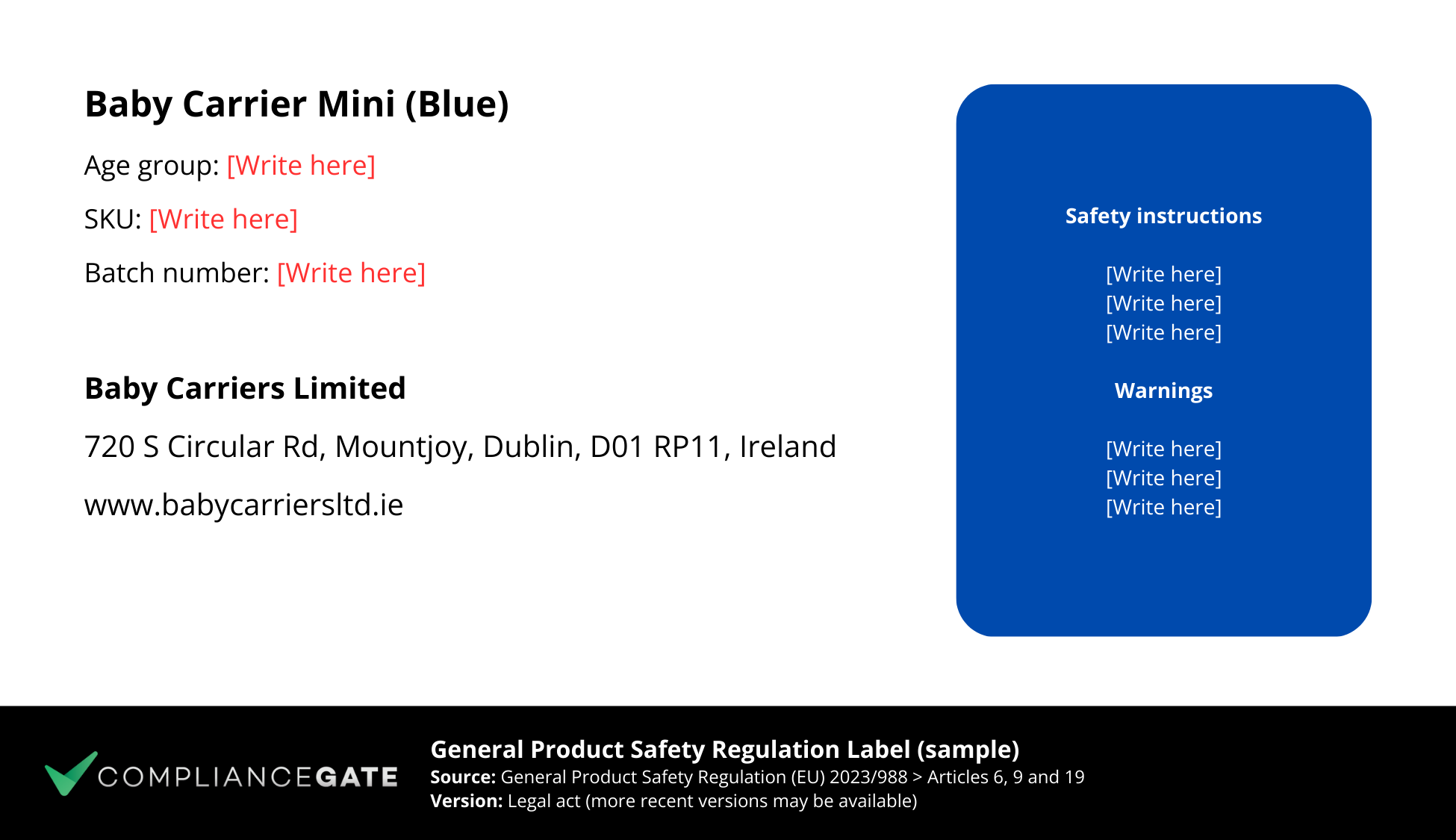
The GPSR mandates that the manufacturer affix the following information:
- Product type
- Batch number or serial number
- Manufacturer name and address
- Safety information and user instructions
- Importer name and address (if any)
- EU AR name and address (if any)
Batch numbers are particularly important to ensure that non-compliant children’s clothing can be traced to a specific production run. Further, specifying the following information is also necessary in many cases:
- Age group
- Size
- Height and weight guidelines
- Care instructions
Textiles labelling
The EU Textiles Labelling Regulation mandates that the textile fibre composition is affixed on textile products, including children’s clothing. Here are a few examples:
- 100% cotton
- 100% polyester
- 98% polyester 2% spandex
However, the regulation does not mandate size or care instructions. Such information is often required for children’s clothing under the General Product Safety Regulation.
Restricted chemicals
Fabrics, zippers, buttons, and other materials used to manufacture children’s clothing are subject to strict substance restrictions in the European Union. Children’s clothing containing restricted substances above the set limits is illegal in the EU.
Here are some substance risks relevant to children’s clothing:
- Fabric dyes containing lead
- Coatings and print ink containing phthalates
- Zippers containing nickel or lead
- Presence of AZO dyes
- Presence of formaldehyde
It is essential to arrange chemical testing or obtain existing test reports (such as OEKO Tex Standard 100) for fabrics and other components. I also recommend that you use brand-name components, such as YKK zippers, whenever possible.
REACH Regulation
REACH restricts chemicals and heavy metals in articles, which include children’s clothing. Examples of restricted substances under Annex XVII include:
- DEHP
- Lead
- Cadmium
- Mercury
- Formaldehyde
- AZO
You can work with a lab to determine which specific REACH substance tests could be necessary for your product.
POPs Regulation
The POPs Regulation sets restrictions for persistent organic pollutants. Here are some examples of such substances:
- Tetrabromodiphenyl
- Pentachlorobenzene
- Polychlorinated Biphenyls (PCB)
Such substances can, in some cases, be found in cotton and other fabrics, resulting from the use of pesticides.
Biocidal Products Regulation
The Biocidal Products Regulation restricts the use of biocides in products, including children’s clothing. Only approved biocides can be used, and companies cannot make unsubstantiated claims about “antibacterial” fabrics or other properties relating to biocides.
FAQ
Is it safe to import children’s clothing from outside the EU?
Not every single piece of clothing for children manufactured on this planet is designed to comply with EU safety standards. Further, not all materials are manufactured to comply with EU substance restrictions.
In fact, most children’s garments are not designed to comply with EU regulations, which are generally among the strictest in the world.
This does not mean that every single baby romper or other children’s garments made outside the EU are toxic and hazardous. But it means that you can never assume that items made outside the EU are compliant with EU requirements.
I have worked with several children’s garment factories in China. We never relied on the factory to “make” the products compliant. Instead, we provided them with techpacks containing designs that were inherently compliant by design. In short, we ensured that the garment was compliant with EN 14682 and other safety criteria on the drawing board.
Never once did I expect a factory in China, Vietnam or elsewhere to manage the compliance process for us.
Finally, testing is essential. Both to verify compliance with physical design safety, and chemicals in materials.
How do I know if children’s clothing is safe?
You must either arrange testing or obtain existing test reports to verify that children’s clothing meets EU regulations and standards.
Do children’s clothing require CE marking?
Children’s clothing should generally not be CE marked. However, protective clothing (such as high visibility vests or protective sportswear) can be subject to the PPE Regulation. If that is the case, then CE marking is required.
Is lab testing required for children’s clothing in the EU?
Yes, lab testing is required to verify that the design is safe and that the materials do not contain restricted substances above the set limits.
Which requirements apply to children’s clothing for EU Amazon sellers?
Companies selling children’s clothing on Amazon in France, Germany, Poland and other EU member states must ensure compliance with all mandatory EU regulations and standards.
Note that Amazon is quite strict when it comes to vetting children’s garments sold on its marketplace. In practice, this means that they can request test reports, label files, and other information.