






 Find US, EU, UK, CA, & AU requirements













The Packaging and Packaging Waste Regulation (PPWR) introduces new labelling requirements applicable to packaging (including product packaging) in the European Union. This guide serves as an introduction to several key labelling requirements.
- Packaging will require a harmonised label
- QR codes are required
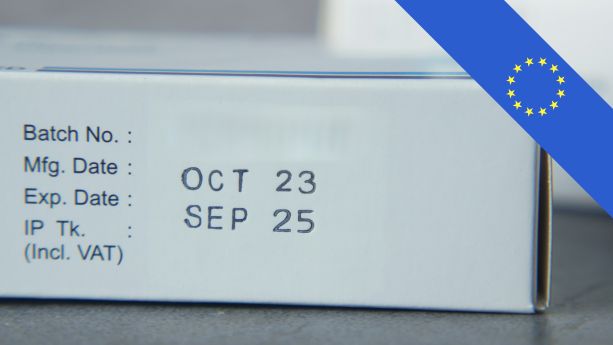
- Type, batch or serial number
- Manufacturer and importer information
Content Overview

FREE CONSULTATION CALL (30 MIN)
 Ask questions about compliance requirements
- Countries/markets:
.png)
.png)
.png)


- Learn how we can help your business
You will speak with:Ivan Malloci
Packaging labelling
Chapter III of the Packaging and Packaging Waste Regulation (PPWR) contains labelling requirements for packaging, waste receptacles and environmental claims.
Note that these are, at the time of writing, quite vague. For example, the chapter frequently references a “harmonised label” that is yet to be realised by a future delegated act.
The table below provides a summary of several labelling requirements mentioned in Article 12.
| Label item | Information |
| Harmonised label | 1. Containing information on its material composition in order to facilitate consumer sorting
2. Based on pictograms, be easily understandable, including for persons with disabilities 3. Label shall indicate that the material is compostable* |
| Substances of concern | Packaging containing substances of concern shall be marked by means of standardised, open, digital-marking technologies (based on Article 12(7)). |
| QR code or other type of standardised, open, digital data carrier | Information on the destination of each separate component of the packaging in order to facilitate consumer sorting. |
| National label | 1. Packaging that is subject to deposit and return systems as referred to in Article 50(1) shall be marked with a clear and unambiguous label.
2. In addition to the national label, packaging may be marked with a harmonised colour label established in the relevant implementing act. 3. Member States may require that packaging that is subject to deposit and return systems be marked with that harmonised colour label. |
| Reusability label / QR code | 1. Reusable packaging shall bear a label informing users that the packaging is reusable
2. Further information on reusability, including the availability of a local, national or Union-wide re-use system and information on collection points, shall be made available through a QR code or other type of standardised, open, digital data carrier that facilitates the tracking of the packaging and the calculation of trips and rotations 3. If that calculation is not feasible, an average estimation. In addition, reusable sales packaging shall be clearly identified and distinguished from single-use packaging at the point of sale. |
| Biobased plastic content | Where packaging is marked with a label containing information on the share of biobased plastic content, that label shall comply with the specifications laid down in the relevant implementing act adopted pursuant to paragraph 6 of this Article. |
| Extended producer responsibility symbol | EPR identification shall be achieved only by means of a corresponding symbol in a QR code or other standardised, open, digital-marking technology in order to indicate that the producer fulfils its extended producer responsibility obligations. |
| Deposit and return system symbol | Packaging covered by a deposit and return system may, under national law, be identified by means of a corresponding symbol throughout the territory in which that scheme or system applies. |
*This obligation does not apply to transport packaging or to packaging that is subject to a deposit and return system
Placement
Article 12(5) states that labels (including QR codes) must (in most cases) be permanently affixed, printed or engraved in a way that it is:
a. Clearly visible on the packaging
b. Cannot be easily removed
QR codes and other data carriers
1. Must be based on specifications set implement acts
2. The container information must also be presented when your customers buy products online
3. You should only use a single QR code or other data carrier if your product is subject to other EU regulations and directives that mandate QR codes or data carriers.
a. For example, QR codes are required for certain batteries and will likely be required for toys and other goods sold in the EU in the future (under the Digital Product Passport).
b. It is possible that this refers to the need to ensure that only one QR code is present that then links to information required by the PPWR and regulations applicable to the contained product.
Labelling requirements
Label information and the information made available via QR codes must be provided in the European languages of the EU member states where you are selling the product. For example, if you sell or distribute in Denmark, then you must provide labels and digital information in Danish.
Misleading labels, marks, symbols, or inscriptions
Article 12(8) states that companies must not use labels, marks, symbols, or inscriptions that may mislead consumers and other end-users regarding the sustainability of the packaging.
It is likely that this refers to unofficial markings (i.e., the Mobius Loop) or third-party markings, which could be in conflict with the labelling requirements under the PPWR.
Waste receptacles labelling
Article 13 of the PPWR states that harmonised labels will be required for waste bins and containers. Further details will be provided in future delegated acts.
Environmental claims
Some brands make claims about recyclability and other environmental aspects related to the packaging. Such statements may be made as part of marketing materials or labelling.
The following definition can be found in Directive 2005/29/EC, which is specifically referenced in the PPWR:
‘Environmental claim’ means any message or representation which is not mandatory under Union or national law, in any form, including text, pictorial, graphic or symbolic representation, such as labels, brand names, company names or product names, in the context of a commercial communication, and which states or implies that a product, product category, brand or trader has a positive or zero impact on the environment or is less damaging to the environment than other products, product categories, brands or traders, or has improved its impact over time;
Article 14 of the PPWR states that any such claims must meet the following criteria:
1. The claims must be based on aspects that exceed the “minimum” requirements set by the PPWR and must be supported by the required methodologies and calculation rules set by the same regulation.
2. It must be clear what the claims relate to (i.e., the entire packaging box or specific parts or materials).
The aim is likely to prevent companies from “green washing” by using claims that cannot be supported, or using vague statements about packaging sustainability.
Manufacturer obligations
Article 15 of the PPWR lists the following labelling requirements for companies defined as manufacturers:
| Label information | Placement |
| Type, batch or serial number | a. Packaging or; b. Accompanying document |
| Manufacturer name, registered trade name or registered trademark | a. Packaging, or; b. QR code or another data carrier |
| Manufacturer postal address | a. Packaging, or; b. QR code or another data carrier |
| Manufacturer electronic contact point | a. Packaging, or; b. QR code or another data carrier |
Note: The specific placement requirements can be found in Article 15. Note that affixing label information on an accompanying document is generally only an option if the packaging is not suitable for labelling (due to small size or other reasons).
Importer obligations
EU Importers are responsible for verifying that the manufacturer has complied with the following labelling requirements:
1. The packaging is labelled according to the requirements under Article 12 (see the packaging labelling table above)
2. The product/packaging information and manufacturer information specified in the table above
Article 18 of the PPWR also lists additional labelling requirements specific to importers:
| Label information | Placement |
| Importer name, registered trade name or registered trademark | a. Packaging, or; b. Digital data carrier |
| Importer postal address | a. Packaging, or; b. Digital data carrier |
| Importer electronic contact point | a. Packaging, or; b. Digital data carrier |
FAQ
What is the harmonised label in the PPWR?
What we know so far is that packaging will require a harmonised label that specifies the material composition, which is used to sort packaging waste. This label will take the form of a pictogram.
That said, we are still waiting for the delegated act that will show us what this label must look like.
Is packaging introduced before the PPWR enters into force covered by these labelling requirements?
No, packaging manufactured in the EU or imported to the EU before August 12, 2026, can still be used for 3 years from the date that specific labelling requirements enter into force.
Can we use a QR code instead of printed labels?
The Packaging and Packaging Waste Regulation (PPWR) mandates QR codes and other data carriers. That said, certain label information and symbols must still be printed or engraved permanently on the packaging.
As such, using QR codes as a replacement for printed labels is not allowed under the PPWR.






One aspect that is often underestimated is the amount of packaging data companies will need to manage in order to comply with these labelling requirements.
For businesses selling hundreds or thousands of SKUs across multiple EU countries, keeping track of material composition, recyclability information, reusable packaging data, QR code content and manufacturer details can quickly become a major operational challenge. The labelling requirements themselves are only one part of the equation; maintaining accurate and auditable packaging records over time is equally important.
It will be particularly interesting to see how the upcoming delegated acts define the harmonised label and digital data carrier requirements, as these will likely shape packaging compliance workflows for many years to come.
Yes, but I wonder how they will be able to enforce all of this
Enforcement is not exactly airtight as it is and with all these new PPWR obligations (which has such a wide reach) it will become even more for the authorities to check and act on
We will see