






 Find US, EU, UK, CA, & AU requirements














Trying to understand what you must do to comply with the Packaging and Packaging Waste Regulation (PPWR) 2025/40? This guide serves as a practical step-by-step guide to PPWR compliance for manufacturers and importers.
Methodology
1. Article 62 lists the specific documents, labels, and other areas the authorities review to determine if your packaging is non-compliant with the PPWR.
2. As such, I used Article 62 to create a roadmap of what you must actually do to comply with the PPWR in practical terms.
Note: This guide does not cover every single requirement or aspect of the PPWR. Further, we only focus on requirements impacting manufacturers and importers.
Content Overview

FREE CONSULTATION CALL (30 MIN)
 Ask questions about compliance requirements
- Countries/markets:
.png)
.png)
.png)


- Learn how we can help your business
You will speak with:Ivan Malloci
Part 1: Packaging covered and exempt by the PPWR

The PPWR generally covers packaging and packaging waste of any material. Further, packaging is generally defined as an item used for the following reasons in relation to a product:
- Containingment
- Protectin
- Handling
- Delivery
- Presentation
What is packaging?
As such, the PPWR covers everything from mailing parcels to clothing hangers, on the basis that these are used for the purposes explained above. The case of clothing hangers is interesting, as the PPWR explicitly states that only hangers that accompany clothing are deemed packaging and thus covered by the PPWR (but not those sold as standalone products).
Packaging is (generally) not an Integral part of the product
It should also be noted that the PPWR exempts certain types of items that could be considered packaging but are integral parts of the products. It is possible that board game boxes will be covered by such exemptions, but we will not comment further until we have seen official guidance from the EU on such matters.
You can find more information about the packaging covered and exempted from the PPWR in this guide.
Part 2: Who must comply with the PPWR?
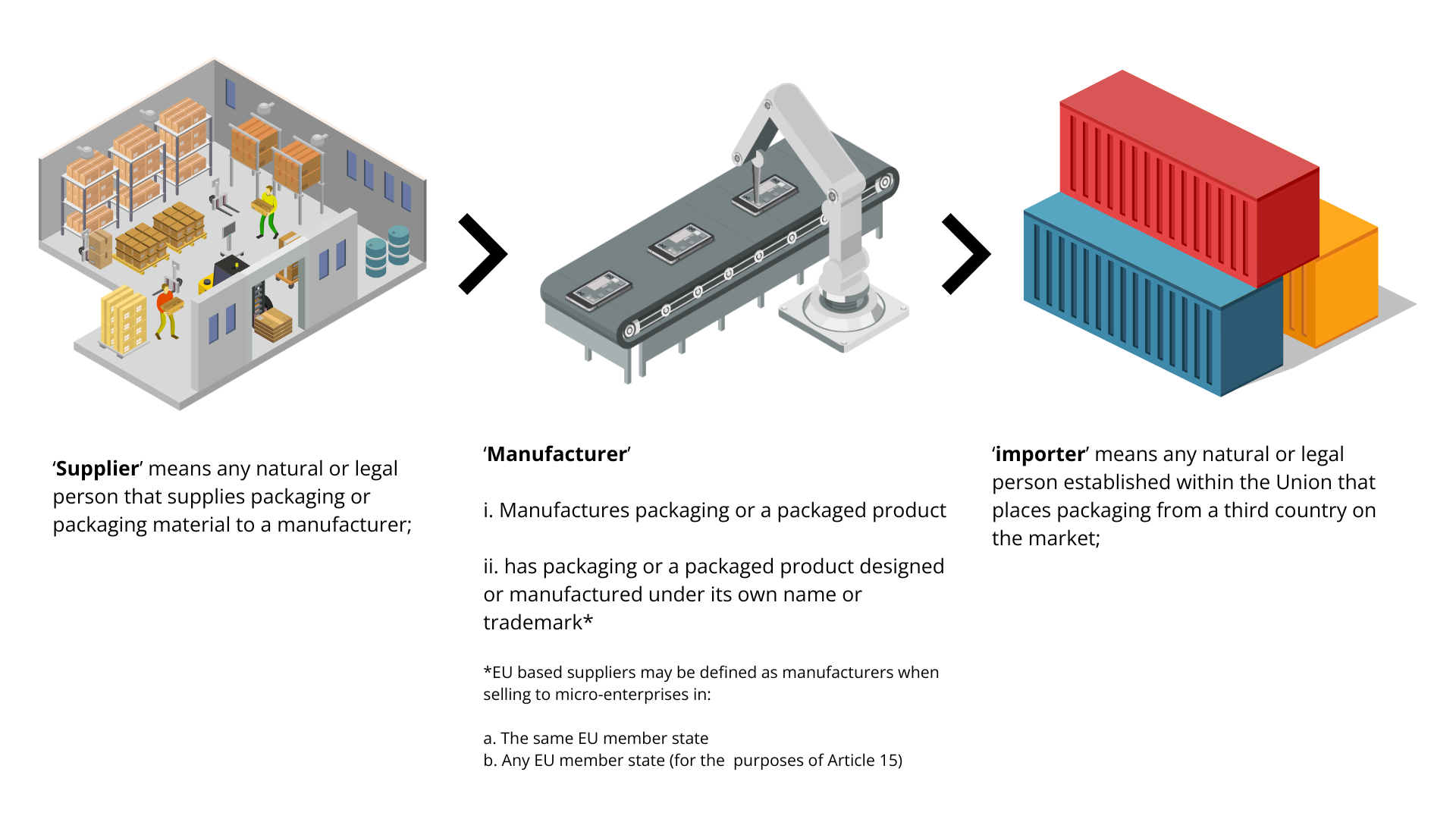
This section breaks down requirements for companies defined as manufacturers, importers, and suppliers. Other economic operators and entities with PPWR obligations are not covered in this guide.
Manufacturers (Primary Responsibility)
Companies defined as manufacturers are generally responsible for ensuring compliance with the PPWR. In practice, this can involve the following:
- Ensure that the packaging is designed based on PPWR requirements
- Ensure that the packaging is correctly labelled
- Ensure that the packaging is correctly documented
- Arrange testing
In short, the manufacturer bears the primary responsibility for complying with the PPWR and must actively manage the process. The specific manufacturer obligations can be found in Article 15.
Note that a manufacturer is not necessarily the packaging factory. The table below provides a breakdown of companies that may be deemed the manufacturer and thereby assume responsibility:
| Who is the manufacturer? | Example |
| A: The company that manufactures packaging or a packaged product | A Spanish jewellery factory produces jewellery packed in boxes in its own facility |
| B: The company that has packaging or a packaged product designed or manufactured under its own name or trademark | A Spanish jewellery brand orders custom-designed necklaces packed in boxes from a factory in China |
| C: The supplier of the packaging, if:
i. The company that has packaging or a packaged product designed or manufactured under its own name or trademark is a micro-enterprise. ii. The packaging supplier is located in the same member state as the company mentioned above (i). |
a. A small-scale jewellery brand in Spain orders jewellery boxes from a packaging factory in Spain.
b. The packaging factory (not the jewellery brand) is the manufacturer in this scenario. Note: Only relevant if the two companies are located in the same EU member state. |
Note: The PPWR also states that the supplier assumes the manufacturer’s obligations listed in Article 15 in case of the following:
a. The company that has packaging or a packaged product designed or manufactured under its own name or trademark is a micro-enterprise.
b. The supplier is located in the EU (but not necessarily the same member state)
Micro-enterprise definition
a. Employs fewer than 10 persons
b. Annual turnover and/or annual balance sheet total does not exceed EUR 2 million
Importers
The PPWR defines importers as entities:
a. Established in the European Union
b. Introduces packaging from a country outside the EU on the EU market
For example, an EU company importing packed products from China are deemed to be an importer. Companies defined as importers are mainly responsible for verifying that the manufacturer has fulfilled their obligations to comply with the PPWR.
This can involve the following:
- Assess if the packaging is designed based on PPWR requirements
- Confirm that the packaging is correctly labelled
- Confirm that the packaging is correctly documented
- Confirm that the packaging is tested
Doing so requires a fairly deep understanding of the PPWR and its requirements. Specific details can be found in Article 18 of the PPWR.
Suppliers
Companies that supply packaging or packaging material to a manufacturer are defined as suppliers. This includes, for example, packaging wholesalers and packaging factories.
The manufacturer must generally obtain information from the supplier as part of the compliance process. Note that the supplier may also, under certain circumstances, be considered the manufacturer.
Part 3: Documentation and labelling
This section lists documentation and labelling requirements mentioned in Article 62 of the PPWR.
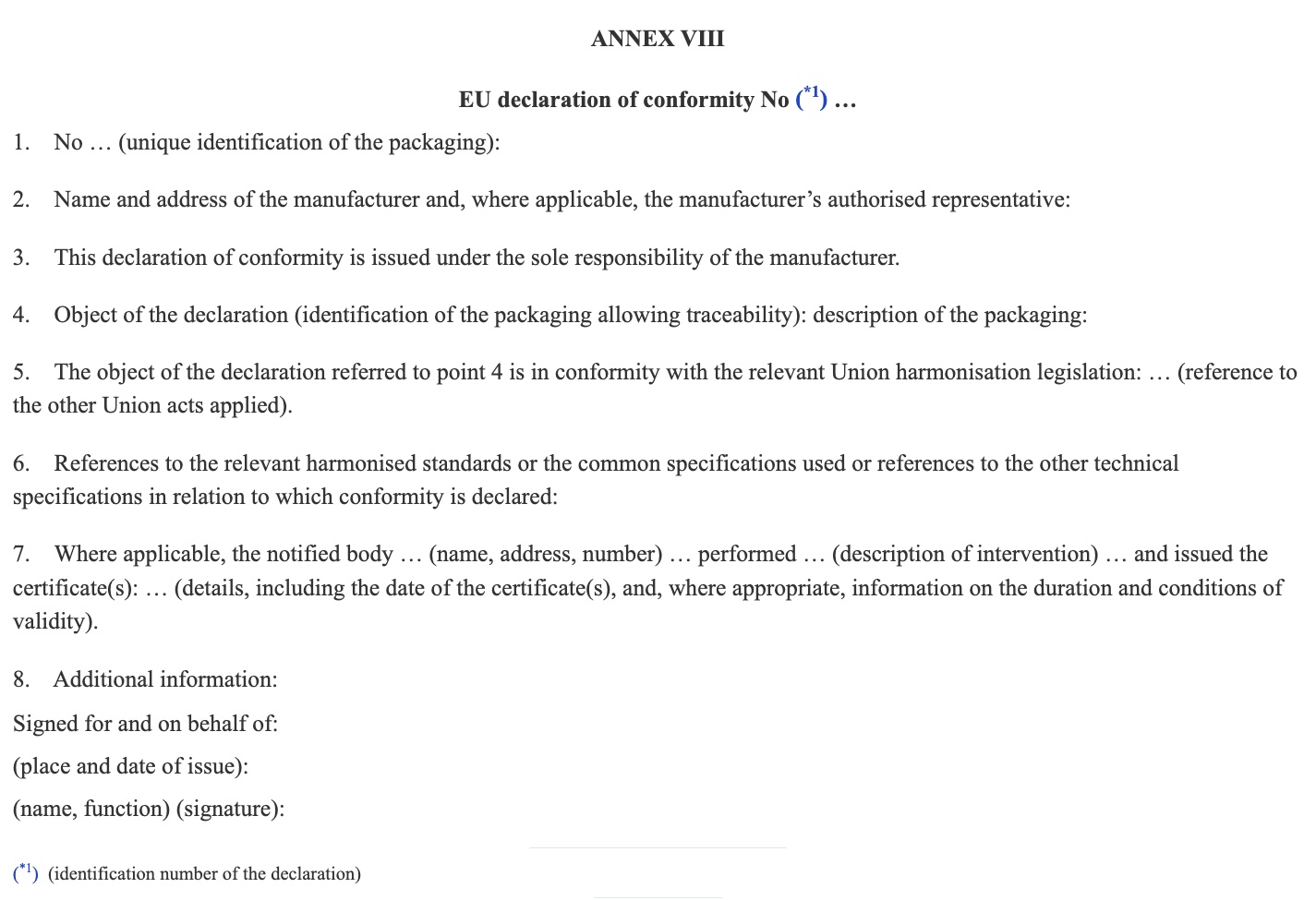
1. Create an EU declaration of conformity
The manufacturer must create a Declaration of Conformity based on the model in Annex VIII:
You can learn more about PPWR documentation requirements in this guide.
2. Affix QR code or data carrier
Article 12 of the PPWR specifies that a QR code or other data carrier is required. This QR code should be scannable and provide the user with the packaging information required in Article 12.
You can learn more about PPWR labelling requirements in this guide.
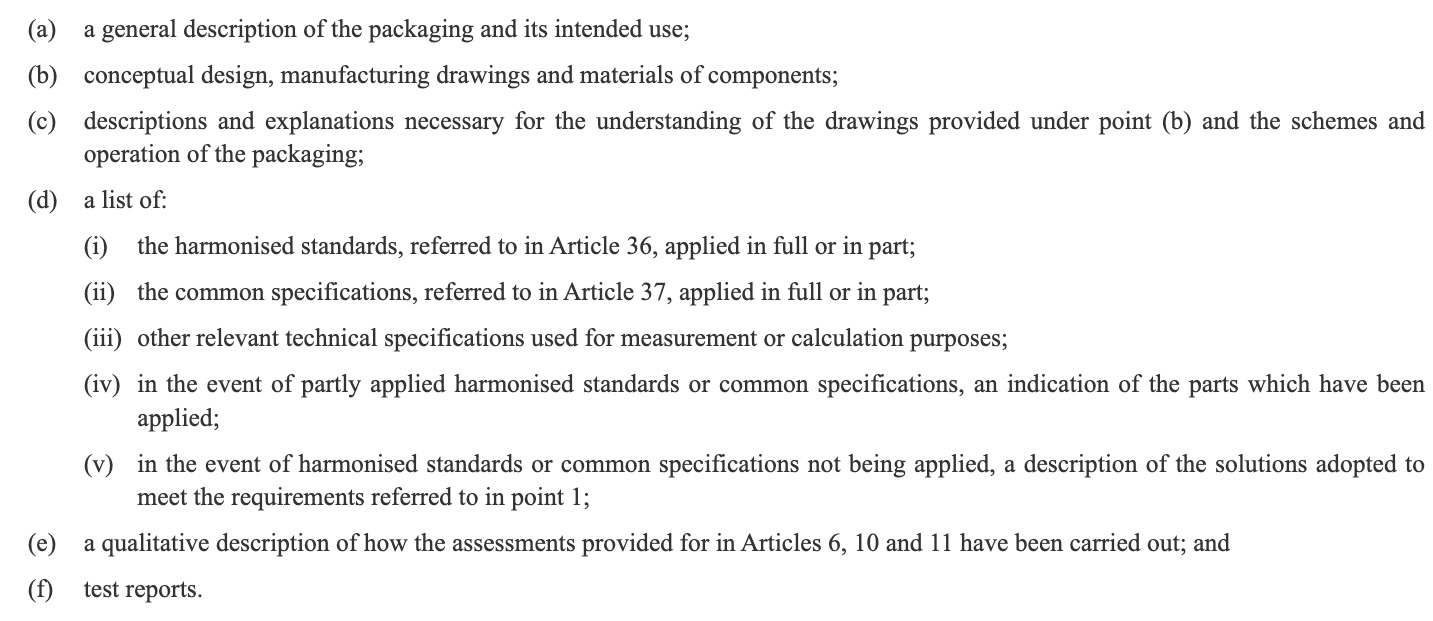
3. Create technical documentation
The manufacturer must create technical documentation that includes the following items:
4. Manufacturer labelling
The following information must be present on the packaging or on a QR code
- Manufacturer name, registered trade name or registered trademark
- Manufacturer postal address
- Manufacturer electronic contact point
5. Importer labelling
The following information must be present on the packaging or via a data carrier:
- Importer name, registered trade name or registered trademark
- Importer postal address
- Importer electronic contact point
Part 4: Manufacturer and importer obligations

In addition to the labelling and documentation requirements mentioned above, manufacturers and importers must meet the obligations listed in articles 15 and 18, respectively.
The following sections break down these requirements into actionable checklists. Note that some of these requirements are mentioned elsewhere in Article 62.
Manufacturers
The role of the manufacturer is to actively manage the process and ensure that the packaging meets requirements concerning design, substances, documentation, labelling, testing, and EPR.
✅ Ensure that packaging materials do not contain restricted substances (heavy metals and PFAS)
✅ Ensure that the packaging meets the set design, material, and labelling requirements (Article 6 to 12)
✅ Carry out the conformity assessment procedure (Article 38) and draw up:
- Technical documentation
- Declaration of conformity
✅ Maintain copies of the technical documentation and DoC for:
- Single-use packaging: 5 years
- Reusable packaging: 10 years
✅ Establish procedures to ensure that the packaging stays in compliance in case of the following:
- Design or material changes
- New harmonised standards
- New PPWR requirements (i.e., due to amendments)
✅ The packaging must be labelled with a type, batch or serial number.
✅ Comply with the manufacturer’s labelling requirements (generally printed or QR code)
- Manufacturer name, registered trade name or registered trademark
- Manufacturer postal address
- Manufacturer electronic contact point
✅ Manufacturers shall provide documentation upon request by market surveillance authorities that demonstrates compliance with the PPWR (within 10 days).
Note: Article 15 also sets requirements for how to manage packaging withdrawals and recalls, and notifying the authorities. Identical regulations apply to importers (as explained in Article 18)
Importers
Importers are responsible for ensuring that the manufacturer has fulfilled their obligations. This, in turn, requires that importers understand what those are and meet their own obligations outlined in Article 18.
✅ Ensure that the manufacturer has met the requirements concerning substances and design/materials
- Obtain test reports
- Review design files
- Review material specifications
✅ Assess if the manufacturer has done the following:
- Carried out the conformity assessment procedure
- Created the technical documentation
- Affixed harmonised label, QR code, and other labelling requirements in Article 12
- Prepared additional required documentation
- Affixed type, batch or serial number
- Affixed manufacturer name, address and contact point (printed and/or QR code)
✅ Comply with the importer labelling requirements (generally printed or data carrier)
- Importer name, registered trade name or registered trademark
- Importer postal address
- Importer electronic contact point
✅ Importers should ensure that the PPWR compliance of the packaging is not affected by storage or transportation conditions. This could, for example, be the case if:
- The packaging design or size is adjusted
- Labels are covered up
- Labels are damaged
✅ Keep a copy of the Declaration of Conformity for a certain period of time:
- Single-use packaging: 5 years
- Reusable packaging: 10 years
✅ Importers shall provide documentation upon request by market surveillance authorities that demonstrates compliance with the PPWR (within 10 days).
Part 5: Packaging Design & Material Requirements

The Packaging and Packaging Regulation (PPWR) 2025/40 sets requirements that directly impact packaging design and materials (in addition to other areas). These are also referenced in Article 62 (g) to (n).
Several of the key requirements are listed in the table below:
| Area | Requirements |
| Excessive packaging | a. The maximum empty space for grouped packaging, transport packaging, and e-commerce packaging should be 50%*
b. Empty space on sales packaging should be reduced to the minimum necessary to ensure product protection and other packaging functions. Note: Sales packaging used as e-commerce packaging and some types of reusable packaging are exempt from the requirements mentioned in point a. above. |
| Restricted packaging formats | Packaging in the format and use listed in Annex V (e.g. single-use plastic packaging) should not be placed in the market.
Note: Member states may allow some exemptions for micro-enterprises. |
| Reusable packaging | a. When making reusable packaging available for the first time in an EU member state, economic operators should ensure that such a state provides a system to reuse the packaging.
b. The above-mentioned system should be described in the technical documentation. c. When making use of reusable packaging, economic operators should participate in a re-use system that complies with the requirements of Annex IV. |
| Refillable packaging | When offering products that can be purchased via refill, economic operators should:
a. Communicate the rules for refill (e.g., types of containers that can be used) to the end user b. Ensure that refill stations comply with the requirements of Annex VI c. Ensure that packaging offered free of charge complies with the requirements of Annex VI |
| Reuse targets | a. When using the types of packaging listed in Article 29, economic operators should ensure that 40% of such packaging is reusable by 2030 (and 70% is reusable by 2040).
b. The packaging should have a “reusable format within a re-use system”** c. There are different reuse targets for specific types of packaging and products (e.g., beverage) Note: There are some exemptions (e.g., sales packaging used for the transportation of dangerous goods). |
| Refill obligations | Distributors operating in the takeaway HORECA sector (which includes food and beverage) should:
a. Provide a system that allows consumers to bring their own containers to be filled. b. Inform consumers that they can bring their own container. |
| Reuse offer obligations | Distributors operating in the takeaway HORECA sector should:
a. Offer the option of providing food and beverage in reusable packaging b. Inform the consumer of this option c. Do not charge an extra fee when providing re-usable packaging (instead of single-use packaging) Note: Micro enterprises are exempted |
| Recyclable packaging | a. All packaging should be recyclable, according to the conditions set in Article 6
b. Compliance with the conditions should be demonstrated in the technical documentation |
| Minimum recycled content in plastic packaging | a. Plastic parts of packaging should contain the minimum percentage of recycled content set in Article 7, according to the type of packaging and material.
b. Compliance with the relevant requirements should be demonstrated by the technical information listed in Annex VII (e.g. technical documentation). |
Notes
*The empty space is calculated as the difference between the total volume of grouped packaging, transport packaging, or e-commerce packaging, and the volume of sales packaging that they contain. Also, space occupied by filling materials, such as paper cuttings, should be considered as empty space.
**Although we could not find a definition of “reusable format within a re-use system”, this could mean that the packaging should have a reusable format that is compatible with the re-use system that the economic operator is planning to use.
FAQ
Are there harmonised standards under the PPWR?
The PPWR states that packaging that complies with the requirements of harmonised standards is deemed to be in compliance with the requirements of the regulation.
The regulation mentions the following two EN standards, which, as far as we know, are harmonised under the Packaging and Packaging Waste Directive:
EN 13428:2004 – Packaging – Requirements specific to manufacturing and composition – Prevention by source reduction
According to Point (60) of the regulation, this standard is harmonised. This point also indicates that EN 13428 should undergo modifications. Until there are new or updated harmonised standards, you can continue to use the existing EN 13428.
EN 13432:2000 – Packaging – Requirements for packaging recoverable by composting and biodegradation – Test scheme and evaluation criteria for final acceptance of packaging
Point (55) of the regulation mentions that EN 13432:2000 is a harmonised standard. It also indicates that the standard should undergo revisions and that the EU should establish another similar standard that applies to home composting.
We could not find any mention of other harmonised standards. However, the regulation is fairly new, and it is possible that new standards will be published soon.
Is packaging testing required?
Yes, packaging testing can be necessary to verify compliance with heavy metals and PFAS restrictions. Further, testing may also be necessary to determine if the packaging complies with the following aspects:
- Size or space ratio
- Recyclability
- Recycled content
- Other PPWR aspects
- Other substance restrictions (i.e., REACH or FCM regulations)
Does the PPWR set Extended Producer Responsibility (EPR) requirements?
Yes, the PPWR mandates that companies register with and contribute to extended product responsibility schemes. In practice, this can require that you complete the following steps:
- Register with a Producer Responsibility Organisation (PRO)
- Register with the national packaging registry in each EU member state
- Ensure compliance with EPR symbols
- Submit data on packaging waste (material, quantity, etc)
Additionally, Article 12 mentions that from 2027, packaging included in a specific EPR scheme (e.g. France or Germany) may be identified in the territory where such scheme applies via a “symbol in a QR code or other standardised, open, digital-marking technology” to indicate that the producer fulfils the EPR requirements.
Although we cannot know this for sure, this seems to indicate that EPR symbols may be standardised.
When will the PPWR apply?
The Packaging and Packaging Regulation (PPWR) 2025/40 applies from Wednesday, 12 August 2026. Note that certain provisions under the PPWR start applying at a later date.
What is a microenterprise?
The definition of a micro-enterprise can be found in Recommendation 2003/361/EC, which defines micro-enterprises based on the following criteria:
a. Employs fewer than 10 persons
b. Annual turnover and/or annual balance sheet total does not exceed EUR 2 million
Are microenterprises exempt from the PPWR?
No, but there are cases where the packaging supplier “becomes” the manufacturer and thus assumes the obligations of manufacturers when selling to companies that are defined as microenterprises.
Microenterprises must still supply compliant packaging.
Further, some suppliers may also choose not to sell to microenterprises if they deem the regulatory burden of the PPWR to be too much (especially when factoring in smaller orders of custom-designed packaging).
When is a supplier deemed to be a manufacturer under the PPWR?
The supplier can assume the responsibility of the manufacturer if the company they are selling to are:
a. A microenterprise selling under their own brand name
b. The supplier is established in the same member state as the company they are selling to
Note that the specific manufacturer obligations in Article 15 of the PPWR apply to any EU suppliers selling to microenterprises in any EU member state.
Does the PPWR require CE marking?
No, the PPWR does not have provisions that require CE marking. As such, packaging should not be CE marked based on the PPWR. That being said, packaging may need to be CE marked if the contained product is subject to one or more EU regulations or directives mandating CE marking.





Hi Fredrik,
hope you are well.
we are wholesaler for sunglasses and would like to comply with upcoming EU PPWR regulation.
we are working on Germany EPR submission (reclay) + Spain EPR submission (Procicular) but we are planning to ship to Sweden / Switzerland etc (qty and countries TBC).
could you please advise
– if we finish germany + spain EPR submission we will not be penalized by PPWR (as we are still working on PPWR which need to have local representatives)?
– i am contacting an EU EPR agency (lovat) looking for one-stop shop service (including agency resolving local representative matter). can i claim we comply with PPRW for which deadline is 12/8/2026 (even though this process may not finish by deadline)?
thanks.
01/7/2026
Business Partnership Proposal for Packing EPR in Hungary / Czech / Luxembourg/ Lithuania
Dear Sir /Madam,
This is Astrid from Shenzhen, China.
Our basic information:
Our company based in Shenzhen, China is a service provider engaging in offering company registration and relevant services for our Chinese cross-border clients. Now we are looking for excellent local service providers in Hungary to assist us in our further business.
Our collaboration pattern:
We will add some price differences to our clients based on your fixed quotation, and we directly contact with our clients. If we build the partnership in the further, we will send your orders.
What we need:
(1)The quotation of some Hungary EPR business
And so on
Could you please offer me a quotation sheet including these services above?
*You can contact me:
Email: [email protected]
Wechat: 13359715642
If there is anyone who can speak Chinese, it will be much better.
(6)It’s much better for us to contact by Wechat if you have a Wechat ID.
Thanks a lot.
Looking forward to your reply.