




 Find US, EU, UK, CA, & AU requirements














Planning to import or manufacture phone cases for the EU market? In this guide, we explain what you must know about the General Product Safety Regulation, REACH, and other compliance requirements relevant to phone cases.
Product examples
- iPhone cases
- Android cases
- Leather phone cases
- Plastic phone cases
- Silicon phone cases
- Aluminium phone cases
- Stainless steel phone cases
- Wooden/bamboo phone cases
Content Overview

FREE CONSULTATION CALL (30 MIN)
 Ask questions about compliance requirements
- Countries/markets:
.png)
.png)
.png)


- Learn how we can help your business
You will speak with:Ivan Malloci
General Product Safety Regulation (GPSR)
The General Product Safety Regulation (GPSR) requires that all consumer products sold in the European Union meet certain safety requirements. In practice, this requires that the product is technically safe, documented and correctly labelled.
Product standards
I am not aware of any product standard specific to phone cases of any sort. That said, all consumer products must be safe, even if no product-specific standards exist.
The option that remains is to identify potential risks and address these by ensuring that your product is safely designed.
Examples
1. Phone cases should not contain restricted chemicals and heavy metals
2. Phone cases should not pose mechanical hazards (i.e., sharp points or risk of breaking)
3. Phone cases should not cause the device to overheat or interfere with its components
Childsafe products
Certain phone cases come with ornaments, beads, or parts that may fall off, and therefore pose a choking hazard. Note that products that are generally not classified as toys must still be safe for children, in particular if they are designed in a way that appeals to a younger audience.
Technical documentation
Manufacturers must issue technical documentation covering the following:
1. General description of the product and its essential characteristics relevant for assessing its safety
2. An analysis of the possible risks related to the product and the solutions adopted to eliminate or mitigate such risks
3. Test reports
4. List of any relevant European standards (or other relevant elements), as applicable
The technical documentation must be maintained for 10 years.
Labelling requirements
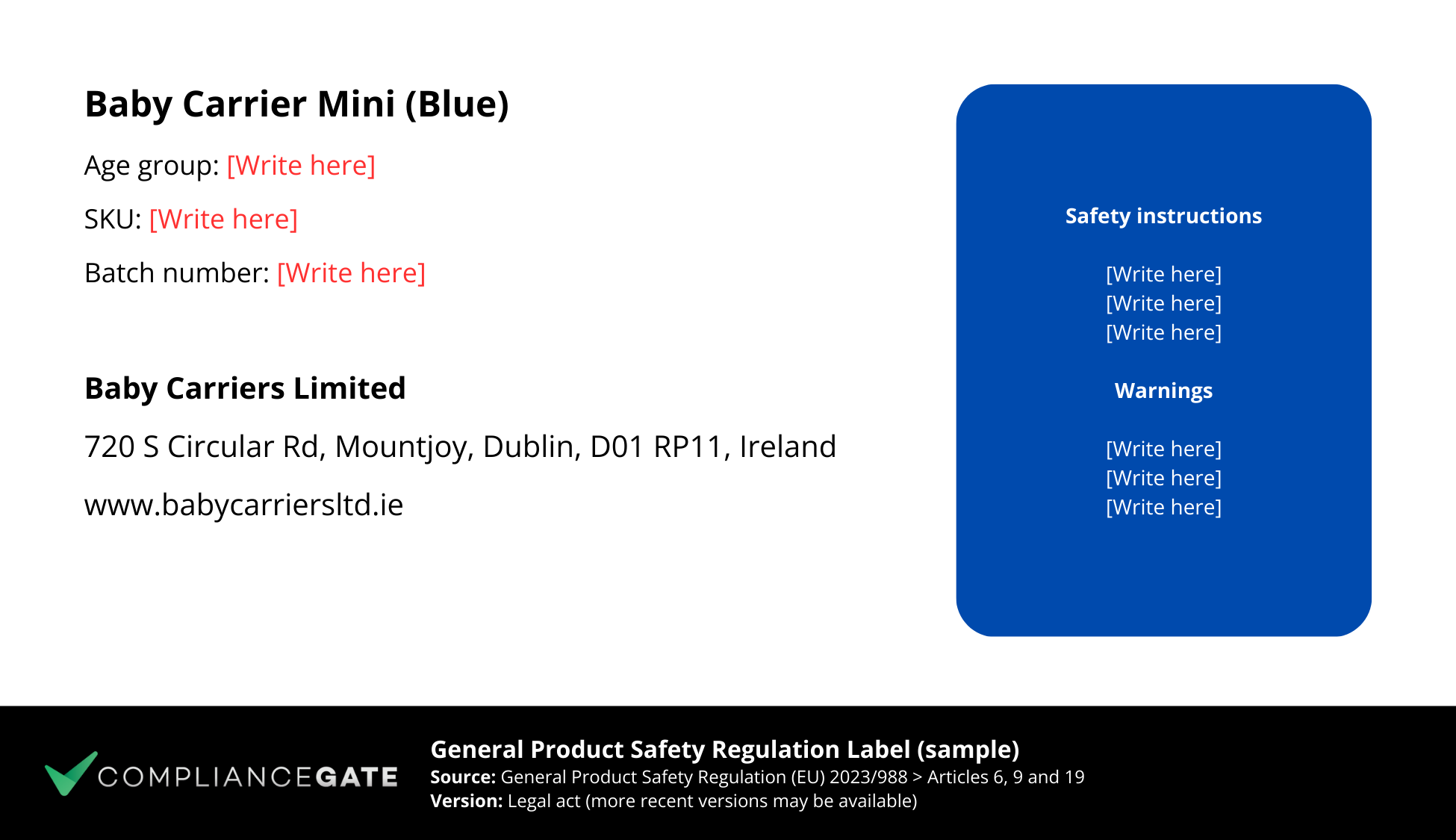
The GPSR requires manufacturers to affix label information to the product or its packaging. Note that the latter is more likely when it comes to phone cases. That said, some brands may opt to affix the label on the inside of the phone case.
- Product type and batch
- Manufacturer name
- Manufacturer address and electronic address
- Age group labelling
Note that importer information must also be present, in case you are an EU company importing phone cases from a supplier in a third country.
Instructions and warnings
The GPSR also requires that safety information and instructions be present when the nature of the product necessitates this. Phone cases are generally not deemed to be high-risk products requiring dense user manuals, but it could be a good idea to provide information concerning the following:
- Comparable phone models
- How to affix and remove the phone case
REACH Regulation
The REACH regulation sets restrictions on chemicals and heavy metals in all products sold in the European Union. As such, it can also be applied to phone cases of various materials.
Examples of restricted substances
Here are some examples of substances that may be found in phone case materials:
- DEHP and other phthalates can be found in soft plastics and coatings
- Metal cases may contain lead and cadmium
- Leather cases may contain lead and hexavalent chromium
Testing
Note that these are not all substance restrictions that may apply to phone cases. My suggestion is that you contact a testing company that can help you assess which substances to test for. This will largely be decided based on the bill of materials of the phone case.
Other Regulations
Other EU regulations and directives may also apply to phone cases. Some are only relevant under certain conditions.
Toy Safety Directive 2009/48/EC
The Toy Safety Directive covers toys for children between the ages of 0 and 14. It defines toys as products with “play value”. If you sell phone cases that have some sort of play features, then the product may be covered by the Toy Safety Directive.
This in turn requires that the phone case is CE marked and meets a range of other requirements.
Other Substance Regulations
The following regulations can also be relevant to phone cases:
- Persistent Organic Pollutant Regulation (EU) 2019/1021
- Mercury Regulation (EU) 2017/852
Product Testing
Product testing is necessary to verify that the phone case materials, coatings and print inks do not contain restricted substances. Such testing can be arranged by QIMA, TUV Rheinland or Intertek.
Here are some other tests that may be relevant:
- Mechanical safety and small parts
- Drop tests
- IPXX testing (i.e., waterproof)
- Recyclability
FAQ
Do phone cases require CE marking?
CE marking is generally only relevant for phone cases that are:
a. Defined as toys
b. Contain electronic components (or incorporated into an electronic device)
Phone cases should not be CE marked unless covered by one or more EU regulations and directives that mandate it.
Are phone cases considered to be toys?
Products that have play value can be considered toys. If your phone case contains some sort of “toy component”, then that may be the case.