






 Find US, EU, UK, CA, & AU requirements














Article 11 of the Batteries Regulation (EU) 2023/1542 introduces new requirements that will make it mandatory to sell many electronic devices with batteries that can be removed and replaced by the end-user.
This means that many brands must redesign their hardware to incorporate batteries and battery compartments that make this possible, while also complying with requirements concerning spare part availability.
This guide breaks down key requirements under Article 11 of the Batteries Regulation (EU) 2023/1542. I also explain which devices are exempt (to some extent) and why.
- The new rules under Article 11 apply from 18 February 2027
- End-user replaceable batteries will be required for many electronic devices
- Many brands will be required to redesign their hardware before 18 February 2027
- Some devices subject to ecodesign requirements are exempt (to a certain extent)
Note: This is still an evolving area of product compliance. The EU received inputs from the industry earlier this year, and it is possible that exemptions will be extended to additional products.
Content Overview

FREE CONSULTATION CALL (30 MIN)
 Ask questions about compliance requirements
- Countries/markets:
.png)
.png)
.png)


- Learn how we can help your business
You will speak with:Ivan Malloci
Are replaceable batteries mandatory in the EU?
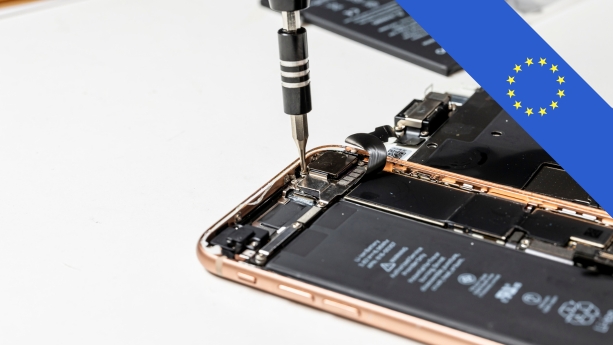
Yes, Article 11 of the Batteries Regulation (EU) 2023/1542 mandates that portable batteries incorporated in electronic devices must be removable and replaceable.
Requirements
✅ Portable batteries must be removable and replaceable by the end-user.
✅ The requirement applies to the entire battery (not individual cells).
✅ The battery must be removable by the consumer using:
- Commercially available tools (i.e., screwdriver), or
- Specialised tools provided free of charge with the product
✅ Instructions for removing and replacing the battery must be provided:
- With the product
- Online
✅ It must be possible to replace the battery with a compatible battery of another brand, without affecting the following aspects:
- Functionality
- Performance
- Battery safety
✅ The specific battery type must be available as spare parts for at least 5 years after a product was last sold on the market. This means that you must consider designing your product to be compatible with standardised and commonly available battery types to the extent possible.
✅ Software must not negatively affect the replacement battery.
⚠️ Removing and replacing batteries should not require proprietary tools, thermal energy, or solvents to disassemble the product.
⚠️ Removing and replacing batteries should not require the involvement of a service centre (with some exemptions).
Which types of products require replaceable batteries?
The requirement applies to products incorporating portable batteries. The following definition can be found in the Batteries Regulation (EU) 2023/1542:
‘Portable battery’ means a battery that is sealed, weighs 5 kg or less, is not designed specifically for industrial use and is neither an electric vehicle battery, an LMT battery, nor an SLI battery;
Product examples
Here are some examples of devices that may require replaceable batteries:
- Smartphones
- Tablets
- Portable speakers
- Video game accessories.
Which types of batteries must be replaceable?
The new requirements apply to portable batteries which have the following characteristics:
✅ Sealed battery
✅ Weights 5 kgs or less
⚠️ Is not an industrial battery, electric vehicle battery, light means of transport (LMT) battery, or starting, lighting and ignition (SLI) battery
As such, most lithium batteries found in consumer electronics are covered by the removal and replacement requirements.
LMT Batteries
Article 11 of the Batteries Regulation (EU) 2023/1542 also states that light means of transport (LMT) batteries must be removable and replaceable, but by an independent professional.
Further, it must be possible to replace the original LMT battery with a compatible battery from another brand. In addition, the requirements concerning spare parts and software also apply to LMT batteries.
Are some devices exempt from the replaceable battery requirement?
Yes, there are several exemptions under Article 11 of the Batteries Regulation (EU) 2023/1542.
Professional battery replacement
Batteries in the following devices may be replaceable only by a professional if necessary for the safety of the product:
a. Electronic appliances used for operating in or exposed to water
b. Professional medical imaging and radiotherapy devices
c. In vitro diagnostic medical devices
Continuity of power supply
Devices that require continuity of power supply and a permanent connection between the product and the battery to ensure:
a. Product safety
b. Collection and supply of data for data integrity reasons
Other exemptions
Article 11(4) states that the European Commission may implement additional exemptions in the future.
Ecodesign Exemptions
There are additional exemptions to some battery replaceability requirements for products covered by certain ecodesign requirements. To understand these exemptions, we must take a closer look at official guidelines and ecodesign regulations.
I have done my best to explain how these are linked together with the Batteries Regulation (EU) 2023/1542 below.
Commission guidelines to facilitate the harmonised application of provisions on the removability and replaceability of portable batteries and LMT batteries in Regulation (EU) 2023/1542
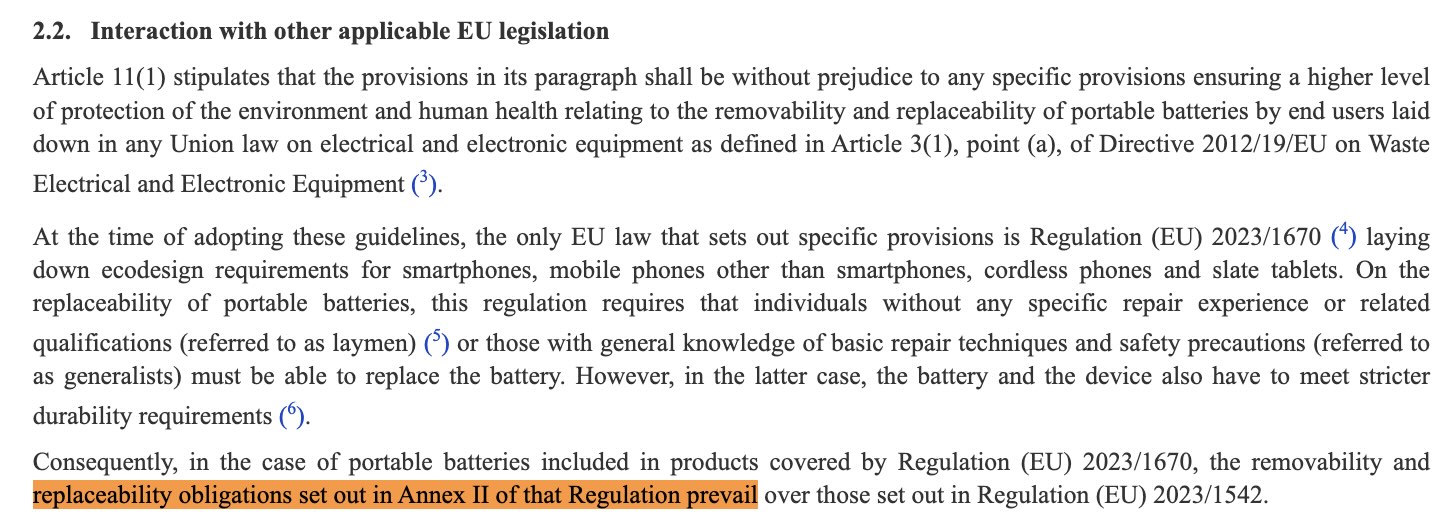
1. These guidelines state that ecodesign requirements concerning battery removability and replaceability in Regulation (EU) 2023/1670 take precedence over those in the Batteries Regulation (EU) 2023/1542. But, only for products covered by the former:
- Smartphones
- Other mobile phones
- Cordless phones and slate tablets
| Condition | Yes | No |
| Are you selling a product covered by Regulation (EU) 2023/1670 containing a portable battery?
Scope: Smartphones, other mobile phones, cordless phones and slate tablets |
Removability and replaceability obligations set out in Annex II of Regulation (EU) 2023/1670 prevail | Removability and replaceability obligations set out in Article 11 of the EU Battery Regulation (EU) 2023/1542 |
2. This principle is also mentioned in an official document titled Battery Removability and Replaceability – Support to the development of Guidelines for Battery Regulation Art.11.
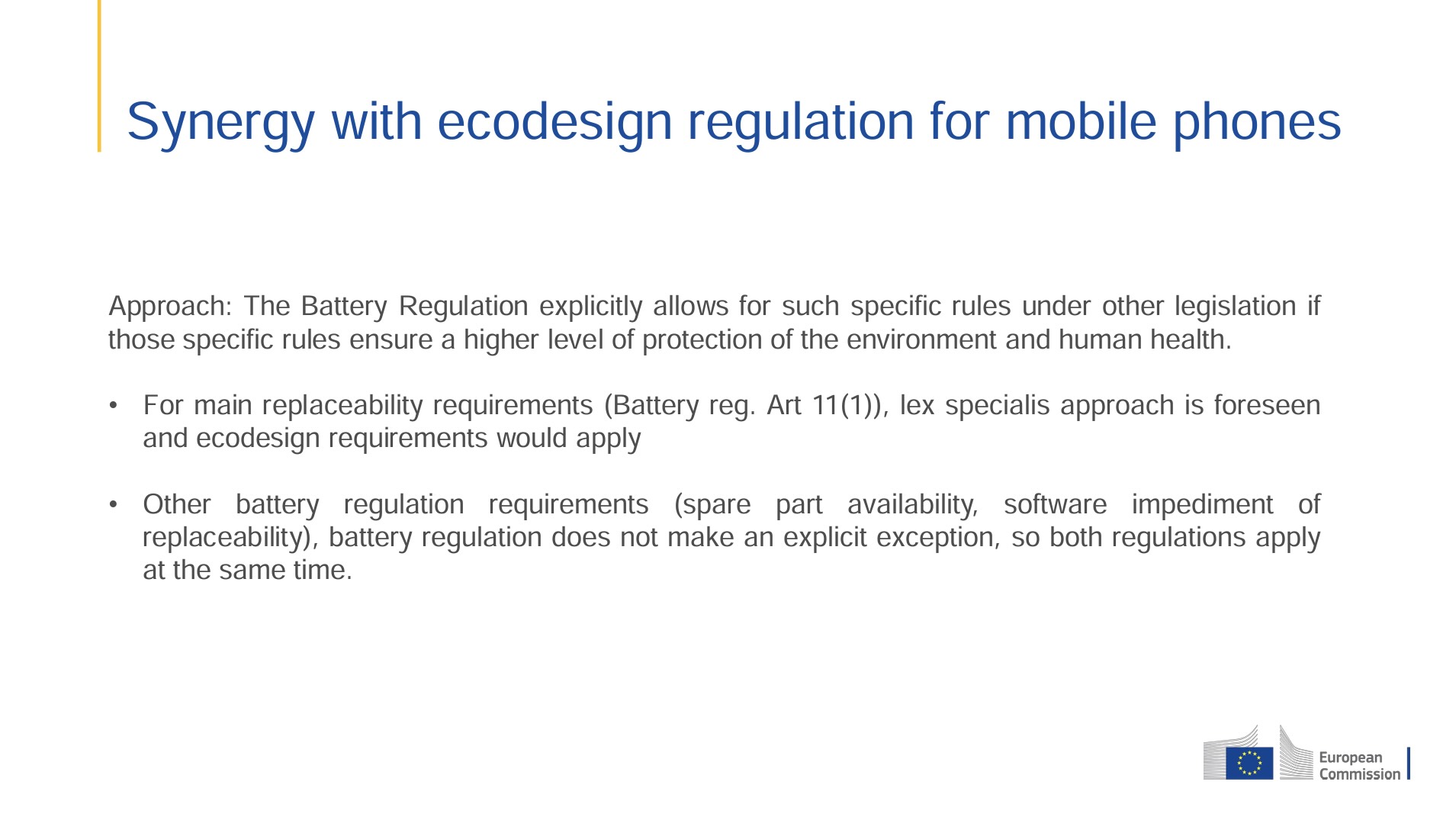
a. Ecodesign requirements (if applicable to a certain product) may prevail over the principle that batteries must be replaceable by the end-user in Article 11(1) of the Batteries Regulation (EU) 2023/1542.
b. Even when this is the case, other parts of Article 11 of the Batteries Regulation (EU) 2023/1542 can still apply.
Regulation (EU) 2023/1670
1. This regulation applies to:
- Smartphones
- Other mobile phones
- Cordless phones and slate tablets
2. Ecodesign requirements concerning battery removability and replaceability can be found in Annex II:

Hence, batteries may only be replaceable and removable for covered products if the battery meets the listed conditions.
Summary
| Condition | Yes (for all) | No (for any) |
| Are you selling products containing portable batteries? | Regulation (EU) 2023/1670
may provide the battery or batteries referred to in point (i)(a) only to professional repairers |
Batteries Regulation (EU) 2023/1542
Batteries must be readily removable and replaceable by the end-user |
| Are your products covered by Regulation (EU) 2023/1670?
Scope: Smartphones, other mobile phones, cordless phones and slate tablets Exemptions: See Article 1(2) |
||
| Condition 1: after 500 full charge cycles the battery has, in a fully charged state, a remaining capacity of at least 83 % of the rated capacity | ||
| Condition 2: the battery endurance in cycles achieves a minimum of 1 000 full charge cycles and after 1 000 full charge cycles the battery has, in a fully charged state, a remaining capacity of at least 80 % of the rated capacity; | ||
| Condition 3: the device meets IP67 rating |
What does this mean? Some devices can have batteries that can only be removed and replaced by a professional repairer.
As mentioned, even when this is the case, other removability and replaceability requirements under the Batteries Regulation (EU) 2023/1542 may still apply.
Note: This example only covers exemptions under Regulation (EU) 2023/1670. It is possible that other ecodesign-related exemptions exist or will exist in the future.
FAQ
Do all products require removable batteries in the EU?
No, not all products require replaceable batteries. However, the requirement applies to most consumer electronics containing portable batteries (unless subject to an exemption).
Do we need to provide spare part batteries for 5 years?
Article 11(7) states that businesses must:
a. Ensure that those batteries are available as spare parts of the equipment that they power;
b. For a minimum of five years after placing the last unit of the equipment model on the market
Many businesses may choose to design their products to be compatible with standardised battery packs and modules commonly available on the market.
Which EU regulation mandates replaceable batteries?
Requirements concerning battery removability and replaceability can be found in Article 11 of the EU Battery Regulation. As mentioned, additional requirements can be found in ecodesign regulations.
When will replaceable batteries become an EU requirement?
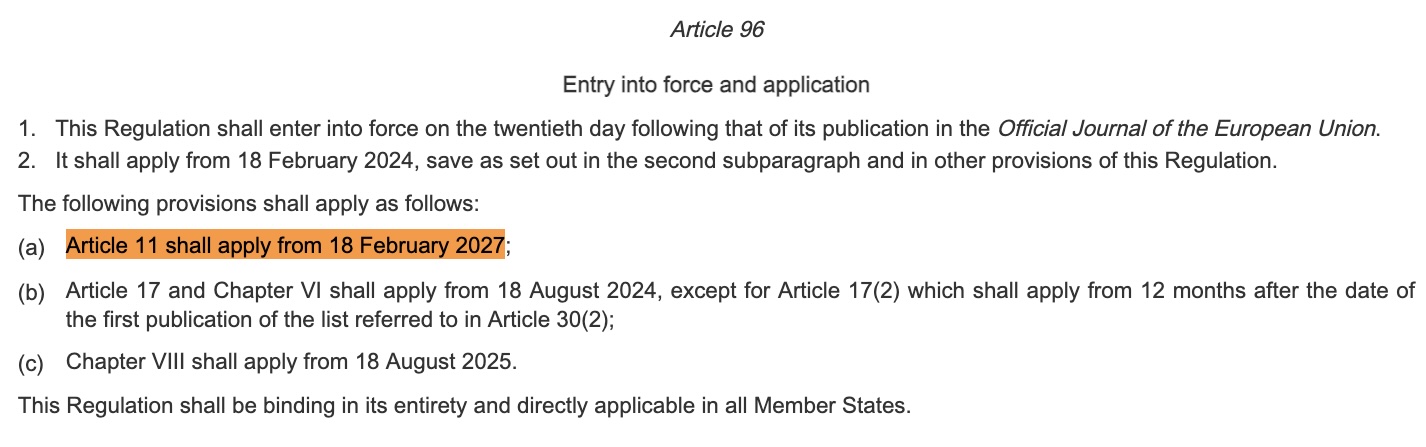
Article 11, which sets requirements for battery removals and replacements, applies from 18 February 2027.
Does this mean that products already on the market must be redesigned?
Yes, that is exactly what this means. Some companies are already launching EU-only versions of their products that comply with the end-user battery removability and replaceability requirements set under Article 11 of the Batteries Regulation (EU) 2023/1542.
For example, Nintendo is expected to launch a new EU version of the Switch 2 and various accessories with user-replaceable batteries.
It is yet to be seen if the new requirements will eventually result in devices with user-replaceable batteries becoming available in the other countries and markets.
Apple did, for example, replace its Lightning connector worldwide shortly after the EU implemented new USB Type-C requirements. It may turn out that most brands opt for a single SKU that can be sold in the EU and all other major markets.
How do we need to redesign our hardware to comply with the new battery requirements?
Here are some examples of aspects that must be taken into consideration when you redesign your hardware to comply with the new user replaceability requirements:
✅ Design a battery compartment that can be opened using common tools (or provided specialised tools)
✅ Design the device to be compatible with battery models that are available on the market
✅ Test your device with various comparable batteries to assess performance
✅ Arrange third-party testing to verify product safety
Does this apply to products already on the market?
No, it is unlikely that battery removability and replacement requirements apply to products already sold in the EU, even after 18 February 2027.
For example, the Commission guidelines state that requirements concerning supplying batteries as spare parts do not apply to devices placed on the market before 18 February 2027.
Such requirement is not applicable to products placed on the market that incorporate portable or LMT batteries before the date of entry into force of Article 11, which is 18 February 2027.
Placing on the market is defined as follows in the Batteries Regulation (EU) 2023/1542:
‘Placing on the market’ means the first making available of a battery on the Union market;
‘Making available on the market’ means any supply of a battery for distribution or use on the Union market in the course of a commercial activity, whether in return for payment or free of charge;
As such, the battery replacement and removability requirements likely do not apply to devices already available for sale in the European Union.
For example, stores and wholesalers will not need to discard existing stocks.
But, it does not mean that a product model introduced before these requirements can be sold without changes to the battery and the battery compartment. That is exactly why Nintendo and other brands are making changes to their hardware in the months leading up to the deadline.
What can happen if we sell a device without user-replaceable batteries after the deadline?
Assuming the product is not subject to any exemption, selling devices that fail to comply with the user-replaceable battery requirements likely result in the product being non-compliant.
Such products cannot be CE marked and can therefore not be sold in the European Union
Products found to be non-compliant can be subject to recalls.