




 Find US, EU, UK, CA, & AU requirements














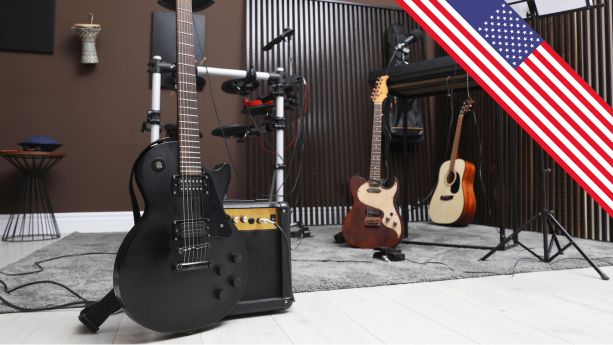
Planning to import or manufacture musical instruments for sale in the United States? This guide covers compliance requirements for acoustic and electric musical instruments. We also cover musical instruments intended for children, including toy instruments.
Content Overview

FREE CONSULTATION CALL (30 MIN)
 Ask questions about compliance requirements
- Countries/markets:
.png)
.png)
.png)


- Learn how we can help your business
You will speak with:Ivan Malloci
Acoustic musical instruments
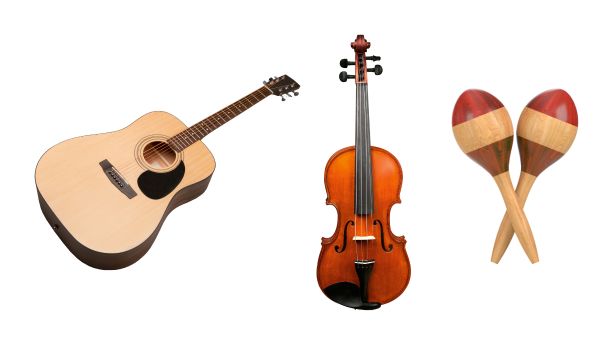
Guitars, pianos, and other musical instruments are subject to various regulatory requirements in the United States.
California Proposition 65
California Proposition 65 restricts chemicals and heavy metals in consumer products sold in California. While not specific to musical instruments, materials to make musical instruments can contain restricted substances.
Examples include the following:
- Di(2-ethylhexyl)phthalate (DEHP)
- Di-isodecyl Phthalate (DIDP)
- Di-n-butyl Phthalate (DBP)
- Lead
- Cadmium
Some businesses opt to affix warning labels to indicate that their products contain or may contain restricted substances.
Part 1262 – Magnets
Musical instruments containing magnets may be subject to requirements under 16 CFR part 1262:
✅ Flux index limit for loose and separable magnets under a certain dimension
✅ Flux index test procedure
Part 770 – Formaldehyde standards for composite wood products
This part restricts formaldehyde in composite wood products and components, which can be used to manufacture guitars and other instruments. Key requirements are summarised below:
✅ Compliance with formaldehyde emission standards and restrictions
✅ Third-party certification
✅ Labelling
✅ Reporting
✅ Record keeping
Country of Origin
Under Part 134, country of origin marking is required for products imported to the United States, including musical instruments. For example, instruments manufactured in Italy must be marked as “Made in Italy”.
Additional requirements apply to companies intending to claim that their product is made in the USA. These can be found under 16 CFR Part 323.
Children’s musical instruments

Musical instruments intended for children between the ages of 0 and 12 must comply with requirements under the CPSIA. This is the case for both actual musical instruments and toy instruments.
Key requirements under the CPSIA are summarised below:
✅ The product must comply with applicable children’s product safety rules
- 16 CFR Part 1307 – Prohibition of Children’s Toys and Child Care Articles Containing Specified Phthalates
- 16 CFR Part 1303 – Ban of Lead-Containing Paint and Certain Consumer Products Bearing Lead-Containing Paint
- §1278a. Children’s products containing lead; lead paint rule
✅ Toy instruments must comply with ASTM F967 (note that other standards incorporated by reference may apply)
✅ Tracking labels
✅ Third-party testing is required (CPSC-accepted labs only)
✅ A Children’s Product Certificate (CPC) must be issued
✅ eFiing is required starting in July 2026
Electronic musical instruments
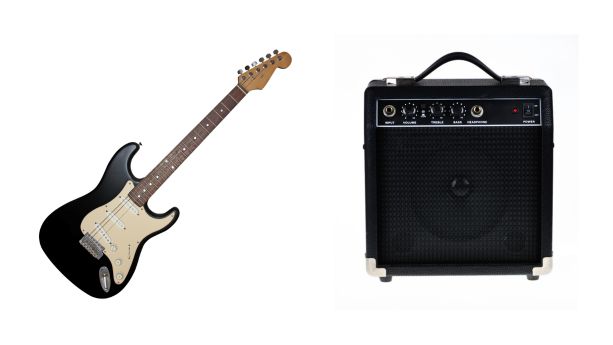
All requirements that apply to acoustics generally also apply to electronic instruments. That said, additional requirements apply to the instruments and accessories, like pedals, etc.
47 CFR Part 15 – FCC
47 CFR Part 15 sets requirements for radio frequency devices, which may also include electronic musical instruments such as electric guitars.
In general, electronic equipment is classified as either an unintentional or intentional radiator.
47 CFR PART 15 – RADIO FREQUENCY DEVICES – Unintentional Radiators

Products that use electrical radio frequency within the product itself and only transmit such a signal via connecting wiring, as opposed to using wireless technology, are generally deemed unintentional radiators.
This could include electrical amplifiers and pianos, for example.
Here are the key requirements:
- Supplier’s Declaration of Conformity (SDoC) authorization procedure
- Compliance with technical requirements and standards
- SDoC Compliance Information Statement
- Device labeling (e.g., product identification information, FCC logo)
- User manual
- Testing
47 CFR PART 15 – RADIO FREQUENCY DEVICES – Intentional Radiators
Products that are wi-fi enabled, Bluetooth enabled, or use other forms of wireless technology are generally classified as intentional radiators. This could include:
- Wireless microphones
- Musical instruments with Bluetooth modules
- Wireless piano keyboards
Here are the main requirements:
- Certification procedure
- Compliance with technical requirements and standards
- Technical report
- FCC ID
- Compliance information statement
- Testing conducted by an FCC-recognized accredited testing lab
UL Standards
In theory, UL standards may be voluntary, unless they are incorporated by an applicable regulation. However, from a practical standpoint, you should still comply with the requirements of relevant standards, as your product must be safe for the user.
Here are some UL standards that may be relevant for musical instruments, their chargers, and batteries:
UL 6500 – Standard for Audio/Video and Musical Instrument Apparatus for Household, Commercial, and Similar General Use
UL 62368-1 – Audio/Video, Information and Communication Technology Equipment – Part 1: Safety Requirements
UL 1310 – Class 2 Power Units
UL 1012 – Power Units Other Than Class 2
UL 1642 – Lithium Batteries
FAQ
Are musical instruments regulated in the United States?
Yes, musical instruments sold in the United States are subject to various regulations and standards applicable to consumer products and electronic products.
Is testing required?
Testing can be required for musical instruments to verify compliance with applicable standards and substance restrictions. The specific testing requirements depend on the applicable legislation.