




 Find US, EU, UK, CA, & AU requirements












A CE Certificate of Conformity (CoC) essentially states that a certain product is compliant with one or more regulations, directives or standards. It also includes information about the issuing company, product, and supplier.
In some cases, reputable companies like TUV Rheinland and Bureau Veritas issue certificates as part of a lab testing and document review procedure.
However, far from all CE Certificates of Conformity are issued based on actual testing and a file review procedure. On the contrary, many of these documents are issued based on nothing but the exchange of money for the sake of deceiving buyers who don’t know better. This can result in companies procuring non-compliant and unsafe products on the basis of fake CE certificates.
Alternative terms
Certificate of Conformity documents can have the following titles:
- CE Certificate
- Attestation of Conformity
- Verification of Conformity
- Certificate of Compliance
Some service providers also refer to these as voluntary certificates.

FREE CONSULTATION CALL (30 MIN)
 Ask questions about compliance requirements
- Countries/markets:
.png)
.png)
.png)


- Learn how we can help your business
You will speak with:Ivan Malloci
Content Overview
What is a CE Certificate of Conformity?
A CE Certificate of Conformity is a third-party-issued document stating that a certain product is compliant with one or more directives, regulations, and harmonised standards. These certificates are sometimes issued as part of a testing process and can involve the review of additional files:
- Declaration of Conformity (DoC)
- Product and packaging labels
- Instructions
- Other files supporting CE marking
While these certificates are generally voluntary, they provide value for the following reasons:
1. CE certificates state if a product is compliant with a certain regulation or directive (which is not always immediately clear when reading a test report).
2. The DoC, labels, instructions and other CE marking requirements are sometimes taken into account.
As such, a CE certificate serves as an assessment from the issuing company that the product is compliant with certain aspects of CE marking regulations or directives. This can be useful for buyers who would otherwise not be able to assess if their products are compliant on their own.
As mentioned, these certificates are often issued as part of a lab testing process by reputable companies like TUV Rheinland or Bureau Veritas. That said, some companies issue such certificates only based on reviewing existing test reports and other supporting documents.

Fake CE Certificates of Conformity
Not all CE certificates of conformity are issued based on an actual test report and other supporting documentation. Unfortunately, some companies issue CE certificates without conducting any testing or file review. In other words, CE certificates of conformity are created out of thin air for the purpose of deceiving buyers into believing that a certain product is compliant.
This can have severe consequences for importers who often end up buying products that are non-compliant and unsafe.
This issue is so prevalent that the European Union has issued a warning on their CE marking portal:
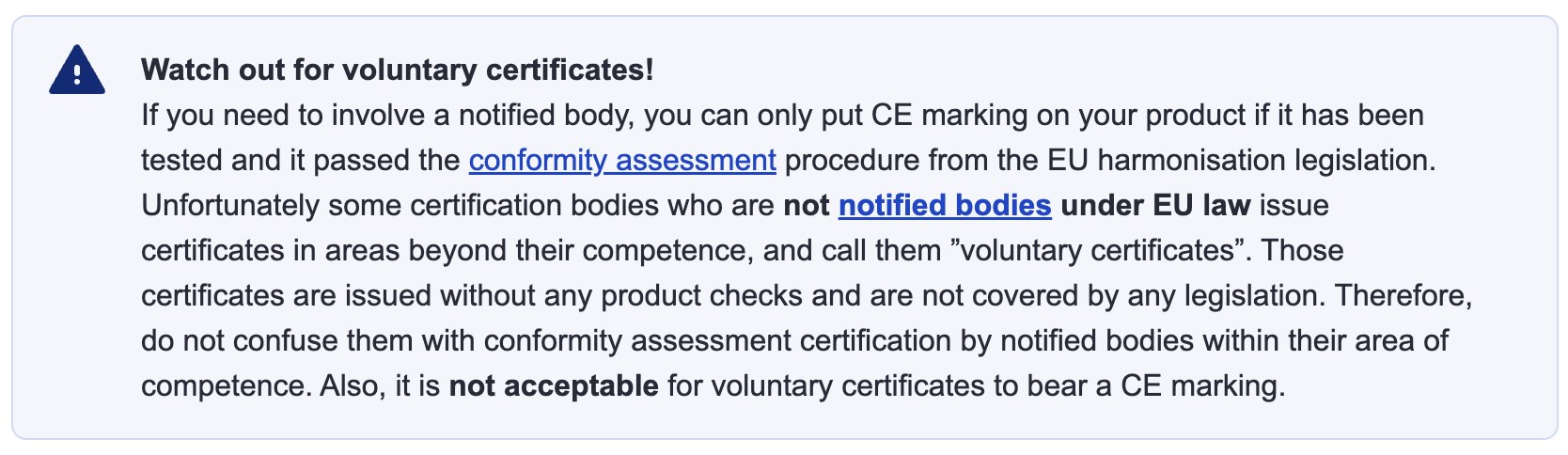
The problem is that many buyers continue to accept such documents.
How common are fake certificates?
We have conducted hundreds of supplier screenings in Asia and elsewhere in the last ten years. This procedure involves requesting and verifying compliance documents held by the supplier. We frequently receive certificates of conformity without any complementary lab test reports or other support documents.
How can I spot a fake CE certificate?
Here are some things we look for:
- Can the issuing company be contacted?
- Can the issuing company or supplier provide test reports and other supporting documentation?
- Are the listed standards harmonised in the EU?
- Is the issuing company relatively well-known?
Causes
Personally, I think most non-EU suppliers simply don’t understand what the CE marking process means in practice. Some may genuinely believe that it’s only a matter of paying a fee for the sake of obtaining a certificate.
It is always cheaper to just “buy” a certificate than to undergo a proper lab testing procedure.
Consequences
Customs authorities and market surveillance authorities in the EU will generally not accept a CE certificate of conformity as evidence that your product is compliant. I know of many cases where goods have been seized or subject to recall orders as a result of importers submitting such documents without having “real” compliance documentation.
Which products require a CE Certificate of Conformity?
In theory, a CE Certificate of Conformity could be issued for any product which requires CE marking. Here are a few examples:
- Toys
- Electronics
- Batteries
- Machinery
- Personal Protective Equipment (PPE)
- Medical devices
- Gas appliances
Notice that none of these actually require a voluntary certificate. Some may require an EC-type examination certificate, but that is a different type of document.
What is the purpose of this document?
A CE Certificate of Conformity serves as a second opinion that your products and their documentation are compliant. At least that’s what it’s supposed to mean. That being said, a CE Certificate of Conformity is not a replacement for a Declaration of Conformity (DoC), technical file, and valid lab test report.
Further, it is not necessarily mandatory to obtain a third-party-issued Certificate of Conformity. However, it is valuable to have a qualified partner manage testing and review the documentation. That way, you can be more confident that it’s been done correctly.
This assumes that the service provider is legit and is not only selling such certificates, without conducting any form of testing or review.
CE Certificate of Conformity Summary
This information is often included in a Certificate of Conformity:
Registration/Report number: The report or certificate number can be used to verify if the document is valid. All certificates have some sort of registration or report number.
Issuing company: The company that issued the Certificate of Conformity, including their contact details and address.
Certificate holder: The company for which the certificate was issued. This is usually the importer or manufacturer who intends to sell the product.
Product information: Product name, SKU, or model number. One certificate can sometimes cover more than one product.
Regulations and directives: A statement that the product is in compliance with certain EU regulations and directives. Here are some examples:
- Toy Safety Directive
- Low Voltage Directive
- EMC Directive
- PPE Regulation
Harmonised standards: A statement that the product has been tested and is compliant with certain harmonised standards. Here are some examples:
- EN 71-1
- EN 71-2
- EN 50581
- EN 50065
- EN 13637
Other files: A statement that the issuing company has reviewed certain files and deems these to comply with specified regulations and directives (in entirety or specified articles):
- Declaration of Conformity
- Label files
- Instructions
- Technical documentation
- Other files
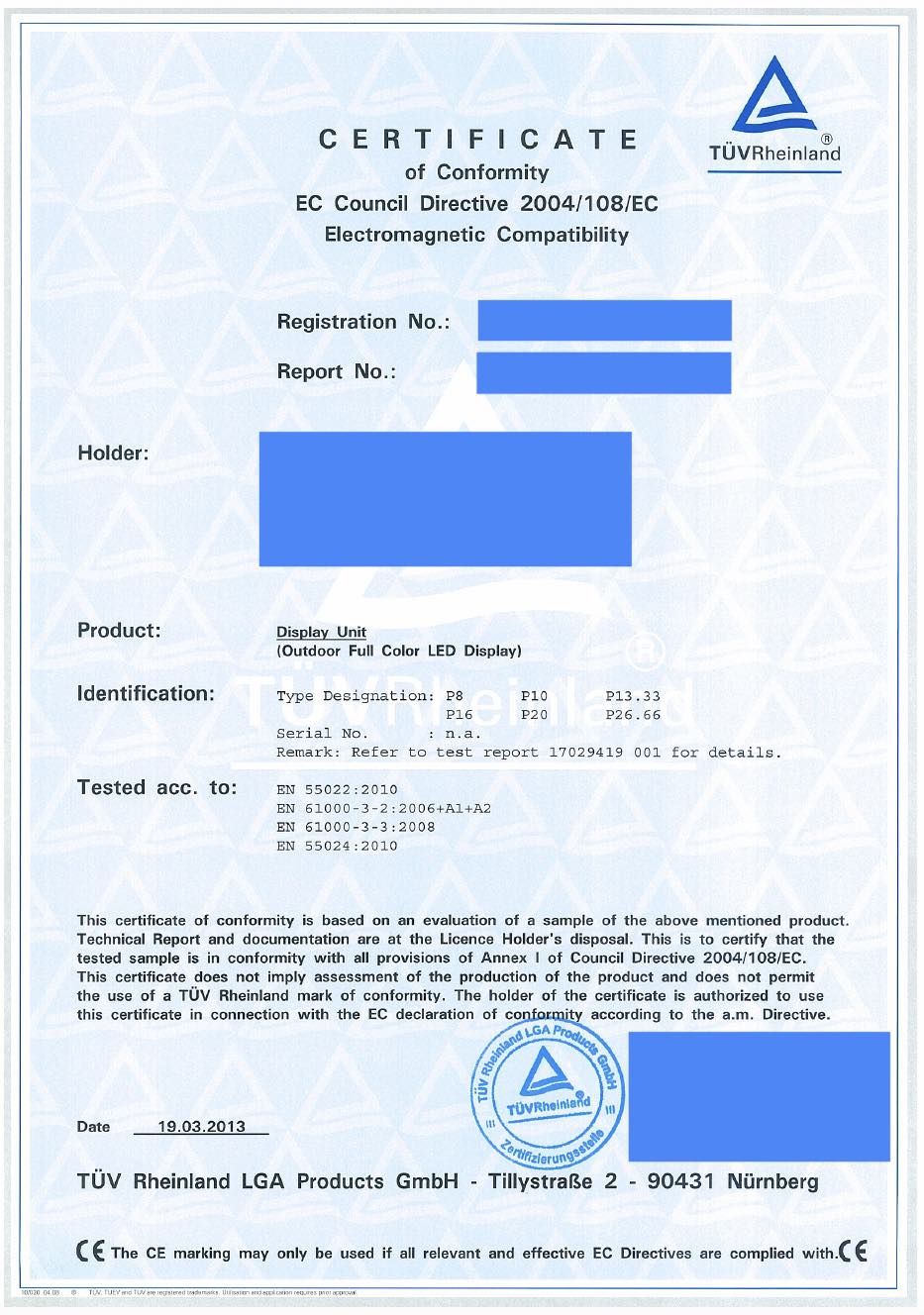
Statement: Explains the basis for issuing the company. This is one example from a certificate issued by TUV Rheinland:
This certificate of conformity is based on the evolution of a sample of the above-mentioned product. Technical report and documentation are at the License Holder’s disposal. This is to certify that the tested sample is in conformity with all provisions of Annex I of Council Directive 2004/108/EC. This certificate does not imply an assessment of the production of the product and does not permit the use of a TUV Rheinland mark of conformity. The holder of the certificate is authorized to use this certificate in connection with the EC declaration of conformity according to a.m. Directive.
Signature: The certificate is usually signed, stamped, or both.
CE Certificates of Conformity Sample
CE Certificates of Conformity Verification
This section explains how you can verify CE certificates of conformity and other ways we use to assess if such documents are legit.
How do I know if a CE Certificate of Conformity is valid?
TUV Rheinland and other companies of good repute generally provide databases where you can search and verify certificates and other documents. For example, the screenshot below is taken from the TUV Rheinland certificate database.
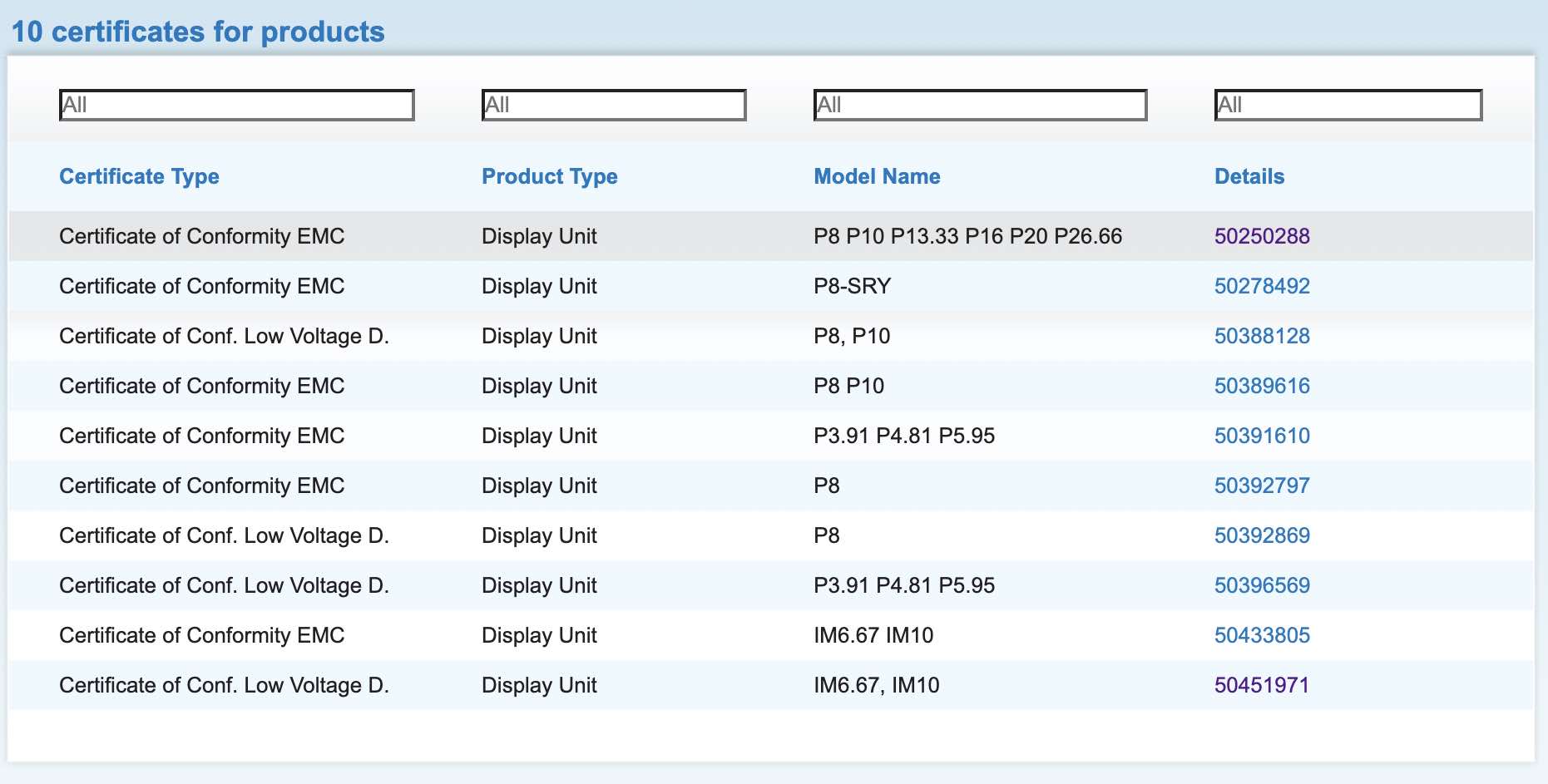
How can I check if a CE Certificate of Conformity is fake?
You can either search for the certificate number in a database or email the issuing company. You can also contact the issuing company by email. You can assume that the document is invalid if the issuing company cannot provide any method of verification.
Assessment
That being said, the verification itself doesn’t prove that the certificate was issued based on an actual conformity assessment. You should therefore ask the issuing company and your supplier to provide supporting documents. Chances are that they don’t have any or that they will not disclose.
Reputation of the issuing company
As such, the acceptance of CE certificates often comes down to the reputation of the issuing company. I would trust a certificate issued by TUV Rheinland or Intertek, but not necessarily one from a company I’ve never heard of before (or one that I know has a history of issuing certificates without conducting testing and file reviews).
FAQ
Can we use a CE certificate of conformity to demonstrate that a product is compliant?
No, you cannot use a voluntary certificate to demonstrate compliance with applicable EU regulations and directives. Market surveillance authorities, customs authorities, and Amazon generally request the following when vetting CE marking compliance:
- Test reports
- Declaration of Conformity
- Instructions
- Label files
At best, a CE certificate of conformity can serve as a summary of all these files. That being said, a certificate alone does not demonstrate compliance.
Can our CE certificate of conformity be rejected by the customs authorities?
Yes, it is unlikely that a CE certificate of conformity alone will be accepted as proof of compliance. I have dealt with cases where EU importers had their products seized by the customs authorities as they could not provide anything but “voluntary” CE certificates.
Are CE certificates of conformity mandatory or voluntary?
The CE certificates of conformity referenced in this guide are voluntary certificates. They are not mandatory in the sense that they are mentioned as a requirement in EU regulations and directives mandating CE marking.
What is the difference between a CE certificate of conformity and a test report?
A test report provides a list of actual product tests that have been carried out according to one or more product standards. The purpose of a test report is to demonstrate that a product has undergone a documented technical testing procedure and whether it conforms with the requirements set by the listed standards.
A CE certificate of conformity, on the other hand, is only a statement declaring that a product conforms to a set of requirements. The certificate itself does not contain an actual testing protocol.
What is the difference between a CE certificate of conformity and a Declaration of Conformity?
A Declaration of Conformity is a mandatory document that must be issued by a manufacturer of essentially all products that require CE marking in the EU.
A CE certificate of conformity, on the other hand, is a voluntary certificate issued by a third-party lab or service provider.
What is the difference between a CE certificate of conformity and an EU type examination certificate?
An EU-type examination certificate is issued by a notified body for PPE, medical devices, and other products subject to this requirement.
Meanwhile, any entity can issue a CE certificate of conformity (with a varying degree of trustworthiness).
How much does a CE certificate of conformity cost?
A CE certificate of conformity can be issued as part of the testing process. The certificate cost is sometimes included in the testing cost, while some labs charge a few hundred dollars or euros.
That being said, some companies sell certificates without conducting testing or document reviews. My understanding is that the price ranges from 100 to 200 USD per document being issued. It should be noted that this only involves creating a PDF file that looks legit, but does not have any value as proof of compliance.
How do I obtain a CE Certificate of Conformity?
There are various ways to obtain a CE certificate of conformity:
1. From a testing company as part of a testing procedure
2. From a service provider reviewing an existing set of test reports and other CE marking documents
3. From a supplier that has already obtained a CE certificate of Conformity
Why do some suppliers provide invalid or fake CE certificates?
Most likely because inexperienced importers keep falling for it. These certificates often look legit and official – and for some buyers, that’s enough to assume that the certificate they’ve received is all they need to ensure compliance.
I think it ultimately comes down to wishful thinking. Spending time and money on lab testing, certification, user manuals, and labelling is something many companies would rather avoid.
From their perspective, it sure would be convenient if a certificate of conformity could serve as a substitute or replacement for an expensive and time-consuming compliance process.
That said, there are no shortcuts, and it doesn’t matter how official a certificate may seem if it’s not based on testing and a review of the actual technical documentation.
What kind of risks do I face if we’re selling products based on an invalid CoC?
Products that are ‘certified’ based on nothing at all (other than payment) are potential safety hazards. Importing products without prior safety testing and mandatory documentation (e.g. DoC and technical files) can result in recalls and fines.
Further, I know for a fact that market surveillance authorities in some EU countries have categorically rejected certificate of conformity documents as acceptable substitutes for a proper DoC, test report, and technical file.
Importing products based on a CoC alone will therefore put both consumers and your business at risk.




Hi,
I note your example C of C from TUV has two CE marks at the bottom. This is explicitly prohibited by the EU. So this is not a valid C of C
Hello Robert,
Yes, you are right. Note that this file is quite old, dating to 2013.
I don’t think they do that anymore
Some of our industrial electronic products carry products from other maker.For instance we have communication devices that contain a small CE marked pluggable device from another brand and delivered by my company as complete product.If our complete product carries the CE mark will it become invalid when I replace the pluggable device from another maker carrying also CE mark?
Where can I complain if I find a CE marking on a networking product that fails the frequency tests?
Thanks.
Bonjour.
J’ais un site sur la sécurité et le transport des bébé (pas de poussette juste les portes bébés). J’ai eu un appel d’un futur client qui voudrait savoir si mes produits sont au norme CE. Et me dit aussi que mes produits doivent avoir la mention CE et EN71 (tout mes produits viennent de Chine). le produit qui l’intéresse et un coussin de sécurité pour bébé. Dans ma formation “E COMMERCE ” on ma dit que la norme CE n’était obligatoire que sur des produits contenant des batteries, ou de l’électronique. Qu’elle est votre avis sur se sujet.
Hello, I paid a laboratory in China to make the CE certifications but then realized they were not recognized as notified body by the Europa.
In that case, is there anything I can do to get my money back ? Since they lied about their ability to issue a real CE certification ?
Dear Fredrik,
we are importer of KEENON ROBOTS from China and they provide us the VERIFICATION OF COMPLIANCE document.
Does the VERIFICATION OF COMPLIANCE confirm that the product is compliant to E_U Regulations?
Thanks in advance for your kind support.
Kristjan Prinčič
Hello Kristjan,
Most likely not.
Is a CE certificate obligatory for electrical products?
Hi,
Is International Certification Bureau (ICB) legit to issue CE Mark certifications ?
Anas
Hi,
You exactly explain what I am facing now as a manufacturer !
Is ICB ( https://icb-uk.com/ ) CE certificate legit ? I developed an Electronic energy logger, advanced one, and want to sell it in Europe and Mena region. While developing it, all the engineering tools, material, QA/QC used taken into consideration to meet Safety and UL94 requirements. Yet for testing lab and documents verification, I can not find any relevant institute to support with it. Please advise
Anas
Hello Anas,
I have not heard of them but that does not mean they are not a legit company.
What is the certificate based on if a DoC and test report was not reviewed?
Hi Fredrik,
I wonder if an importer of metalworking machinery can base on a Declaration of Conformity (issued by the Chinese manufacturer) to import to the EU or if the importer needs the Certificate of Conformity issued by a third party.
I have not found the answer in the post. Thanks!
Hi Juan,
This is addressed in the Machinery Directive.
In any case, a Declaration of Conformity alone is not sufficient as you also need to obtain and review the test reports and technical documentation, as well as labels.
I am in need of a CE Certificate for a boat
Pursuit 2870 Walkaround 2006
How can I obtain one Pls??
How to check given CE certificate is fake or ok?
Hi Ravindra,
You can contact the issuing company for starters. That said, I suggest you read the article to better understand why many of these certificates are useless.
I need for my G80 3.3T Sport, VIN: KMHGN4JB3JU270336, a “Certificate of Conformity” as only the manufacturer of the car usually can provide. In Germany it is always needed to register a new car and therefor the manufacturer (Hyundai Motors) provides it automatically. This COC – Documentation, I now need to be able to take my 2018 G80 3.3T, registered in the US, from the US as part of the household goods to Germany in order to re-registered it in Germany legally. (TUV Requirement)
Hi @Fredrik Gronkvist,
Certificates of Conformity should be signed and stamped to be valid? specially for the Aviation Industry. Is there any literature about it?
Thanks!
Hello Nelson,
We don’t have any expertise concerning aviation certificates.
what is the list of certifications should I can ask for as a purchaser from the manufacturer of CE-marked products?
Hi Bhavik,
That depends on the product type.
Hi, quick question. So the certificate of conformity or compliance is the same thing? I read that compliance is when it comes to EU regulations and conformity is actual manufacturer regulations. Is that correct? I am asking in regard to importing PPE from China. Can you also tell me who should issue these documents? The manufacturer or the company selling goods should obtain these when the product arrives?
Hi Dorota,
Compliance can mean many things, and it can involve certificates of various kinds.
The issuing company depends on whether you are a manufacturer (by definition) or an importer. There is no answer that applies to all products and situations.
So the company in china is a manufacturer of these products, and the company in Poland wants to purchase for retail. They’re not sure what certificates they should be requesting from the manufacturer. It’s in regard to riding helmets.
Hello Dorota,
For starters they will not receive any certificates from their supplier, assuming they are not based in the EU already.
They need to look into the PPE Regulation.
Hi, same question here, I received an ” Verification of Compliance”” from the manufacturer, but Im not clear if this is considerer as an CE Certificate
Hello Sheyla,
What kind of product does this concern?
respected sir/mam,
I am an Amazon seller in the UK market place. I have been selling toys for 1 year, but right now Amazon is seeking an EC declaration of conformity certificate. So please guide me what I should have to do and how can I get the EC certificate.
I really need you precious assistance or suggestions.
regard
Hello Isaac,
I suggest you read this guide: https://www.compliancegate.com/declaration-of-conformity/
@ Philip Walter Stevenson,
It should be an “EC Declaration of Conformity” also known as a “CE Certificate” or a “CE Statement”. These are document names that are not the topic of this article and easily mistaken by many and also in this case with a name like: “CE Certificate of Conformity” by Frederik Gronkvist.
@Frederik Gronkvist,
The correct title for this article should be: “Certificate of Conformity: A Complete Guide”. As I mentioned above the terminology is wrong and a mistake is easily made.
A “Certificate of Conformity” has a small difference with an “EC Declaration of Conformity”, what that is is a Declaration is made by the Manufacturer and the Certificate by a Third party. Because you mentioned the third party in your article it’s save for me to assume you are talking about the Certificate of Conformity and not the others.
Different names for the Certificate of Conformity:
Letter of Conformity
also known as:
Certificate of Conformance
Certificate of Compliance
Certificate of Origin
Different names for the Declaration of Conformity:
EC Declaration of Conformity
CE Certificate
CE Statement
also known as:
Declaration of Conformance
Declaration of Compliance
Declaration of Origin
Hello Niels,
This article only concerns “Certificate of Conformity” documents, not the EC Declaration of Conformity. We have a separate guide on the DoCs.
Should be a “CE Declaration of Conformity” not a “CE Certificate of Conformity”
Hi Philip,
I am fully aware of that.
This guide is about Certificate of Conformity documents – which are provided by various third parties. This is explained in the article.