



 Find US, EU, UK, CA, & AU requirements












Imagine spending thousands of dollars and waiting months developing prototypes, only to find out during testing that built in design flaws rendered your product non-compliant.
The principle of designing products for compliance before it even leaves the drawing board can help you avoid that exact scenario.
To better understand how this is done in practice, we reached out to Kim Mai, who spent 5 years working for Mattel. He shares a practical case study, while also laying out the methodology he uses to design products for compliance.
You can also reach out to Kim Mai if you need help with implementing product standards for consumer product designs.
Content Overview

FREE CONSULTATION CALL (30 MIN)
 Ask questions about compliance requirements
- Countries/markets:
.png)
.png)
.png)


- Learn how we can help your business
You will speak with:Ivan Malloci
Why is it important to make products compliant by design?
We see it all the time. A brand has a fantastic product idea. The industrial designers create a beautiful, market-ready 3D render. Moulds and tooling are ordered, and production begins. And then, someone sends a sample to a lab for final testing, and it fails.
The cost? Devastating. Scrapping expensive tools, delaying a launch, missing a critical retail window, or even facing a product recall.
What if you could identify and fix those risks before a single mould was paid for? That is the power of designing products for compliance from the very beginning (instead of waiting until things blow up during testing).
In short, you want to make sure that product compliance is “built in” before it even leaves the drawing board..
Product Case Study
Let’s move from theory to practice. We’ll use a specific example:

- Product name: Steering Wheel toy
- Age group: 18 months+
- Intended market: United States
1. Sample risk assessment
a. Client A needs to develop a new type of children’s Steering Wheel toy for the 18M+ age group, targeting the US market as specified above.
b. It is known that the drop test standard for 18 months+ toys specified by ASTM F963, the US toy standard, is: 10 × 4.5 ft ± 0.5 in. (137cm).
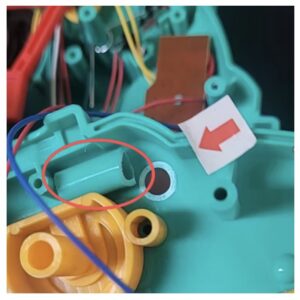
c. Client A has found ready-made samples of steering wheel toys on the market and asked us to conduct a sample risk assessment for them. After the full assessment following ASTM F963, we found that small parts would break off from the product after an internal drop test, as shown below:
2. Production plan
a. The customer’s required order quantity for this product is 50,000 sets. Client A has already received the order in April, with the delivery date scheduled for July. This leaves only 3 months for the sample design to be delivered. If the pre-production samples fail to meet the quality requirements in terms of design, it will lead to severe commercial losses.
b. Current production line capacity is equivalent to the delivery demand, with no surplus capacity available.
c. The current sample design improvement plan has not yet been provided. If the mould structure cannot be developed and designed correctly in one go, it will affect the delivery schedule and result in high air freight costs.
3. Implementing solutions early
a. In the current drop test of the samples, the internal screw boss column experienced a fracture. Following evaluation by our QA engineers, the optimal corrective action is to incorporate cross reinforcement ribs and a single rib at the base of the screw boss column.
b. Client A has approved our sample improvement plan. After mould opening and one round of mould modification, we have successfully developed qualified pre-production samples.

c. In addition, our QA engineers have put forward production process improvement suggestions for the internal wires of the product. As there are many internal wires which are messy, they are prone to being crushed during assembly and closure, leading to wire detachment and functional failure. We propose fixing the wires at specific positions with adhesive tape to prevent wire crushing and subsequent product malfunction.
Finally, customer A shipped the steering wheel toy with full compliance after our compliance control.
Process
This section describes the internal process applied by All Pass Global.
1. Identify product standards
We have our internal sample compliance checklist, which is specified for the product and intended market. With this checklist, we can identify the relevant standards in the European Union and the United States.
Our sample compliance checklist is cross-referenced to the test protocol of our partner third-party labs, such as Bureau Veritas. We will read through the checklist when assessing the standards applied to the products.
We have our own channel to access the latest standards, such as buying from office websites, sharing from partner labs or industry associations, etc.
2. Sample evaluation
First, our QA Engineers have more than 10 years of experience in the evaluation of samples regarding safety and reliability. They have been well-trained and familiar with the requirements of standards.
Second, we have our internal testing checklists for each applicable standard to avoid any points missed.
We will follow the requirements of the standards, if their result relies on specified equipment to be worked out. We will give our advice to our customer to send samples to our partner labs for further verification.
3. Implement product standards into technical drawings
Our QA engineer will clearly explain the risk findings and our improvement ideas to customers or their manufacturer, and they will make the improvement. We can go to the factory to support it if necessary in some cases.
Designing products for compliance isn’t just about the product itself. It’s about the whole package, quite literally.
We will also provide the services below for full compliance control:
- Customised Quality and Compliance strategy
- Quality Management System setup
- Supplier assessment
- Warning labels suggestions
- Testing arrangement
- Formulation compliance review
- Preparing technical files
- Onsite manufacturing control
- Inspections etc
About Kim Mai

Bachelor’s degree in Materials Science and Engineering, with nearly 20 years of experience in the toy industry. Kim Mai worked for 5 years at Mattel, a world-leading toy brand, as a core member of the laboratory team.
8 years of experience in liaising with quality departments of renowned retailers in Europe, the US, Canada, and Australia (e.g., Target, ASDA, Woolworths).
- Experienced 5 HOKLAS audits and 5 CNAS audits in toy testing.
- Previously served as Toy Quality Technical Manager at Bureau Veritas and NetEase.com.
- Served as Quality & Compliance Director at a toy company with annual sales of USD 50 million.
- 7 years of independent quality consulting experience (as of the end of 2025).
- Board member of the Guangxi Chamber of Commerce in Ningbo
About All Pass Global
Established in 2017 in the beautiful city of Ningbo, Zhejiang, All Pass Global is a consulting company specialising in interpreting quality and compliance requirements for toys and light industrial products at the market and retail ends and ensuring continuous fulfilment through quality planning.
Its core mission is “Facilitate Your Compliance”
All Pass Global provides quality and compliance strategy development, quality & compliance system establishment, technical knowledge base creation, early compliance warning, supplier enhancement and daily quality assurance, quality control, and quality engineering services to help domestic and international enterprises address compliance challenges and enhance international competitiveness.
Note: Ningbo Allpass Quality Technology Service Co., Ltd. is currently a board member of the Chamber of Commerce in Ningbo.