





 Find US, EU, UK, CA, & AU requirements












Companies that first introduce packaging or packaged products in an EU member state are generally considered to be producers under the Packaging and Packaging Waste Regulation (PPWR) 2025/40. This can also be the case for companies selling directly to end users in other EU member states.
The entity defined as a producer is generally responsible for extended producer responsibility tasks. This includes reporting packaging materials and volumes, and paying corresponding fees.
This guide explains how you can determine which company is the PPWR producer. I also share several practical examples of supply chains involving both EU and non-EU-based companies.
- Manufacturers, importers, and distributors can be defined as producers
- The producer is often the first entity that introduces packaging in a particular EU member state
- The producer must comply with EPR obligations
Content Overview

FREE CONSULTATION CALL (30 MIN)
 Ask questions about compliance requirements
- Countries/markets:
.png)
.png)
.png)


- Learn how we can help your business
You will speak with:Ivan Malloci
Who is defined as a producer under the PPWR?
Under the Packaging and Packaging Waste Regulation (PPWR) 2025/40, manufacturers, importers, and distributors can be defined as producers if they make packaging available for the first time in an EU member state.
Step 1: Are you a manufacturer, importer, or distributor?
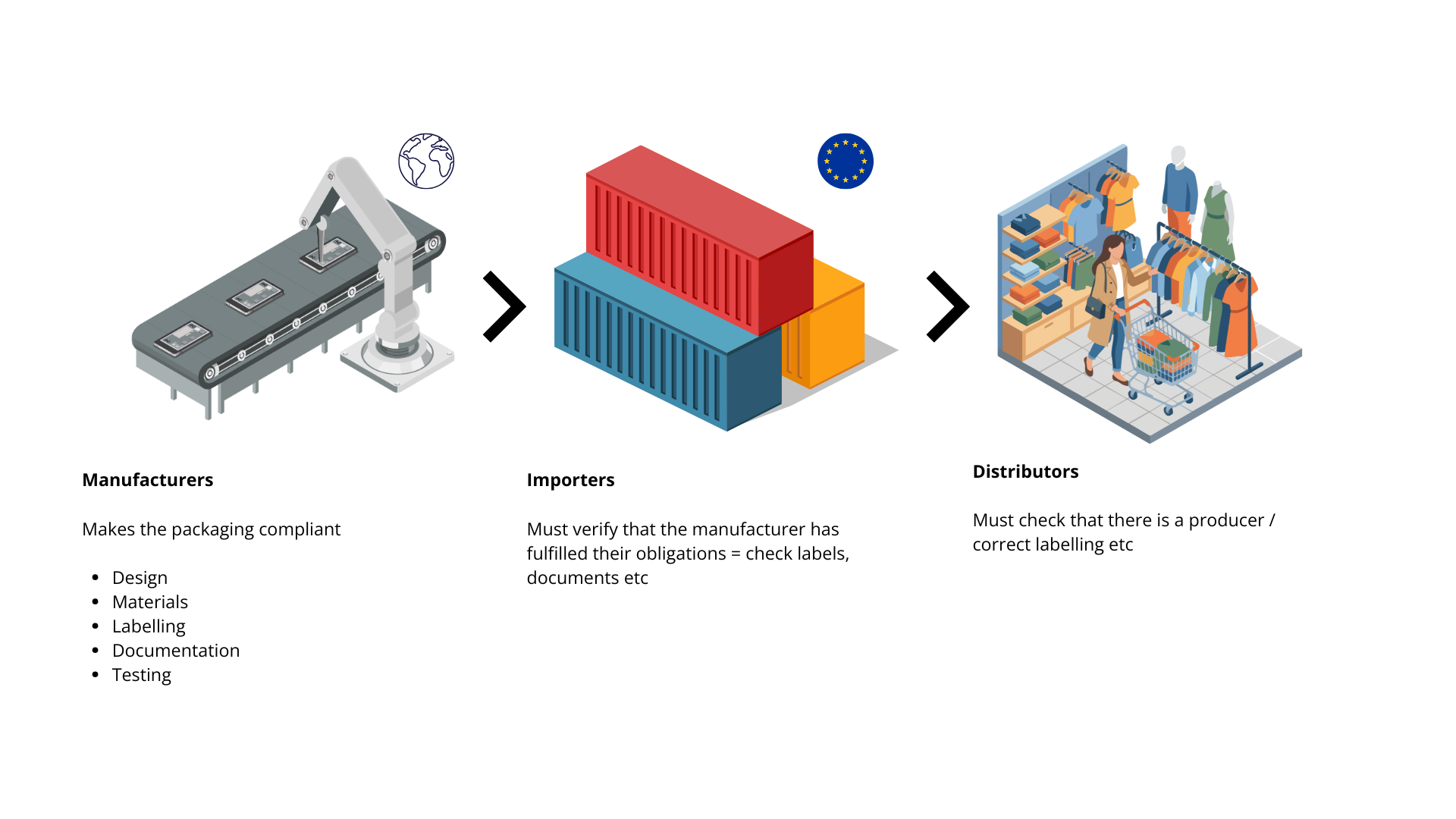
To be considered a producer, your company must be defined as one of the following:
Manufacturer: This is usually the company that has products manufactured and sold under its brand. They may or may not have their own production facilities. They can be located in or outside the EU.
Importer: This is the first EU-based company to introduce a product to the EU market. Only EU entities can be importers.
Distributor: This definition includes entities that are not manufacturers or importers, such as:
- Retailers buying goods from EU manufacturers or importers
- Wholesalers buying goods from EU manufacturers or importers
Step 2: When do you become a producer?
You generally become a producer under the PPWR when you are the first entity to introduce packaging into an EU member state. The definition of producers covers the following four scenarios:
| Manufacturer, importer or distributor | Packaging type | Examples |
| a. Established in a Member State
b. and makes available for the first time from within the same Member State |
Transport packaging, service packaging, or primary production packaging, whether as single-use packaging or as reusable packaging | a. EU brands introducing products in the same member state
b. EU importers introducing products in the same member state c. EU retailers and wholesalers introducing products in the same member state |
| a. Established in a Member State
b. and makes available for the first time from within the same Member State |
Products packaged in packaging | |
| a. Established in a Member State or in a third country
b. and makes available for the first time on the territory of another Member State, directly to end users |
Transport packaging, service packaging or primary production packaging, whether as single-use packaging or as reusable packaging; or | a. EU e-commerce company selling directly to end users (consumers and professional users) in another EU member state
b. Non-EU Amazon seller selling directly to end users in any EU member state |
| a. Established in a Member State or in a third country
b. and makes available for the first time on the territory of another Member State, directly to end users |
Products packaged in packaging | |
| a. Established in a Member State
B. and unpacks packaged products without being an end user, unless another person is the producer as defined in point (a), (b), (c) or (d); |
Packaged products |
The last point serves sort of as a safety net. If no entity has taken the role of a producer, then the entity that unpacks products becomes the producer.
Step 3: Find the producer in the supply chain
A producer is generally the company that makes packaging available for the first time in an EU member state. As described in the table above, there are two main principles that determine who the producer is:
This is further explored in the next section.
PPWR Producer Scenarios
The companies that are defined as producers in the member state of the consumer marked in violet below. Note that these are only examples, and there can be situations where this is not the case.
I use the Netherlands and Germany as examples to indicate geographical locations.
DE = Germany
NL = Netherlands
Within the same EU member state
EU manufacturer (NL) > End user (NL)
EU manufacturer (NL) > EU distributor (NL) > End user (NL)
Selling to another EU member state
EU manufacturer (NL) > End user (DE)
EU manufacturer (NL) > EU distributor (NL) > End user (DE)
EU manufacturer (NL) > EU distributor (DE) > End user (DE)
EU manufacturer (NL) > EU distributor (NL) > EU distributor (DE) > End user (DE)
EU manufacturer (NL) > EU distributor (NL) > EU distributor (DE) > End user (DE)
Non-EU manufacturer
Non-EU manufacturer > End user (DE)
Non-EU manufacturer > EU importer (NL) > End user (DE)
Non-EU manufacturer > EU importer (NL) > EU distributor (DE) > End user (DE)
Non-EU manufacturer > EU importer (NL) > EU distributor (NL) > EU distributor (DE) > End user (DE)
Multiple supply chains
Some brands sell both to distributors and directly to consumers. This means that the same company can be considered a producer in some EU member states, but not others.
| Manufacturer | Supply chain | Producer |
| Manufacturer (NL) | Selling B2C to end users in NL | Yes (Makes available for the first time from within the same Member State) |
| Selling B2B to retailers in NL | Yes (Makes available for the first time from within the same Member State) | |
| Selling B2C to end users in FR | Yes (Makes available for the first time on the territory of another Member State, directly to end users) | |
| Selling B2B to wholesalers in DE | No |
Visual examples
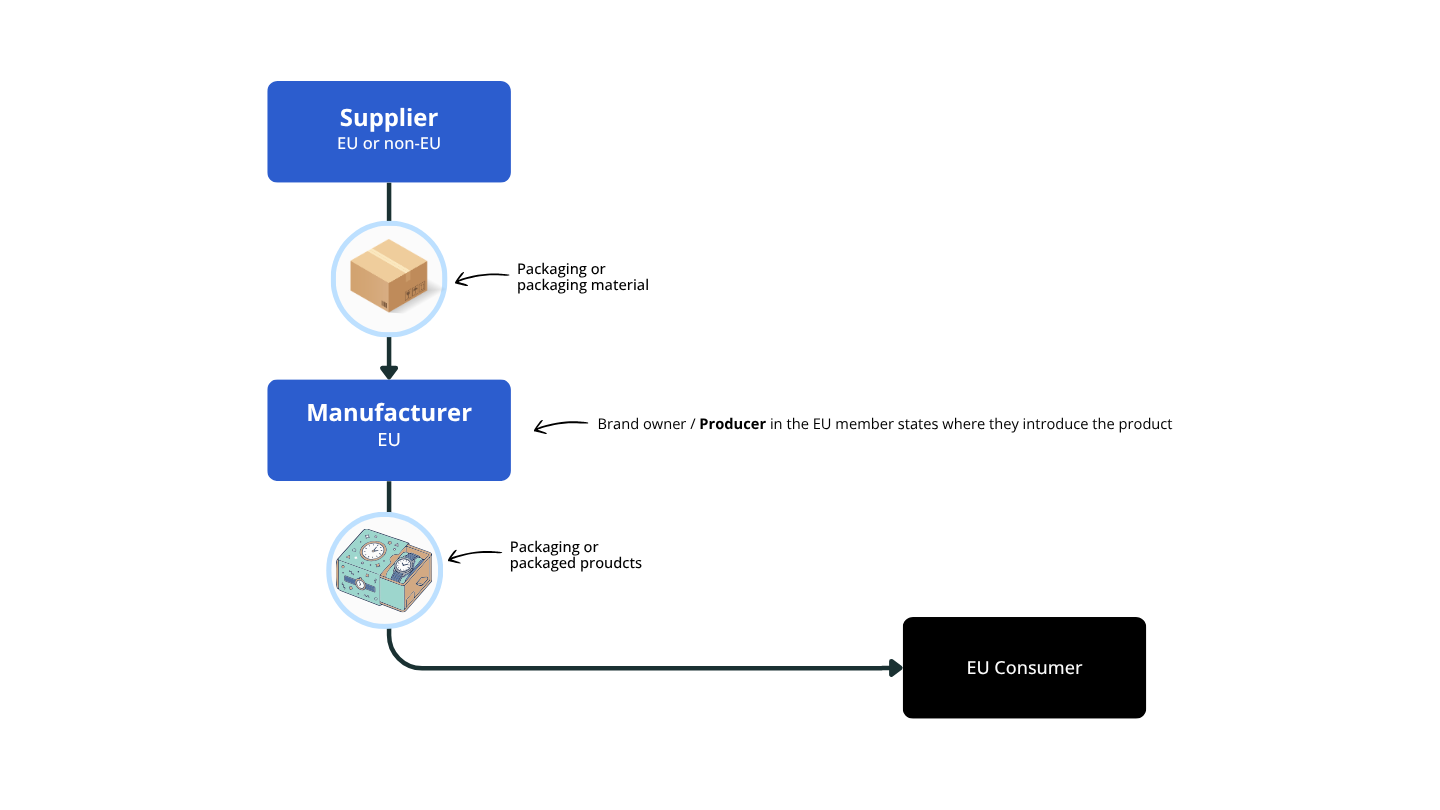
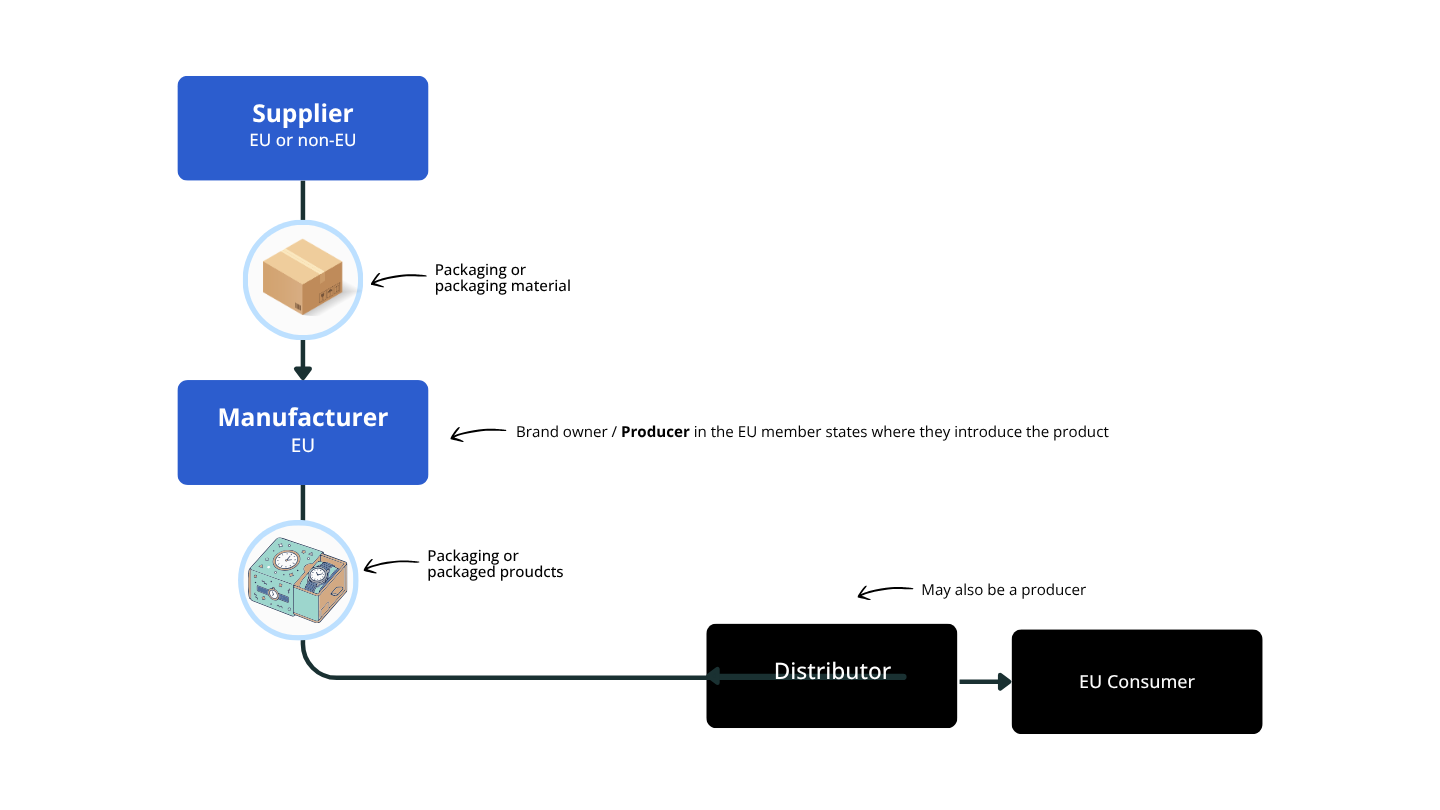
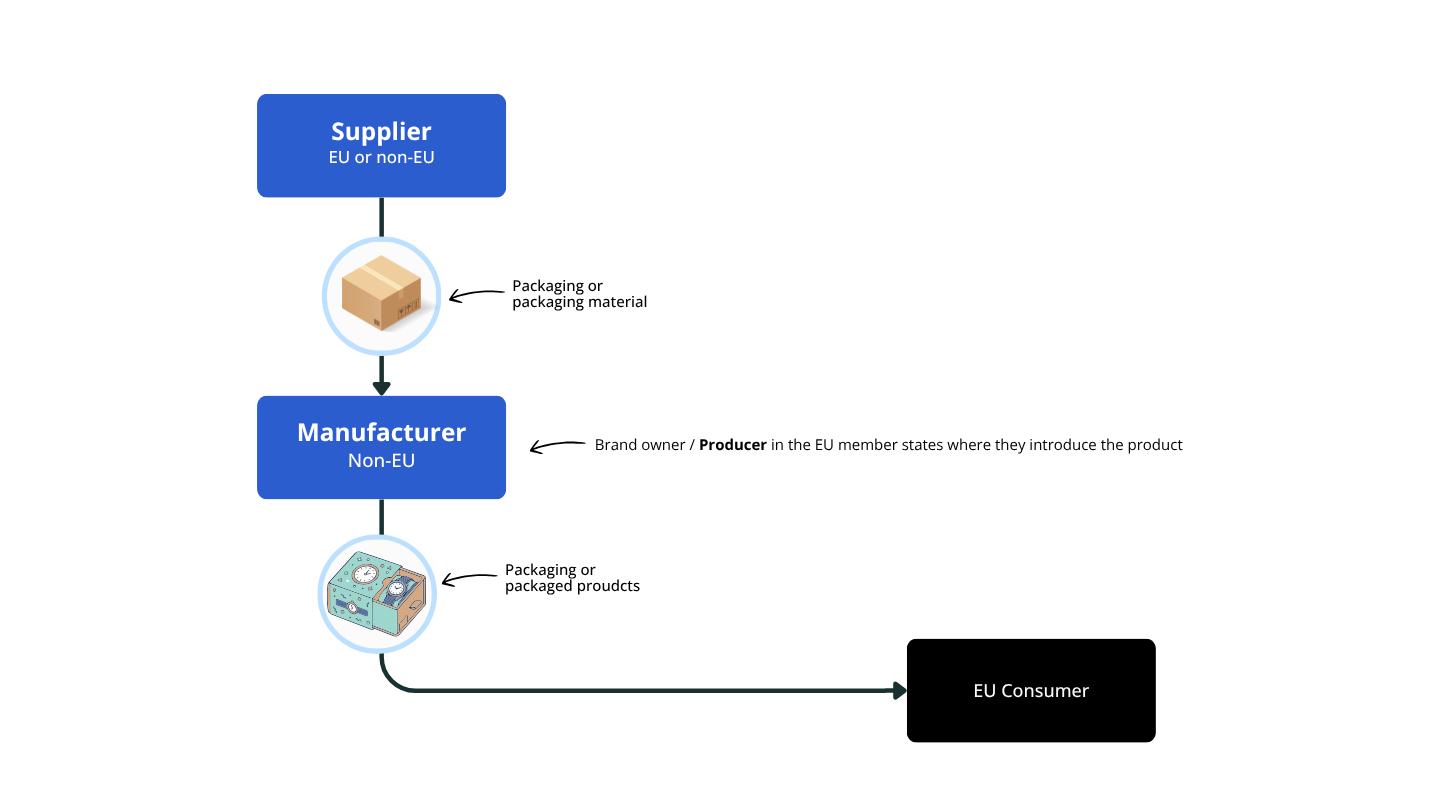
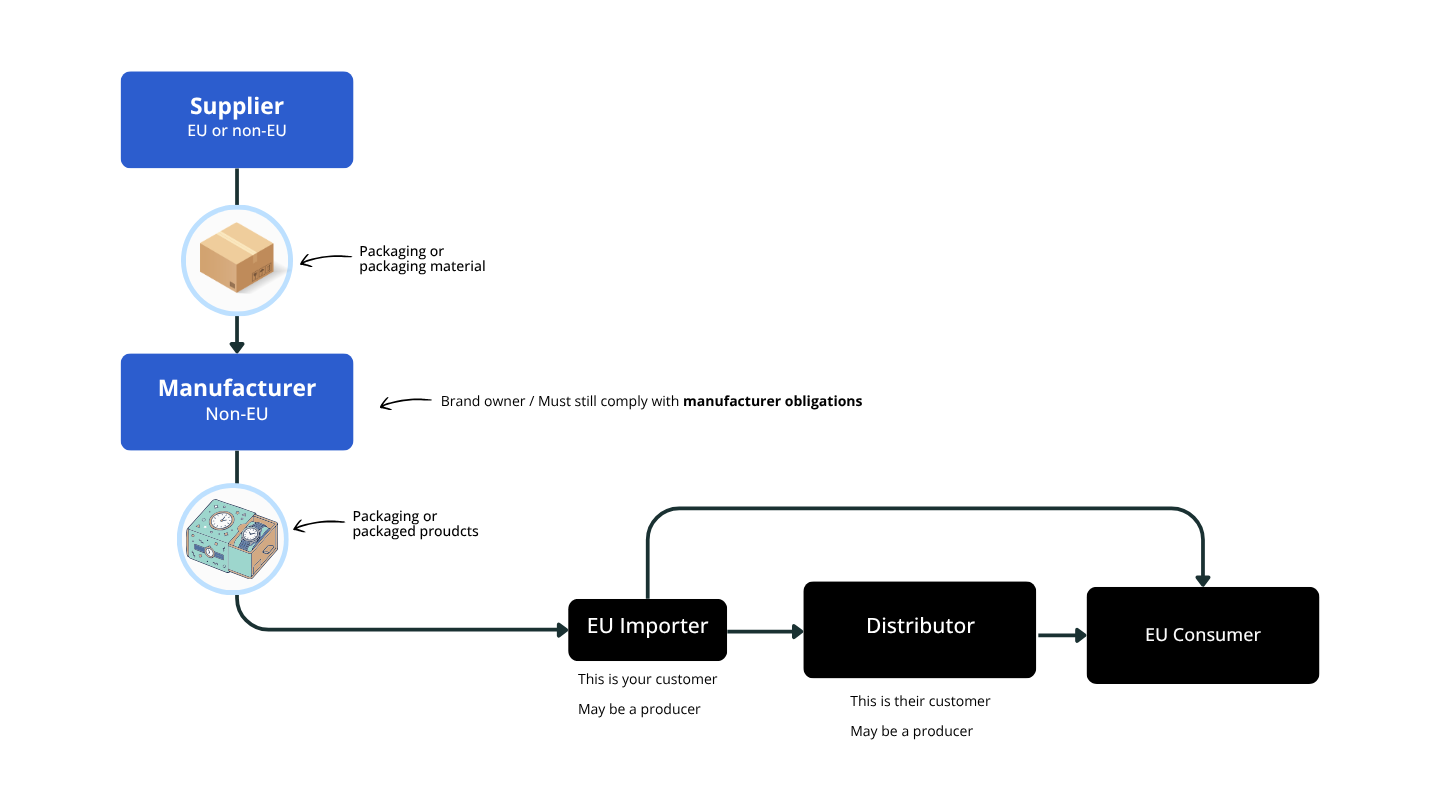
Producer obligations
Manufacturers are generally responsible for making packaging compliant in terms of design, chemicals, labelling, and documentation. The producer, on the other hand, is responsible for ensuring compliance with extended producer responsibility requirements.
This is also why a producer is only considered as such within a particular EU member state.
Here are some examples of actions that must be taken by producers:
1. Register with the national packaging registry
2. Appoint a producer responsibility organisation (PRO)
3. Appoint an authorised representative for extended producer responsibility
4. Submit reports on packaging materials and volumes
5. Pay the invoice based on the submitted data
You can find more information about producer responsibility in the following PPWR articles:
- Article 44 – Register of producers
- Article 45 – Extended producer responsibility
- Article 46 – Producer responsibility organisation
- Article 47 – Authorisation on fulfilment of extended producer responsibility
FAQ
Who is an end user?
The PPWR defines end users as:
a. Consumers, or
b. Professional end user in the course of its industrial or professional activities, and that does not make that product further available on the market
As such, an end user could be an individual buying products via Amazon, or a workshop buying tools for their own use (but not resale).
What is the difference between a manufacturer or producer?
A manufacturer is generally responsible for “making” the packaging compliant. In practice, this can mean
Can manufacturers be defined as PPWR producers?
Yes, manufacturers can be defined as producers when:
Yes, manufacturers can be defined as producers when:
a. Introducing a product in an EU member state where it is established
b. Selling to end users in other EU member states
Can importers be defined as PPWR producers?
Yes, an EU company importing products into a member state can be defined as producers.
Can retailers and wholesalers be defined as PPWR producers?
Yes, if a retailer or wholesaler in, for example, Germany can be defined as a producer when buying products from a manufacturer or importer in the Netherlands.
This is because the German company is the first to introduce the product in Germany.