




 Find US, EU, UK, CA, & AU requirements













The Packaging and Packaging Waste Regulation (PPWR) 2025/40 sets requirements applicable only to certain types of entities. In plain language, this means that what you must do to comply with the PPWR differs depending on whether your company is defined as a:
a. Manufacturer
b. Importer
c. Supplier
d. Distributor
It is therefore critical that you understand their respective definitions and can accurately find your place in the PPWR supply chain.
Further, companies can also be defined as producers (in addition to their primary definition), which results in additional extended producer responsibility (EPR) obligations applying.
Why should I read this guide?
Read this guide if you want to understand whether you are defined as a producer, manufacturer, importer, distributor, supplier, or other entity. You can read this guide to learn more about PPWR requirements:
Content Overview

FREE CONSULTATION CALL (30 MIN)
 Ask questions about compliance requirements
- Countries/markets:
.png)
.png)
.png)


- Learn how we can help your business
You will speak with:Ivan Malloci
Definitions
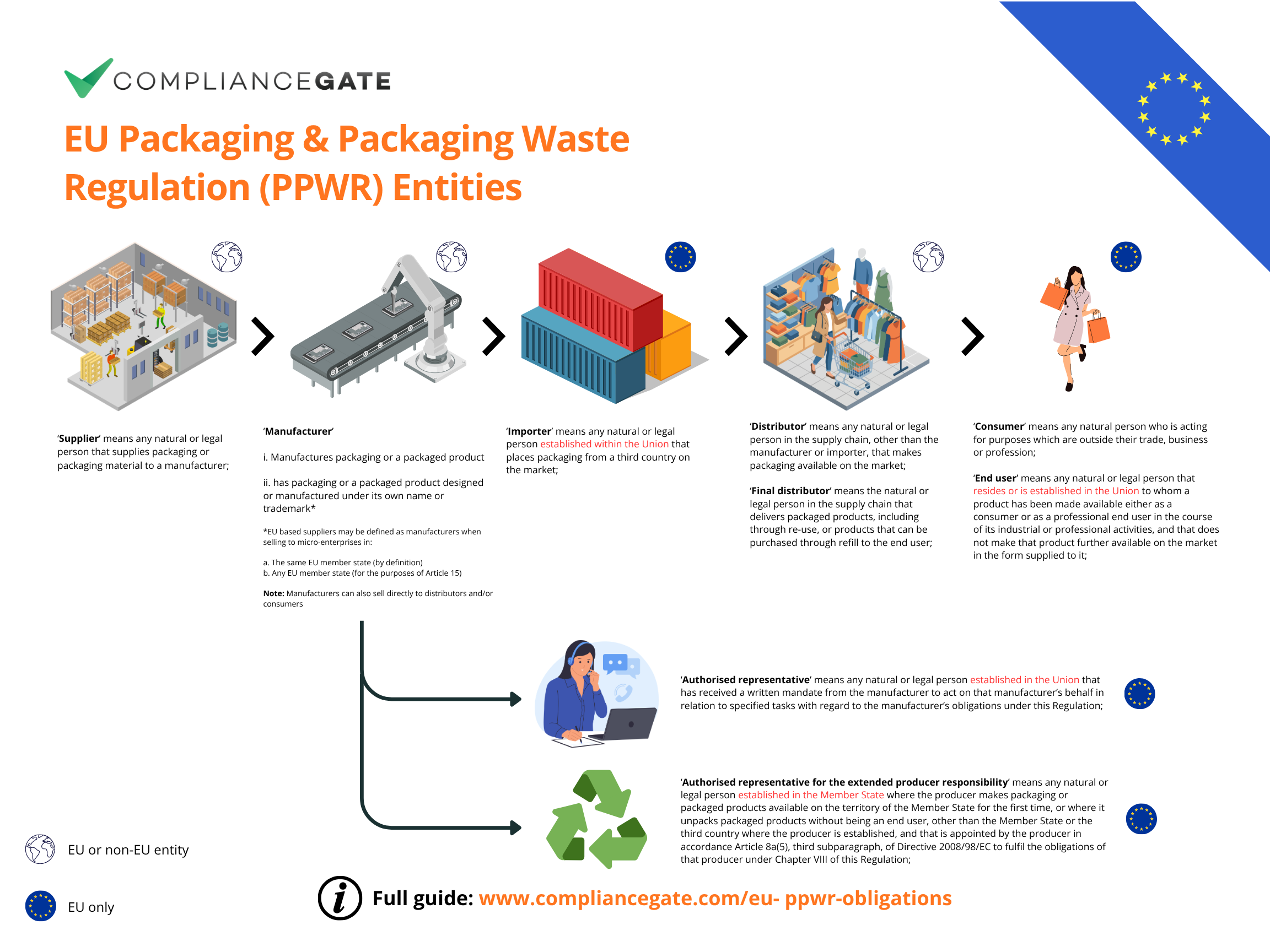
The PPWR sets obligations for many different types of entities. You must understand which definition your company falls under before you can determine what you must do to comply with the PPWR.
Overview
| Entity | Definition | Example |
| Supplier | Natural or legal person that supplies packaging or packaging material to a manufacturer; | Packaging factory selling gift boxes to a jewellery brand
Note: The supplier can be located both in the EU and outside |
| Manufacturer | i. Manufactures packaging or a packaged product
ii. Has packaging or a packaged product designed or manufactured under its own name or trademark* *Suppliers may be defined as manufacturers when selling to micro-enterprises in: a. The same EU member state (by definition) |
i. Jewellery factory produces jewellery packed in boxes in its own facility
ii. Jewellery brand ordering custom-designed necklaces packed in boxes from a factory Note: The manufacturer can be located both in the EU and outside |
| Importer | Natural or legal person established within the Union that places packaging from a third country on the market | EU-based jewellery wholesaler importing finished pieces from a UK-based jewellery brand
Note: Companies importing goods can also be defined as manufacturers |
| Distributor | Natural or legal person in the supply chain, other than the manufacturer or importer, that makes packaging available on the market | An EU-based jewellery wholesaler buying products from EU-based companies |
| Final distributor | Natural or legal person in the supply chain that delivers packaged products, including through re-use, or products that can be purchased through refill to the end user | EU-based jewellery retailer |
| Consumer | Natural person who is acting for purposes which are outside their trade, business or profession | A person buying a necklace for their own use or as a gift |
| End consumer | Natural or legal person that resides or is established in the Union to whom a product has been made available either as a consumer or as a professional end user in the course of its industrial or professional activities, and that does not make that product further available on the market in the form supplied to it |
Example supply chain
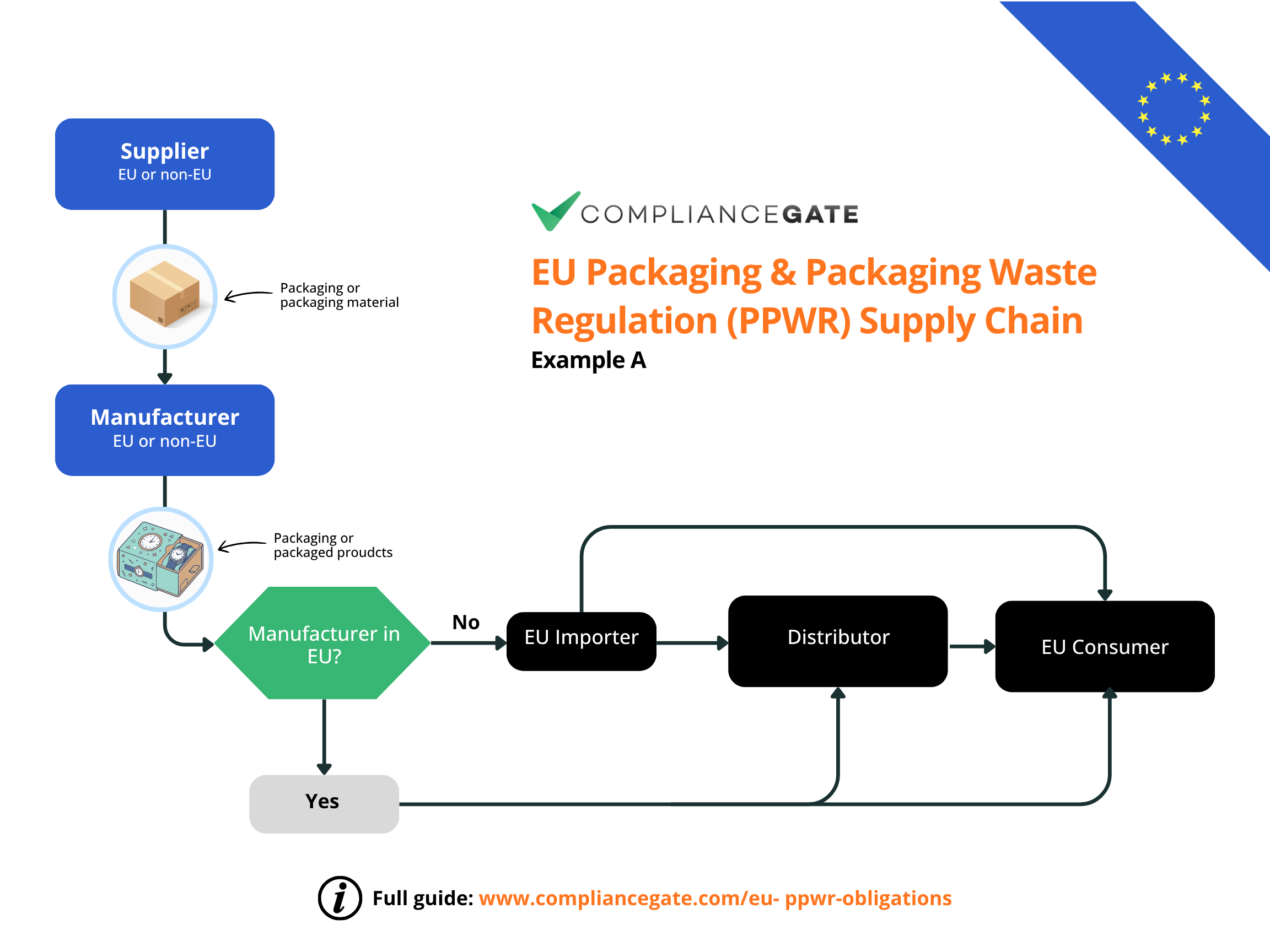
Non-EU companies
The location of the entity is relevant in the following ways:
a. Certain entities (i.e., importers) can only be defined as such if established in the EU
b. Certain requirements are only applicable if the entity is established in the EU (i.e., supplier selling to microenterprises)
That said, suppliers, manufacturers, and even distributors are not strictly defined as being based in the EU.
Who is the PPWR manufacturer?
The manufacturer is primarily responsible for ensuring that the packaging “physically” is compliant with the PPWR. Here are some areas that fall under manufacturer obligations:
- Substance restrictions
- Packaging design
- Labelling
- Documentation
- Testing
The first question that must be asked is often whether or not a particular company falls within the PPWR manufacturer definition.
The table below provides several scenarios that can be helpful when placing yourself in the PPWR supply chain.
| Entity A | Scenario | Procures | Entity B | Outcome |
| EU company | imports | custom branded or custom designed packaging or packaged products | from a non-EU factory | The EU buyer is the manufacturer/importer |
| EU company | buys | custom branded or custom designed packaging or packaged products | from an EU factory | The EU buyer is the manufacturer |
| EU company | imports | packaging or packaged products (seller owns the brand/design) | from a non-EU factory | i. EU company = Importer ii. Non-EU factory = Manufacturer |
| EU company | buys | packaging or packaged products (seller owns the brand/design) | from an EU factory | i. EU company = Importer ii. EU factory = Manufacturer |
| EU packaging supplier | supplying | packaging | to a micro-enterprise in the same EU member state | EU packaging supplier is the manufacturer |
| EU packaging supplier | supplying | packaging | to a micro-enterprise in any EU member state | EU packaging supplier is the manufacturer (within Article 15 only) |
| Non-EU company | sells | branded or custom designed packaging or packaged products (buyer brand brand) | to an EU importer | EU importer is the manufacturer |
| Non-EU company | sells | branded or custom designed packaging or packaged products (seller brand) | to an EU importer | Non-EU company is the manufacturer |
| Non-EU company | sells | branded or custom designed packaging or packaged products (seller brand) | to an EU consumer | Non-EU company is the manufacturer |
Who is the PPWR producer?
Whereas the manufacturer is primarily responsible for ensuring that the packaging is correctly designed, labelled, and documented, the entity defined as the producer is primarily responsible for ensuring that EPR obligations are met.
- Register with a producer responsibility organisation and the national register
- Assign EU authorised representatives for extended producer responsibility
- Report packaging materials and volumes
- Pay financial contributions for recycling and waste management of packaging
Note that a company defined as a manufacturer, importer, or distributor can also be defined as a producer and thereby assume responsibility for producers.
Overview
Point 15 under Article 3 provides four scenarios where a manufacturer, importer, or distributor can be defined as a producer:
| Point 15(a) | Point 15(b) | |
| Producer | Manufacturer, importer, or distributor | Manufacturer, importer, or distributor |
| Producer location | EU | EU |
| Customer location | EU (Same Member State) | EU (Same Member State) |
| Scope | Transport packaging, service packaging, or primary production packaging, whether as single-use packaging or as reusable packaging | Products packaged in packaging |
| Conditions | i. Makes available for the first time from within the territory of that Member State and on that same territory
ii. transport packaging, service packaging, or primary production packaging, whether as single-use packaging or as reusable packaging; or |
i. Makes available for the first time from within the territory of that Member State and on that same territory
ii. products packaged in packaging other than those referred to in point (a) |
| Point 15(c) | Point 15(d) | |
| Producer | Manufacturer, importer, or distributor | Manufacturer, importer, or distributor |
| Producer location | EU or non-EU | EU or non-EU |
| Customer location | EU: Another EU Member State
Non-EU: Any EU Member State |
EU: Another EU Member State
Non-EU: Any EU Member State |
| Scope | Packaging (single-use and reusable) | Products packaged in packaging |
| Conditions | i. Makes available for the first time on the territory of another EU Member State
ii. Directly to end users, transport packaging, service packaging, or primary production packaging, whether as single-use packaging or as reusable packaging |
i. Makes available for the first time on the territory of another Member State
ii. Directly to end users, products packaged in packaging other than those referred to in point (c); or |
Definition
‘Producer’ means any manufacturer, importer, or distributor to whom, irrespective of the selling technique used, including by means of distance contracts, one of the following applies:
(a) the manufacturer, importer or distributor is established in a Member State and makes available for the first time from within the territory of that Member State and on that same territory transport packaging, service packaging, or primary production packaging, whether as single-use packaging or as reusable packaging; or
(b) the manufacturer, importer or distributor is established in a Member State and makes available for the first time from within the territory of that Member State and on that same territory products packaged in packaging other than those referred to in point (a); or
(c) the manufacturer, importer or distributor is established in a Member State or in a third country and makes available for the first time on the territory of another Member State, directly to end users, transport packaging, service packaging or primary production packaging, whether as single-use packaging or as reusable packaging; or
(d) the manufacturer, importer or distributor is established in a Member State or in a third country and makes available for the first time on the territory of another Member State, directly to end users, products packaged in packaging other than those referred to in point (c); or
(e) the manufacturer, importer or distributor is established in a Member State and unpacks packaged products without being an end user, unless another person is the producer as defined in point (a), (b), (c) or (d);
FAQ
What are the PPWR responsibilities for manufacturers?
Manufacturers are generally responsible for ensuring that packaging is “physically” compliant with the requirements set by the PPWR. This includes the following aspects:
1. Ensure that the packaging does not contain restricted substances
2. Ensure that packaging meets design and sustainability requirements
3. Affix required labels and label information
4. Prepare the DoC and technical documentation
5. Arrange testing
The manufacturer is then expected to pass on compliance documentation to importers and distributors who are further downstream in the supply chain.
What are the PPWR responsibilities for importers?
Importers are generally responsible for ensuring that the manufacturer has done what they need to do to comply with the PPWR. Doing so often involves the following actions:
1. Obtain test reports to determine if the packaging meets substance restrictions
2. Evaluate if the packaging meets design and sustainability requirements
3. Validate labelling and documentation
Note that additional labelling requirements apply to importers.
In any case, evaluating if a manufacturer has done everything by the book requires a thorough understanding of the PPWR.
What are the PPWR responsibilities for distributors?
Distributors also have certain obligations under the PPWR, which can be found in Article 19. Here are some of the key requirements:
1. Verify that the producer who is responsible for EPR is registered in the register of producers
2. Verify that the packaging meets labelling requirements in Article 12
3. Check that the following manufacturer and importer (if any) label information is present:
- Type, batch, or serial number
- Manufacturer name, registered trade name, or registered trademark
- Manufacturer postal address and electronic contact point
- Importer name, registered trade name or registered trademark
- Importer postal address and electronic contact point
What is the difference between a manufacturer and a producer?
A manufacturer is primarily responsible for making the packaging compliant by design, affixing labels, creating documentation, and arranging testing. The manufacturer can either be the factory producing packaging or packaged products, or the company designing and branding the goods.
The producer, on the other hand, is responsible for extended producer responsibility. The producer is generally the company that first introduced a product in an EU member state.
Note that a company can be both a manufacturer and a producer under the PPWR.
Are non-EU companies required to comply with the PPWR?
Yes, non-EU companies can also be defined as manufacturers or even producers under the PPWR. This means that companies in the United Kingdom, the United States, China, and other countries can be subject to PPWR obligations.
Are non-EU companies selling B2B to EU companies responsible for PPWR?
Yes, they can, for example, be defined as manufacturers and thus responsible for ensuring compliance with the PPWR.
PPWR compliance is, of course, not mandatory for all companies around the world. But non-EU manufacturers who fail to comply with the PPWR cannot:
a. Sell to EU importers
b. Sell directly to consumers in the EU
Again, selling to the EU is not mandatory, but the PPWR is a big deal for non-EU companies that currently do so and intend to continue doing so.
Are non-EU companies selling B2C to EU consumers responsible for PPWR?
Yes, as mentioned above, PPWR compliance is mandatory for non-EU companies selling directly to consumers.
Non-EU companies can, for example, be defined both as manufacturers and producers. This means that they can be subject to both packaging obligations and those related to EPR.
Are UK companies responsible for PPWR compliance when selling to the EU?
Yes, UK companies must comply with PPWR obligations if they wish to sell to businesses in the EU or directly to consumers. What those obligations are depends on whether the UK company is defined as a supplier, manufacturer, or other entity.
Are Chinese factories exporting to the EU responsible for PPWR compliance?
Chinese companies selling to EU importers may be considered manufacturers and thus be responsible for PPWR compliance, at least if they want to enable EU importers to purchase their packaging or packaged products.
That said, EU companies outsourcing production of their own branded products (or custom-designed products) are likely deemed manufacturers. In this scenario, the responsibility mainly falls on the company defined as the manufacturer, which is an EU company.
Even in the latter scenario, Chinese factories must still ensure that the packaging does not contain restricted substances.