




 Find US, EU, UK, CA, & AU requirements













Planning to manufacture or import general-use products to the United States? This guide explains what you must know about product safety rules, testing, certification, labeling, and other requirements.
- Compliance with product safety rules is mandatory
- Testing is required to verify compliance
- You must issue a GCC
- eFiling is mandatory for general-use products
Content Overview

FREE CONSULTATION CALL (30 MIN)
 Ask questions about compliance requirements
- Countries/markets:
.png)
.png)
.png)


- Learn how we can help your business
You will speak with:Ivan Malloci
What are General-Use Products?
General-use products are a term used by the US Consumer Product Safety Commission (CPSC) referring to non-children’s products subject to one or more product safety rules.
For example, devices containing button cell batteries are defined as general-use products on the basis that Part 1263 applies.
You can find a list of general-use products below:
- All-terrain vehicles
- Architectural glazing materials
- Adult portable bed rail
- Artificial emberizing materials
- Bicycle helmets
- Bicycles
- Bunk beds
- Button cell or coin battery
- Carpets and rugs (large)
- Carpets and rugs (small)
- CB antennas
- Cellulose insulation
- Cigarette lighters
- Clothing storage units
- Consumer patching compounds
- Dive sticks and other similar articles
- Drywall
- Fireworks
- Garage door openers
- Lawn darts
- Liquid nicotine packaging
- Magnets
- Matchbooks
- Mattresses and mattress pads
- Mattresses and mattress sets
- Metal-cored candlewicks
- Multipurpose lighters
- Paints and similar surface coatings containing lead
- Portable fuel containers (flame mitigation device)
- Portable fuel containers (special packaging)
- Power lawn mowers (walk-behind)
- Refrigerator doors
- Refuse bins
- Wearing apparel
- Special packaging
- Swimming pool slides (freestanding)
- Toy, look-alike, and imitation firearms
- Vinyl plastic film
- Pool and spas
General-Use Product Requirements
Below follows a breakdown of key requirements applicable to general-use products covered by one or more product safety rules.
1. Product safety rules
The first step of the process is to identify all applicable product safety rules, as this determines if your product is subject to general-use product safety requirements in the first place.
Examples
| Product | Rule |
| Clothing storage units | 16 CFR part 1261 |
| Carpets and rugs (large) | 16 CFR part 1630 |
| Magnets | 16 CFR part 1262 |
| Button cell or coin battery | 16 CFR part 1263 |
| Mattresses and mattress pads | 16 CFR part 1632 |
| Wearing apparel | 16 CFR part 1610 |
2. Design for compliance
Product safety rules set requirements that impact the design, functionality, flammability, labeling, and other safety aspects of the covered products. This requires that you design your product according to the requirements set by the product safety rule.
Here are some examples of what this can mean in practice:
16 CFR part 1263 – Button cell or coin battery
a. Design the battery compartment to ensure that it meets the mechanical requirements.
b. Affix warning labels
16 CFR part 1610 – Wearing apparel
Ensure that you only use fabrics that meet flammability requirements.
Note
The specific requirements and technical details can be found in the eCFR. In any case, you need to thoroughly read the text in the eCFR and adjust your technical design files and material specifications accordingly.
3. Reasonable testing program
The manufacturer or importer must establish a “reasonable testing program” that ensures that compliance with the applicable product safety rules is verified.
For many products, it is up to the manufacturer or importer to determine what a reasonable testing program is, even though the CPSC has issued the following guidelines:
a. Compliance must be verified
b. The program must be available in writing
c. The program should consider the number, frequency, and methods of tests
It should also be noted that some product safety rules set more specific testing requirements.
Example
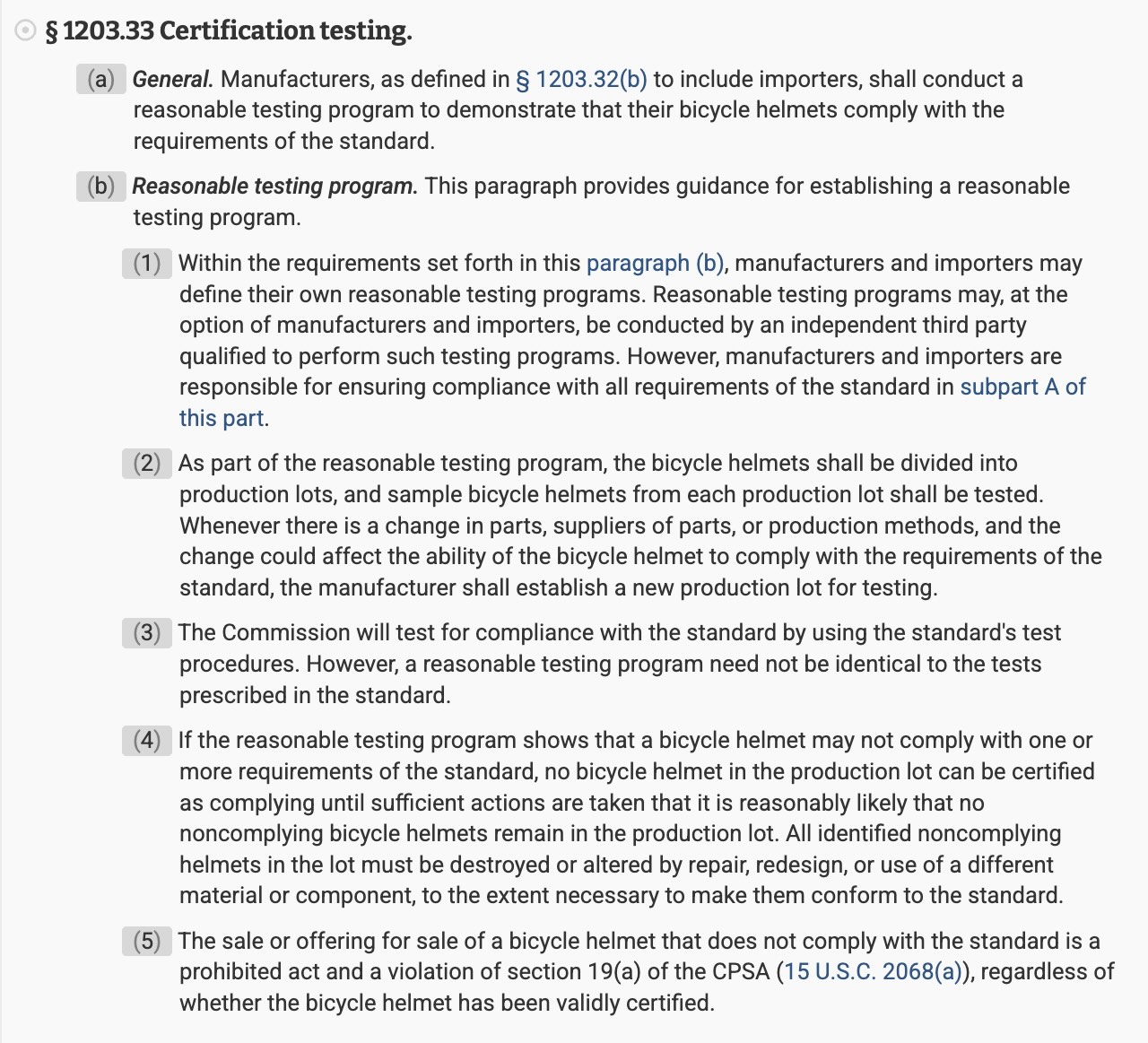
For example, Part 1203 – Safety Standard for Bicycle Helmets sets the following requirements:
(e) Reasonable testing program means any tests which are identical or equivalent to, or more stringent than, the tests defined in the standard and which are performed on one or more bicycle helmets selected from the production lot to determine whether there is reasonable assurance that all of the bicycle helmets in that lot comply with the requirements of the standard.
More detailed requirements can be found under 1203.33 Certification Testing:
Mandatory testing
A common misunderstanding is that testing is voluntary when it comes to general-use products. It may be the case that third-party testing is not always required. That said, compliance with product safety rules is mandatory, and conformity with their requirements must be verified.
Most companies do not have the equipment and expertise to verify compliance through testing, which is why third-party testing is in practice often necessary.
General Certificate of Conformity (GCC)
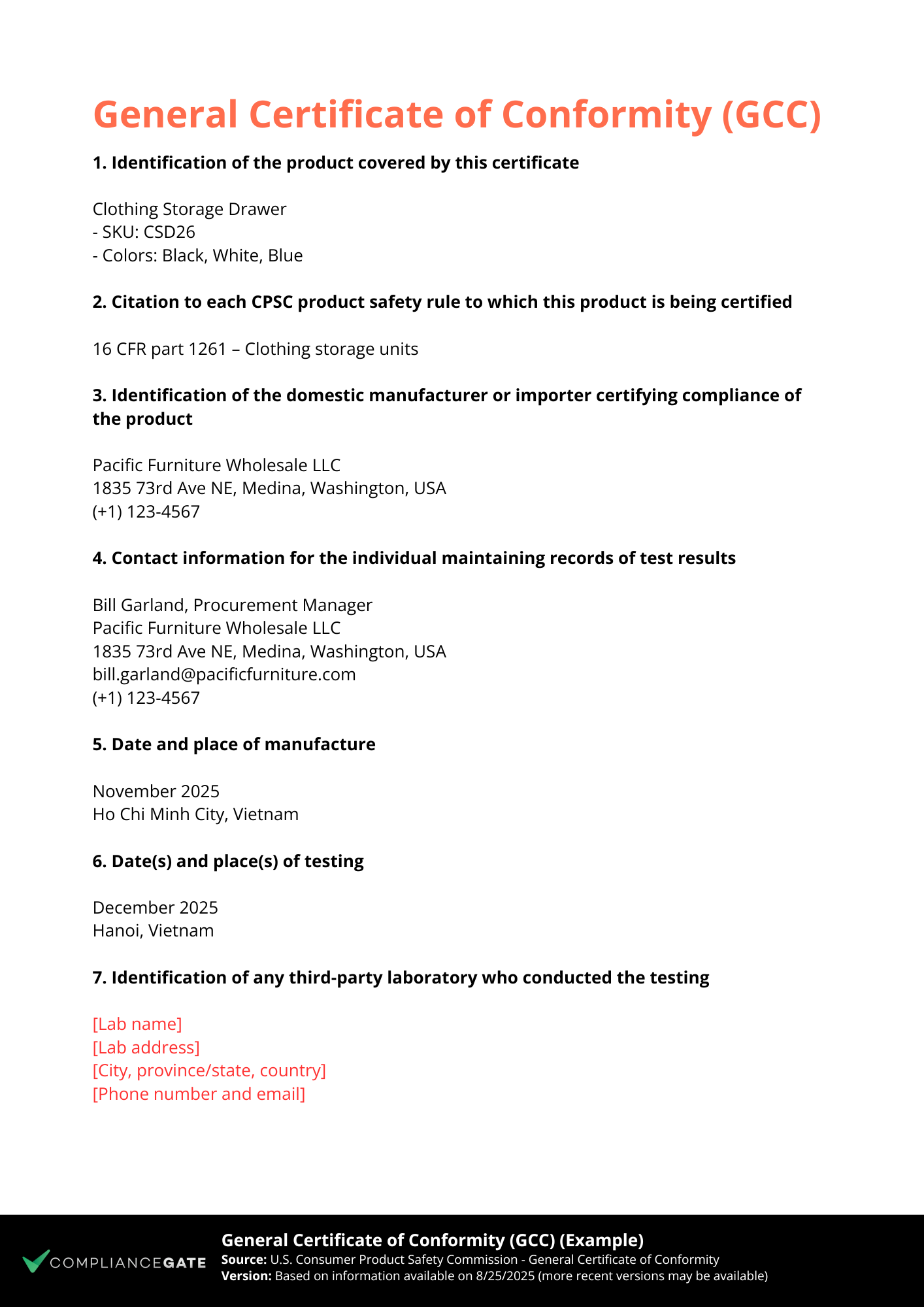
You must issue a General Certificate of Conformity (GCC), which contains information about the product and product safety rules.
Labeling and documentation
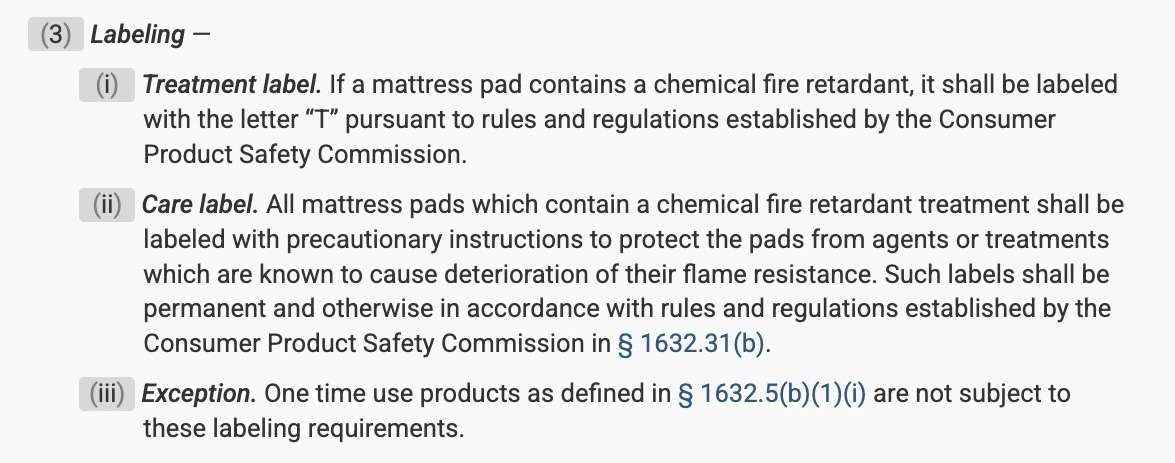
There is, as far as I know, at least, no uniform tracking label format which applies to all general-use products. That being said, many product safety rules do contain labeling and documentation requirements that must be complied with.
A few examples can be found below.
Part 1263 – Button cell or coin battery

16 CFR part 1632 – Mattresses and mattress pads
eFiling of Certificate Data
eFiling is required when importing general-use products subject to product safety rules into the United States. This process requires that you:
a. Create an eFiling account
b. Submit certificate data for each shipment for general-use products
You can learn more about eFiling for general-use products in this guide.
FAQ
Are general-use product safety rules mandatory?
Yes, general-use product safety rules are mandatory for products that fall within their scope. For example, devices with button cell batteries must comply with Part 1263.
Are all non-children’s products general-use products?
No, not all non-children’s products are subject to general-use product requirements. This is only the case for products subject to product safety rules, which require a GCC.
Plenty of products are not subject to such rules and are therefore not subject to general-use product requirements. However, such products can still be subject to other regulatory requirements in the United States.
How do I know if a product is subject to general-use product requirements?
You need to determine if your product is subject to one or more CPSC product safety rules. For example, devices containing button cell batteries are covered by Part 1263 and are therefore subject to general-use product requirements.
Is testing required for general-use products?
Yes, testing is required in the sense that you need to verify compliance with the applicable product safety rules, which in turn requires testing.
Is testing voluntary for general-use products?
No, you need to write and implement a reasonable testing program, which should result in compliance with applicable product safety rules being validated.
Do we need to arrange testing with a CPSC-accepted lab for general-use products?
No, unlike children’s products, you do not need to use a CPSC-accepted lab. That said, I don’t see a reason why you should not, as CPSC-accepted labs are more likely to be:
a. Recognised and trustworthy testing companies
b. Capable of testing products according to CPSC product safety rules
It is ultimately in your best interest as a manufacturer or importer to validate compliance with applicable product safety rules. I would personally not consider a testing lab that is not found within the CPSC lab database.
Do I need a GCC for general-use products?
Yes, a GCC is mandatory for general-use products.