



 Find US, EU, UK, CA, & AU requirements












Home textile products imported or manufactured for sale in the European Union are subject to various regulations and standards. These cover flammability, mechanical safety, chemicals, and labelling requirements.
Product examples
Here are some examples of home textile products covered by this guide:
- Curtains and drapes
- Blinds
- Rugs
- Bedding products
- Cushions
- Mattress covers
- Hand towels
- Bath towels
- Tablecloths
- Table and kitchen textiles
- Oven mitts
- Furniture fabrics
- Floor coverings
- Bath mats
- Shower curtains
Content Overview

FREE CONSULTATION CALL (30 MIN)
 Ask questions about compliance requirements
- Countries/markets:
.png)
.png)
.png)

- Learn how we can help your business
You will speak with:Ivan Malloci
Are home textiles regulated in the EU?
Yes, home textiles are generally deemed to be consumer products and must therefore meet the requirements under the General Product Safety Regulation. Various home textile products are also covered by EU textiles labelling requirements.
In addition, chemical restrictions under REACH and other regulations also apply to home textiles.
General Product Safety Regulation (GPSR)
The General Product Safety Regulation (GPSR) mandates that all consumer products sold in the EU are fundamentally safe. This can often be achieved by implementing relevant product standards. Here are some examples of safety aspects relevant for many home textile products:
Flammability
Flammability is a key safety aspect that must be addressed for home textile products. Here are examples of EN standards covering textiles flammability:
EN ISO 12952-1 – Textiles – Assessment of the ignitability of bedding items – Part 1: Ignition source: smouldering cigarette
EN ISO 12952-2 – Textiles – Assessment of the ignitability of bedding items – Part 2: Ignition source: match-flame equivalent
EN 1101 – Textiles and textile products – Burning behaviour- Curtains and drapes – Detailed procedure to determine the ignitability of vertically oriented specimens (small flame)
EN 1102 – Textiles and textile products – Burning behaviour – Curtains and drapes – Detailed procedure to determine the flame spread of vertically oriented specimens
EN 1021-1 – Furniture – Assessment of the ignitability of upholstered furniture – Part 1: Ignition source smouldering cigarette
EN 1021-2 – Furniture – Assessment of the ignitability of upholstered furniture – Part 2: Ignition source match flame equivalent
EN 14533 – Textiles and textile products – Burning behaviour of bedding items – Classification scheme
Mechanical safety
Curtain rods, rails and other hardware must be mechanically safe. Here are some examples of aspects that should be taken into account:
- Structural integrity
- Stability
- Sharp points
- Small parts
Note that foreseeable misuse must also be factored in, including potential incidents caused by children.
A few examples of relevant standards in this area are listed below:
EN 13120 – Internal blinds – Performance requirements including safety
EN 13561 – External blinds and awnings – Performance requirements including safety
EN 13659 – Shutters and external venetian blinds – Performance requirements including safety
Chemicals and heavy metals
Home textiles can contact harmful chemicals and heavy metals. While this should be part of the risk analysis, the specific substance limits that must be met are found in other regulations.
Other requirements
Note that the GPRS also set the following requirements for consumer products:
- Traceability labelling
- Technical documentation
- Testing
Textile Labelling and Fibre Composition Regulation
The Textile Labelling and Fibre Composition Regulation requires that the correct fibre composition is permanently affixed to the product.
Examples
- All cotton
- Pure cotton
- 100% cotton
- 75% cotton 25% polyester
Covered products
The regulation applies to products containing at least 80% textile fibers by weight. The scope also mentions the following home textile products:
- Upper layer of multi-layer floor coverings
- Mattress coverings
- Textiles incorporated in other products
As such, the regulation covers most home textile products. Note that some components are exempt from labelling.
Inclusive labelling
A single label for several textile products or components (inclusive labelling) is accepted for the following home textile products:
- Floorcloths
- Cleaning cloths
- Edgings and trimmings
- Passementerie
- Ribbons
- Elastic
- Handkerchiefs
- Bibs, washgloves and face flannels
- Sewing, mending and embroidery yarns (for retail sales)
- Tape for curtains and blinds and shutters
Exempt items
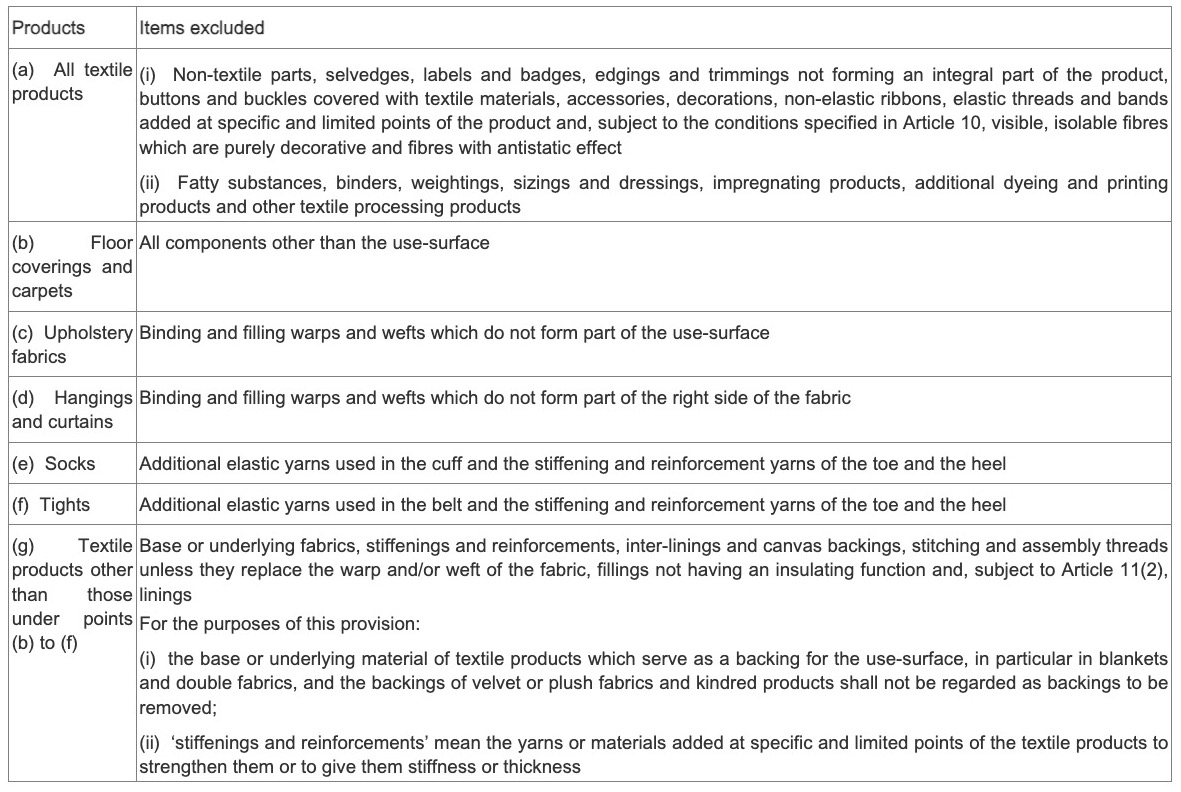
Certain exemptions apply to certain components that may be incorporated into home textile products. These are summarised in the table below:
Exemptions
The following home textile products are exempt from textile labelling requirements under the regulation:
- Labels and badges
- Stuffed pan-holders of textile
- Coffee cosy covers
- Tea cosy covers
- Sleeve protectors
- Muffs other than in pile fabric
- Pin cushions
- Textile products for base and underlying fabrics and stiffenings
- Hand-embroidered tapestries
- Book covers of textile materials
- Table mats having several components and a surface area of not more than 500 cm2
- Oven gloves and cloths
- Egg cosy covers
- Disposable products, with the exception of wadding
- Flags and banners
REACH Regulation
The REACH regulation restricts substances that can be found in home textiles. Here are some examples of such substances:
- Lead
- Cadmium
- DEHP
- AZO dyes
Note that restricted chemicals can be found in not only fabrics, but also hardware parts and surface coatings. The specific substance limits can be found in Annex XVII of the regulation.
Third-party lab testing is often required to verify compliance with REACH, and other substance regulations.
POPs Regulation
The POPs Regulation set restrictions on various persistent organic pollutants that can sometimes be found in home textiles, often caused by pesticide use. This includes various types of PFAS.
Testing is generally required to verify compliance with the POPs regulation.
Biocidal Product Regulation
The Biocidal Product Regulation covers products which are treated with biocides. Here are a few examples of home textiles treated with biocidal products:
a. Anti-mold treatment applied to outdoor home textiles
b. Antibacterial home textiles
c. Anti-odor treated home textiles
d. Insecticide treated home textiles
Label
A label must be affixed to the product if the manufacturer makes claims regarding the biocidal properties of the product:
(a) a statement that the treated article incorporates biocidal products;
(b) where substantiated, the biocidal property attributed to the treated article;
(c) without prejudice to Article 24 of Regulation (EC) No 1272/2008, the name of all active substances contained in the biocidal products;
(d) the name of all nanomaterials contained in the biocidal products, followed by the word ‘nano’ in brackets;
(e) any relevant instructions for use, including any precautions to be taken because of the biocidal products with which a treated article was treated or which it incorporates.
FAQ
Is lab testing required for home textiles sold in the EU?
Yes, lab testing is generally required if you cannot obtain existing test reports from the manufacturer. The following is often included in a testing plan for home textiles:
- Flammability
- Mechanical safety
- Chemicals and heavy metals
Are home textiles subject to flammability standards in the EU?
Yes, there are various flammability standards which are practically mandatory under the GPSR. This is the case even for standards that are not harmonised under the regulation.
Are home textiles subject to chemical restrictions in the EU?
Yes, home textiles are subject to substance restrictions under the REACH regulation, POPs regulation, and other EU regulations which concern chemicals.