




 Find US, EU, UK, CA, & AU requirements











A REACH declarations generally state that a product complies with Annex XVII restrictions and whether any SVHCs are present. These documents can be valuable when based on actual testing or other validation.
That said, some companies use REACH declarations as a cheap substitute for lab testing, which comes with serious risks.
Content Overview

FREE CONSULTATION CALL (30 MIN)
 Ask questions about compliance requirements
- Countries/markets:
.png)
.png)
.png)


- Learn how we can help your business
You will speak with:Ivan Malloci
What is a REACH Declaration?
A REACH Declaration often refers to a signed statement declaring that a certain product, material, or mixture complies with the EU REACH regulation.
The following information may be included in a REACH declaration:
1. Supplier information
- Company name
- Address
2. Product, material, or mixture information
- Product name
- Description
- Packaging
3. A statement declaring compliance with Annex XVII restrictions
4. A statement declaring that the items do not contain substances on the REACH SVHC Candidate List in a concentration above 0.1% (w/w)
5. Date and place of issue
6. Name and signature
A REACH declaration may or may not be based on actual testing, which I will discuss later in this article.
Are REACH Declarations mandatory?
In short, no, a REACH declaration is not strictly mandatory.
There is no mention of a “REACH Declaration” in the REACH Regulation. There is no Annex or other part of REACH that mentions “REACH Declarations”, and, unlike DoCs required for CE marking, there is no model structure to be found.
That said, the REACH regulation does mandate information sharing that may take the form of a declaration.
Article 33 – Duty to communicate information on substances in articles
1. Any supplier of an article containing a substance meeting the criteria in Article 57 and identified in accordance with Article 59(1) in a concentration above 0,1 % weight by weight (w/w) shall provide the recipient of the article with sufficient information, available to the supplier, to allow safe use of the article including, as a minimum, the name of that substance.
Comment: Companies selling products containing SVHCs above 0,1% weight by weight (w/w) must share the names of SVHCs contained.
2. On request by a consumer any supplier of an article containing a substance meeting the criteria in Article 57 and identified in accordance with Article 59(1) in a concentration above 0,1 % weight by weight (w/w) shall provide the consumer with sufficient information, available to the supplier, to allow safe use of the article including, as a minimum, the name of that substance.
Comment: Consumers have the right to request information about SVHCs from companies selling products containing SVHCs above 0,1% weight by weight (w/w).
The relevant information shall be provided, free of charge, within 45 days of receipt of the request.
Note that the text specifically mentions sufficient information available to the supplier.
A supplier cannot truly know if an article contains an SVHC based on a declaration alone. Instead, they need to either obtain test reports from their suppliers or send samples for testing.
Why do companies provide REACH Declarations?
There are a few reasons why companies provide REACH Declarations:
A: SVHC information requests
Companies are required to share information about SVHC content in products. Instead of sharing the actual test reports that verify the SVHC content, some may provide some sort of SVHC statement or declaration that is easier to understand.
B: Test report summaries
Interpreting test reports can be complex, especially if there are several test reports that relate to a particular product. For example, a product contains several components, paints, coatings and other materials that have undergone compliance testing at different stages in the supply chain.
It can be too much for buyers to piece this information together.
Instead, some companies provide REACH declarations as a summary of the supporting documentation.
C: Declarations replacing test reports – High risk
REACH testing can be expensive. In addition, many suppliers outside of the EU do not have test reports or other data demonstrating compliance with the REACH regulation.
As such, some companies ask their suppliers to sign REACH declarations as a “better than nothing” alternative. The problem is that such REACH declarations without supporting testing or chemical data are just signed papers.
There is often no actual verification of whether the product contains lead, DEHP, or other substances restricted under Annex XVII. Or, SVHCs for that matter. Some brands may assume that their suppliers sign REACH declarations based on actual knowledge of the substance content. That is often not the case in my experience (they sign to get the order).
The REACH regulation does not explicitly state that all products or mixtures require third-party testing. That being said, it does state that compliance must be validated:
Article 1(3) This Regulation is based on the principle that it is for manufacturers, importers and downstream users to ensure that they manufacture, place on the market or use such substances that do not adversely affect human health or the environment. Its provisions are underpinned by the precautionary principle.
A declaration alone is only a signed piece of paper, unless it is supported by testing or other substance data.
It is therefore questionable to what extent a declaration “ensures” that the company does not use restricted or banned substances.
REACH Declaration Example
I am not aware of any official REACH declaration template. That said, the example below is based on samples we have seen out in the wild in recent years.
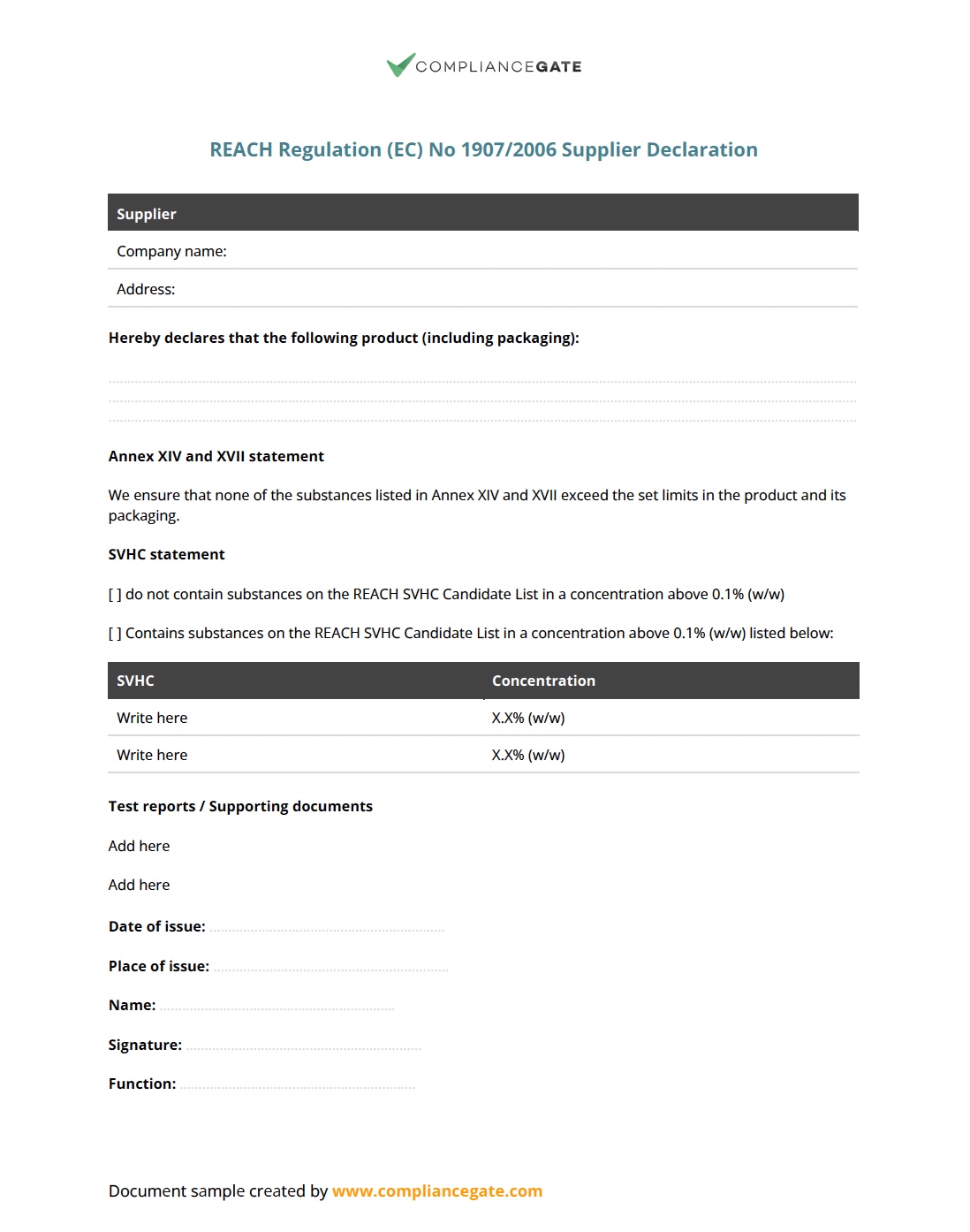
Download REACH Declaration Template
FAQ
Do EU market surveillance authorities accept REACH declarations?
I have never encountered a situation where an EU market surveillance authority has even commented on a REACH declaration.
However, when they do attempt to validate REACH compliance, they tend to be interested in actual substance content, which requires test reports or other substance data.
A REACH declaration could still be a valuable complement, as long as it has supporting documentation.
Can a REACH declaration protect my business?
No, if it turns out that your product actually contains restricted substances, such as DEHP or lead, then a declaration will not make any difference.
It is in your interest to actually verify if your product contains substances restricted under Annex XVII or SVHCs. A REACH declaration alone does not provide such verification and can create a false sense of security.
Do we need a REACH declaration if we have a test report?
No, I cannot find any statement, article or annex in the REACH regulation which states that a REACH declaration is required with or without a test report.
Further, it is not stated that test reports are required either, but you need to validate compliance one way or the other. This often involves testing, which produces test reports.
You can still provide a complementary declaration to “explain” the results in the test report if you wish.
That said, many REACH test reports are clear enough on their own as they provide information about the substances tested for and the result.
Can we use a REACH declaration without a test report?
As said, a REACH declaration without a test report does not provide any actual verification of compliance with Annex XVII or SVHC rules.
Does Amazon accept REACH declarations?
I am not aware of any case in which Amazon, after requesting REACH compliance information, have accepted a REACH declaration as a substitute for an actual test report.
This does not mean that it never happens, but I imagine they also share the opinion that a declaration without supporting test reports or substance data is just a signed piece of paper.