






 Product assessments in 2 minutes



















The EU Batteries Regulation (EU) 2023/1542 introduces new labelling requirements for batteries in the European Union. This guide covers key requirements under Article 13 and labelling requirements for manufacturers and importers.
- All batteries require QR codes from 18 February 2027
- General information must be affixed
- Manufacturer and importer information must be affixed
- Certain batteries are subject to additional labelling requirements
Content Overview

Get a FREE Product Assessment in 3 Steps
 Step 1: Select market
.png)
.png)
.png)


- Step 2: Select product/material modules
- Step 3: Set specifications
👍 Included: Track new, updated and future regulations using the LexDatabase
Article 13 – Labelling and marking of batteries
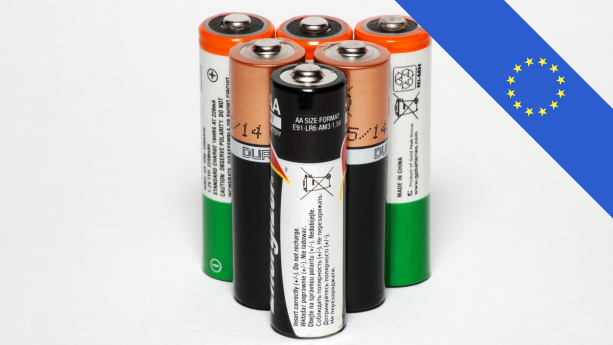
Article 13 sets labelling requirements for various types of batteries. Some apply to batteries in general, while other labelling requirements are specific to certain types of batteries.
Only future dates are indicated. Further, additional information is provided for labelling requirements applicable to all batteries.
| Label item | Battery type | Placement |
| 1. General information (Part A of Annex VI) | Batteries | Default: Printed or engraved visibly, legibly and indelibly on the battery.
Alternative: Affixed to the packaging and to the documents accompanying the battery* *Only if not possible or not warranted on account of the nature and size of the battery |
| 2. Capacity label | Rechargeable portable batteries, LMT batteries and SLI batteries | |
| 3a. Minimum average duration label (when used in specific applications) | Non-rechargeable portable batteries | |
| 3b. label indicating ‘non-rechargeable’ | Non-rechargeable portable batteries | |
| 4. Symbol for separate collection of batteries (Part B of Annex VI) | All batteries | |
| 5. Chemical symbol for the metal concerned: Cd or Pb | Batteries containing more than 0,002 % cadmium or more than 0,004 % lead | |
| 6. QR code From 18 February 2027 |
All batteries |
Note that new labels must be affixed for batteries that are intended for:
- Re-use
- Repurposing
- Remanufacturing
General information
The following information must be included in the label:
- Manufacturer information in accordance with Article 38(7)
- Battery category and information identifying the battery in accordance with Article 38(6)
- Geographical location of the battery factory
- Manufacturing date (month and year)
- Battery weight
- Battery capacity
- Battery chemistry
- Hazardous substances present in the battery*
- Usable extinguishing agent
- Critical raw materials present in the battery in a concentration of more than 0,1 % weight by weight
*Other than mercury, cadmium or lead.
Battery symbol

The following requirements apply to the battery symbol:
a. Size: Minimum 3% area of the largest side of the battery up to a maximum size of 50 x 50 mm
b. Cylindrical battery cells: Cover at least 1,5% of the surface area of the battery and shall have a maximum size of 50 x 50 mm
c. Symbol is not required if the size of the battery results in the symbol being smaller than 47 x 47 mm*
*In this case, a 10 x 10 symbol must be printed on the battery packaging.
Battery QR code
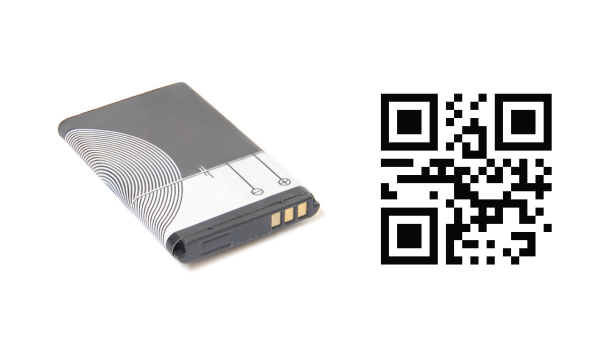
A QR code that can be read by phones and other handheld devices is required. This QR code should link to specific information.
| Battery type | QR must provide access to |
| LMT batteries, industrial batteries with a capacity greater than 2kWh and electric vehicles batteries | Battery passport |
| Other batteries | 1. Label information list in Article 13(1) to 13(5)
3. Report on battery due diligence policy 4. Information regarding the prevention and management of waste batteries *Only for some battery types. See the table above. |
| SLI batteries | Amount of cobalt, lead, lithium or nickel recovered from waste and present in active materials in the battery |
Battery type and company information
Other labelling requirements for batteries can be found in the following articles:
- Article 38 – Obligations of manufacturers
- Article 41 – Obligations of importers
Manufacturer
The manufacturer of the battery must affix the following information:
- Battery model identification and batch or serial number, or product number
- Manufacturer name, registered trade name or registered trade mark
- Manufacturer postal address
- Single contact point (if available, web and email address)
Importer
The first EU entity which imports batteries from manufacturers or suppliers outside the EU is generally defined as the importer. They must affix the following:
- Importer name, registered trade name or registered trade mark,
- Importer postal address,
- Single contact point (if available, web and email address)
Placement
The information should be placed on the battery. If the label information cannot be printed and engraved on the battery, then you generally have these options:
a. Affix on packaging
b. Affix in the instructions or other documentation that comes with the battery
FAQ
Who is responsible for battery labelling?
My understanding is that this responsibility falls on the battery manufacturer. Note that the manufacturer is defined as follows:
‘manufacturer’ means any natural or legal person who manufactures a battery or has a battery designed or manufactured, and markets that battery under its own name or trademark or puts it into service for its own purposes;
As such, a battery manufacturer can be the company that operates the factory or a product that designs or brands batteries.
For example, a company ordering batteries with their own brand from a contract manufacturer could be defined as the manufacturer.
But the battery manufacturer is likely not the same company that makes the product containing the battery. One company could therefore be the “battery manufacturer” while another is the “device manufacturer”.
That said, the device manufacturer still needs to check the labels to determine that the battery is correctly labelled. Using non-compliant batteries can still trigger recalls and other issues.
Do all batteries in the EU need a QR code?
Yes, at least batteries that fall within the scope of the EU Batteries Regulation (EU) 2023/1542. Article 13(6) explicitly states that the QR code is required for all batteries.
That being said, the information that must be accessible via the QR code does differ depending on the battery type. As such, not all QR codes are created equal.
When will batteries require a QR code in the EU?
The new QR code requirements are currently expected to apply from 18 February 2027.
How should the QR code be affixed?
If affixed on the battery, then the QR code must be printed or engraved. When this is not possible, then it is only written that the QR code must be “affixed” to packaging or accompanying documentation (without explaining what affixed means).
Where should the battery QR code be placed?
The following placements are mentioned:
a. On the battery
b. On the packaging or accompanying documentation (if it’s not possible to affix it on the battery itself).
Do EU battery regulation labelling requirements apply to the final device?
Article 13 specifically mentions batteries, not battery-powered devices. For example, it is mentioned that “batteries shall be marked with a QR” and that “batteries shall bear a label containing the general information”.
Likewise, manufacturers shall ensure that “batteries bear a model identification and batch or serial number”.
I cannot find any labelling requirements for final devices.