
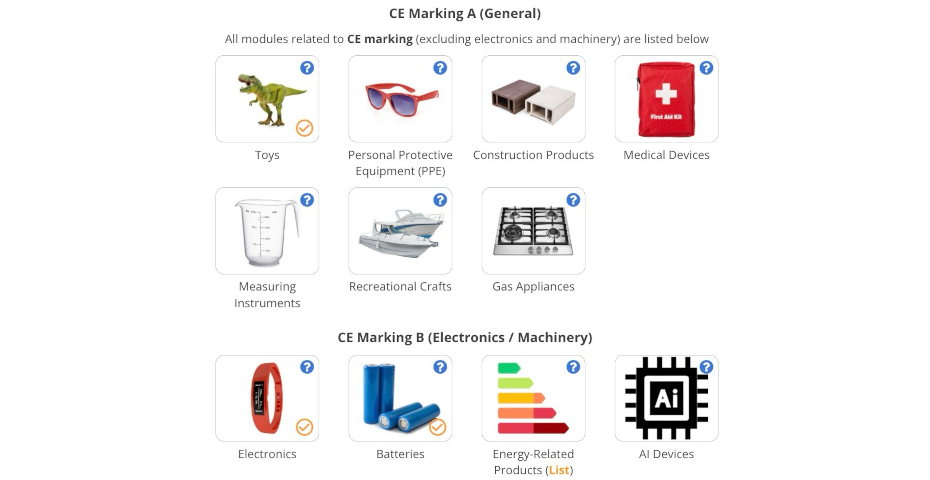





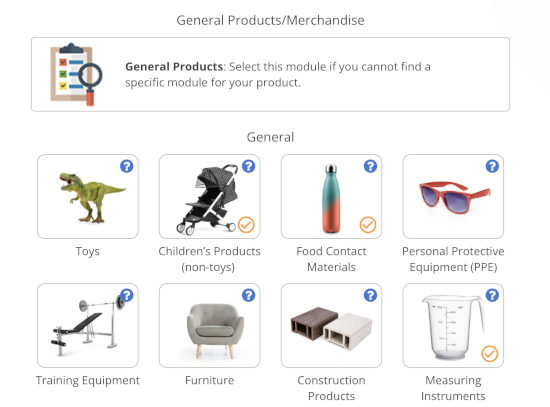
 Product assessments in 2 minutes


















Children’s and adult jewelry manufactured, imported, or sold in the United States must meet chemical safety, mechanical safety, warning, labeling, and other requirements.
In this guide, I cover several key regulations, standards, and requirements that are relevant to different types of jewelry.
Product examples
- Adult jewelry
- Children’s jewelry
- Piercings
- Liquid-filled jewelry
- Gold jewelry
- Silver jewelry
- Pearl jewelry
- Pewter jewelry
- Magnetic jewelry
- Wildlife jewelry
Content Overview

Find Requirements for Your Product Free
Estimated time: 2 to 3 minutes
 Step 1: Select market
.png)
.png)
.png)


- Step 2: Select product/material modules
- Step 3: Compliance Requirements List Created View Sample >
 Data: Primarily based on official legislation databases (Learn >)


Free Consultation (30 min)
Do you have questions about US, EU, or UK product compliance requirements?
ASTM Standards
The CPSC states that while there are no mandatory federal requirements that are specific to jewelry, the two standards below represent the industry best practices.
| Overview | ASTM F2923 – Standard Specification for Consumer Product Safety for Children’s Jewelry | ASTM F2999 – Standard Consumer Safety Specification for Adult Jewelry |
| Age group | 0 to 12 years old | Over 12 years old |
| Product scope | Children’s jewelry, including piercings.
It does not apply to:
|
Adult jewelry, including piercings.
It does not apply to:
|
| Substance restrictions | The following substances are mentioned on the standard page:
|
The following substances are mentioned on the standard page:
|
| Mechanical safety | Yes | Yes |
| Liquid-filled jewelry requirements | Yes | Yes |
| Labeling and warnings | Yes, including age labelling and warnings, and guidelines to identify the primary intended users (e.g., children) | Yes |
16 CFR Part 23 – Guides for the Jewelry, Precious Metals, and Pewter Industries
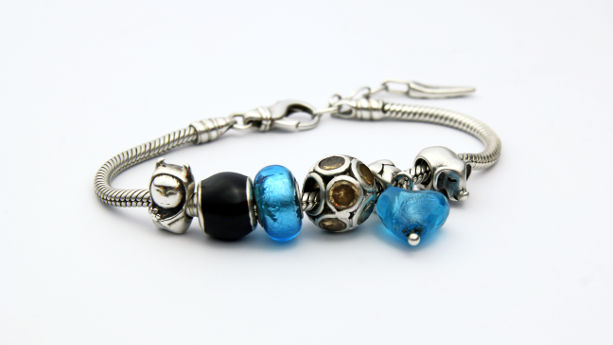
16 CFR Part 23 covers “jewelry industry products”, which are defined in Part 23.0 as follows:
The guides in this part apply to jewelry industry products, which include, but are not limited to, the following: Gemstones and their laboratory-created and imitation substitutes; natural and cultured pearls and their imitations; and metallic watch bands not permanently attached to watches. These guides also apply to articles, including optical frames, pens and pencils, flatware, and hollowware, fabricated from precious metals (gold, silver, and platinum group metals), precious metal alloys, and their imitations. These guides also apply to all articles made from pewter. For the purposes of these guides, all articles covered by these guides are defined as “industry products.”
In particular, these guides cover different types of claims that may be used to describe covered products in labeling, advertising, and marketing material in general.
In general, any misrepresentation is considered unfair no matter if it concerns the grade, quality, quantity, metallic content, or other characteristics of the product.
Besides general requirements, there are also specific sections on:
- Misuse of the terms (e.g., handmade, hand-polished)
- Misuse of the words (e.g., platinum, iridium, pearl)
- Misrepresentation of content (e.g., gold, silver, pewter)
- Disclosures
- Quality marks
National Gold and Silver Stamping Act of 1906
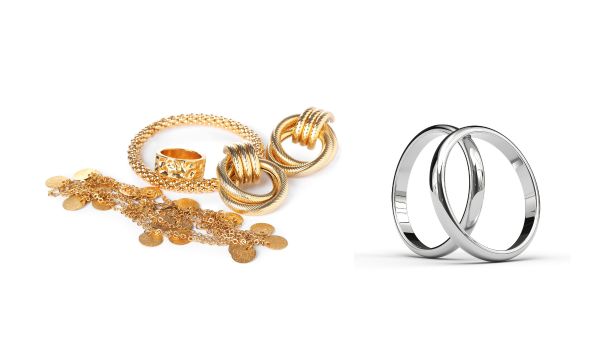
The National Gold and Silver Stamping Act of 1906 aims at protecting consumers from fraud by setting:
- Standard of fineness of gold articles
- Standard of fineness of silver articles
- Requirements for stamping plated articles
Specifically, in the US, it is not compulsory to affix a quality mark (e.g., “14K” or “.925”) on gold or silver. However, if you decide to affix such a quality mark, it is also necessary to affix a trademark that identifies the maker or sponsor who guarantees the claimed fineness.
16 CFR Part 1262 – Safety Standard for Magnets
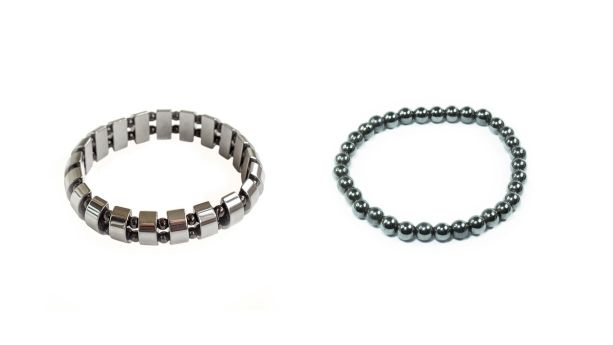
16 CFR Part 1262 sets requirements for magnet products, which include adult and children’s jewelry that contains one or more loose or separable magnets.
The part states that each loose or separable magnet contained in the product that fits entirely in the cylinder described in 16 CFR 1501.4 must have a flux index of less than 50 kG2 mm2 (when tested in accordance with the method described in Part 1262.4).
If you sell adult jewelry covered by this part, you must draft a General Certificate of Conformity (GCC). This is a declaration where you state that the product complies with the relevant CPSC requirements.
For children’s jewelry, you would need a Children’s Product Certificate (CPC), as explained in the next section.
Finally, if you import products covered by GCC requirements, you must submit the relevant data via eFiling.
CPSIA – Children’s Jewelry
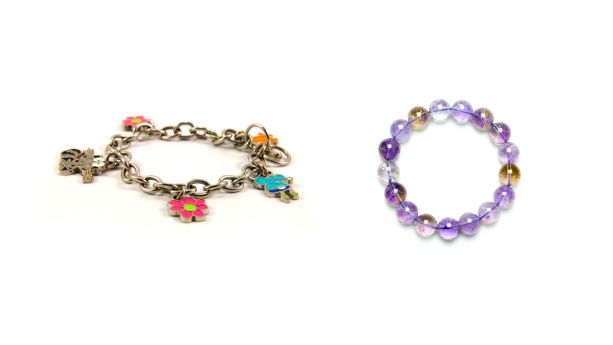
Children’s jewellery sold in the United States must comply with CPSIA requirements. This means that children’s jewelry must be tested by a CPSC-accepted third-party lab.
Examples
- 16 CFR part 1250 – ASTM F963 (for toy jewelry)
- 16 CFR part 1303 – Paints and similar surface coatings containing lead
- 16 CFR part 1307 – Phthalates
- 16 CFR Part 1262 – Safety Standard for Magnets
CPC and labelling
Based on the test result, you must then issue a Children’s Product Certificate. The following requirements also apply:
a. Tracking label information must be affixed to the product and packaging
b. eFiling is required for children’s jewellery
ASTM F2923 – Standard Specification for Consumer Product Safety for Children’s Jewelry
We could not find any information stating that ASTM F2923 is mandatory or incorporated by reference under any of the rules that require a CPC. That said, the standard is widely recognised, and our understanding is that compliance with the standard is often necessary for children’s jewelry for the sake of ensuring safety.
Lacey Act – Wildlife Derived Jewelry
The Lacey Act aims to protect wildlife, fish, and plants from illegal traffic. The document titled “Commercially Importing and Exporting Jewelry Made with Wildlife” published on the US Fish & Wildlife Service website, mentions the following types of “wildlife jewelry”:
- Mother of pearl
- Puka shells
- Conch pearls
- Black and red coral
- Feathers of some birds
- Sea turtles
- Walrus ivory
- ElephantiIvory
- Wildlife teeth or claws
- Reptilian leathers
Offenses
The Lacey Act mentions several offenses:
a. It is unlawful to import, export, or sell wildlife or other covered products in violation of any law, treaty, or regulation of the United States or in violation of any Indian tribal law.
b. It is unlawful to import or export any container or package containing any wildlife that is not marked or labeled according to the requirements of this title. Specifically, it is unlawful to make any false record, account, or label for, or any false identification of wildlife or other covered products.
Due care
“Due care” should be exercised. I found that it is described by the USDA APHIS as a “long-standing legal principle that means the degree of care at which a reasonably prudent person would take under the same or similar circumstances.”
Lacey Act Declaration
A Lacey Act Declaration is necessary to import plants and plant products that are listed in the Lacey Act Declaration Implementation Schedule. While I could not find any jewelry, I found that the schedule mentions “Jewelry boxes, and similar containers of a kind normally sold at retail with their contents”.
Substance Restrictions
TSCA
While the Toxic Substances Control Act (TSCA) mainly regulates chemicals, it also regulates the use of substances in some materials that can be used in jewelry, such as plastics and rubber.
For example, Part 751 of the TSCA restricts the use of the following chemicals, which may be found in plastic parts:
- Phenol, isopropylated phosphate (PIP) (3:1)
- Hexachlorobutadiene (HCBD)
- 2,4,6-Tris(tert-butyl)phenol (2,4,6-TTBP)
- Decabromodiphenyl ether (DecaBDE)
This means that, in practice, you need to test your product to ensure that it does not contain restricted substances above the set limits.
The TSCA also sets reporting and record-keeping requirements.
California Proposition 65
California Proposition 65 restricts various heavy metals that can be found in jewellery. For example, metal jewellery can contain heavy metals like lead, nickel, and mercury.
Lower-cost zinc alloys can also contain high amounts of cadmium.
While California Proposition 65 does provide the option to affix warning labels, the best path to compliance is often to arrange third-party testing. This does not necessarily have to be expensive if you use one or a few materials.
Country of Origin
In general, you must affix a Country of Origin marking on jewelry that is sold in the United States. If it is impossible to mark the product, for example because it is too small, the country of origin information should be provided in the packaging.
There are special requirements for Native American-style jewelry, that is, jewelry that includes traditional Native American design motifs, materials, and construction.
Such products must be indelibly marked with the country of origin by “cutting, die-sinking, engraving, stamping, or some other permanent method”.
If it is impossible to use any of the methods above-mentioned, you can then use a tag or adhesive label securely affixed to the product.
FAQ
Is ASTM F2999 mandatory?
I could not find any sources claiming that ASTM F2999 is a mandatory standard. However, according to the CPSC, it represents the industry standard for adult jewelry. Thus, in practice, you should adhere to the standard requirements to ensure the safety of your product.
Is jewelry hallmarking mandatory in the United States?
As far as I know, hallmarking is not required in the United States. However, you must still comply with the National Gold and Silver Stamping Act of 1906. The Act aims to ensure that articles marked as gold or silver meet specific fineness standards, and prohibits the importation and transportation of falsely marked gold and silver.
Is country of origin required for jewelry sold in the United States?
Yes, a country of origin marking is generally required for jewelry sold in the United States. Also, there are special requirements for Native American-style jewelry, which must be marked using a permanent method such as die-sinking, engraving, stamping, or others.
Which requirements apply when selling jewelry on Amazon?
Amazon generally mandates that jewelry sold on its US marketplace comply with federal and state regulations. In my experience, they do require that all children’s jewellery comply with CPSIA and relevant ASTM standards.
I am also aware of cases where they have requested proof of compliance with California Proposition 65 in the form of test reports when selling jewelry to customers in California.
Is lab testing required for jewelry sold in the US?
Yes, at least for children’s jewelry and jewelry subject to GCC product safety rules. That said, testing is often necessary for the sake of verifying compliance with ASTM standards and other substance restrictions.
It is ultimately in your best interest to ensure that the jewelry you sell is safe in terms of substance and design. Testing can help you verify that this is the case.
Is eFiling required for jewelry?
Yes, eFiling is required for the following jewelry products:
a. Children’s jewellery
b. Jewelry subject to one or more GCC product safety rules


Thanks for the reminder that there are different levels of legislation involved in jewelry products. I’d like to find a good fine jewelry store soon because I want to buy new items for my outfits soon. As such, it would be best to accessorize accordingly in order for them to complement each other.
Thanks for info.