






 Find US, EU, UK, CA, & AU requirements














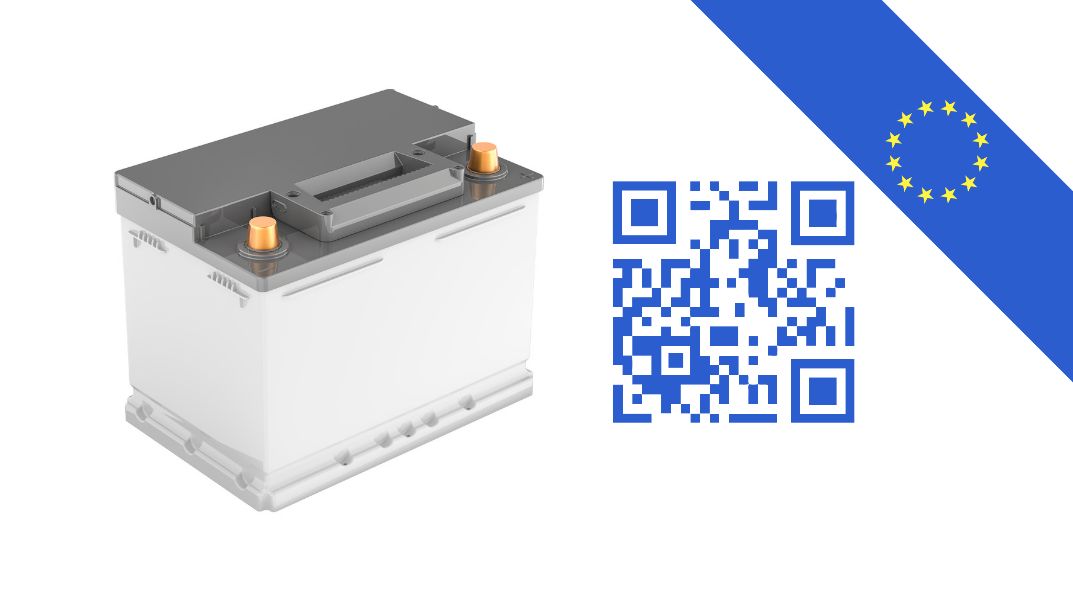
Digital Battery Passports are required under the EU Batteries Regulation 2023/1542 for certain types of batteries starting 18 February 2027. In this guide, we explain which battery types require a digital battery passport, and the information you need to include in it.
Key points
- Required for LMT batteries, industrial batteries (2kWh+) and EV batteries
- Access via a printed or engraved QR code is required
- Must contain the information listed in Annex XIII
- Registration in the DPP registry is mandatory
Content Overview

FREE CONSULTATION CALL (30 MIN)
 Ask questions about compliance requirements
- Countries/markets:
.png)
.png)
.png)


- Learn how we can help your business
You will speak with:Ivan Malloci
What is a Digital Battery Passport?
A Digital Battery Passport is an electronic record which is mandatory for certain types of batteries under the EU Batteries Regulation.
The Digital Battery Passport must be accessible when scanning a QR code placed on the battery.
Which batteries require a Digital Battery Passport?
Article 13(6) states that a QR code must be affixed which provides access to the digital battery passport for the following battery types:
(a) for LMT batteries, industrial batteries with a capacity greater than 2kWh and electric vehicles batteries, the battery passport in accordance with Article 77;
Overview
Definitions for LMT batteries, industrial batteries, and electric vehicle batteries can be found in the table below:
| Type | Definition |
| LMT batteries |
‘light means of transport battery’ or ‘LMT battery’ means a battery that is sealed, weighs 25 kg or less and is specifically designed to provide electric power for the traction of wheeled vehicles that can be powered by an electric motor alone or by a combination of motor and human power, including type-approved vehicles of category L within the meaning of Regulation (EU) No 168/2013 of the European Parliament and of the Council ( 2 ), and that is not an electric vehicle battery; |
| Industrial batteries with a capacity greater than 2kWh |
‘industrial battery’ means a battery that is specifically designed for industrial uses, intended for industrial uses after having been subject to preparation for repurposing or repurposing, or any other battery that weighs more than 5 kg and that is neither an electric vehicle battery, an LMT battery, nor an SLI battery; |
| Electric vehicles batteries |
‘electric vehicle battery’ means a battery that is specifically designed to provide electric power for traction in hybrid or electric vehicles of category L as provided for in Regulation (EU) No 168/2013, that weighs more than 25 kg, or a battery that is specifically designed to provide electric power for traction in hybrid or electric vehicles of categories M, N or O as provided for in Regulation (EU) 2018/858; |
QR code
The QR code should be printed or engraved on the battery. If this is truly not possible, then the QR code can be affixed to the packaging or a printed document.
Note that the QR code also requires a unique identifier. Both the QR code and the identifier must meet the following ISO/IEC standards:
- ISO/IEC 15459-1:2014
- ISO/IEC 15459-2:2015
- ISO/IEC 15459-3:2014
- ISO/IEC 15459-4:2014
- ISO/IEC 15459-5:2014
- ISO/IEC 5459-6:2014
- or their equivalent
What information must be included in the Digital Battery Passport?
The information that must be contained in the Digital Battery Passport can be found in Annex XIII of the EU Batteries Regulation.
Part 1: Battery model information (public)
(a) the information specified in Part A of Annex VI;
- information identifying the manufacturer in accordance with Article 38(7);
- Battery category and information identifying the battery in accordance with Article 38(6);
- Place of manufacture (geographical location of a battery manufacturing plant);
- Date of manufacture (month and year);
- Weight;
- Capacity;
- Chemistry;
- Hazardous substances present in the battery, other than mercury, cadmium or lead;
- Usable extinguishing agent;
- Critical raw materials present in the battery in a concentration of more than 0,1 % weight by weight.
(b) the material composition of the battery, including its chemistry, hazardous substances present in the battery, other than mercury, cadmium or lead, and critical raw materials present in the battery;
(c) the carbon footprint information referred to in Article 7(1) and (2);
(d) information on responsible sourcing as indicated in the report on battery due diligence policy referred to in Article 52(3);
(e) recycled content information as contained in the documentation referred to in Article 8(1);
(f) the share of renewable content;
(g) rated capacity (in Ah);
(h) minimal, nominal and maximum voltage, with temperature ranges when relevant;
(i) original power capability (in Watts) and limits, with temperature range when relevant;
(j) expected battery lifetime expressed in cycles, and reference test used;
(k) capacity threshold for exhaustion (only for electric vehicle batteries);
(l) temperature range the battery can withstand when not in use (reference test);
(m) period for which the commercial warranty for the calendar life applies;
(n) initial round trip energy efficiency and at 50 % of cycle-life;
(o) internal battery cell and pack resistance;
(p) c-rate of relevant cycle-life test.
(q) the marking requirements laid down in Article 13(4) and (5);

(r) the EU declaration of conformity referred to in Article 18;
(s) the information regarding the prevention and management of waste batteries laid down in Article 74(1), points (a) to (f).
Part 2: Battery model information (limited access)
(a) detailed composition, including materials used in the cathode, anode and electrolyte;
(b) part numbers for components and contact details of sources for replacement spares;
(c) dismantling information, including at least:
- Exploded diagrams of the battery system/pack showing the location of battery cells,
- Disassembly sequences
- Type and number of fastening techniques to be unlocked,
- Tools required for disassembly
- Warnings if risk of damaging parts exist
- Amount of cells used and layout
(d) safety measures.
Part 3: Information accessible to notified bodies, market surveillance authorities and the Commission
Test reports demonstrating compliance with:
a. EU battery regulation and relevant harmonised standards
b. Delegated or implementing act/s (if applicable)
Part 4: Information and data (limited access)
(a) the values for performance and durability parameters referred to in Article 10(1), when the battery is placed on the market and when it is subject to changes in its status;
(b) information on the state of health of the battery pursuant to Article 14;
(c) information on the status of the battery, defined as ‘original’, ‘repurposed’, ‘re-used’, ‘remanufactured’ or ‘waste’;
(d) information and data resulting from its use, including the number of charging and discharging cycles and negative events, such as accidents, as well as periodically recorded information on the operating environmental conditions, including temperature, and on the state of charge.
DPP Registry
The manufacturer or importer that introduces the battery to the EU market must:
a. Create a unique identifier using the ISO/IEC standards
b. Create an account in the Digital Product Passport (DPP) registry
c. Register the Digital Battery Passport in the Digital Product Passport (DPP) registry
Note that the registry does not provide access to the actual Digital Battery Passport. It is only used as a central register, whereas the actual Digital Battery Passport file can (based on our understanding) be hosted by the manufacturer or importer.
FAQ
Where should the Digital Battery Passport be hosted?
The Digital Battery Passport can be hosted by the manufacturer or importer that placed the battery on the market.
As expected, there are several companies offering solutions for creating and hosting Digital Battery Passports. Examples include the following:
- Circuland
- Passport Labs
- Minespider
Do all batteries require a Digital Battery Passport?
No, the Digital Battery Passport is only required for specific types of batteries. That said, note that other batteries still need a QR code, which provides access to the following information:
1. Label information list in Article 13(1) to 13(5)
- General information
- Capacity label*
- Average duration / ‘non-rechargeable’*
- Battery symbol
- Cd or Pb symbol*
2. Declaration of Conformity
3. Report on battery due diligence policy
4. Information regarding the prevention and management of waste batteries
*Only for some battery types.
When will the Digital Battery Passport become mandatory?
The Digital Battery Passport is required from 18 February 2027.
Who is responsible for the Digital Battery Passport?
The company defined as the manufacturer is generally responsible for creating and maintaining the Digital Battery Passport.
They must also ensure that it can be accessed via a printed QR code.
Will devices containing a battery require a Digital Battery Passport?
Article 77(1) only states that a Digital Battery Passport is required for batteries. There is no mention of devices containing batteries being subject to this requirement.
That said, the batteries contained in devices sold in the EU must still be compliant, and that involves a Digital Battery Passport for the covered battery types.
It is therefore important that companies manufacturing or importing devices containing batteries confirm the specific battery brand and model, and then verify that the QR code linking to the Digital Battery Passport is affixed.
In any case, you do not need to create a separate battery passport for each device that contains batteries. Simply use batteries that are already compliant.
What is the difference between a Digital Battery Passport and a Digital Product Passport?
A Digital Battery Passport is only applicable to certain types of batteries. Digital Product Passports are similar, in the sense that they are an electronic record that can be accessed via a scannable QR code.
That said, Digital Product Passports will be used for many different product types, such as electronics, toys, textiles, and construction products.