





 Product assessments in 2 minutes














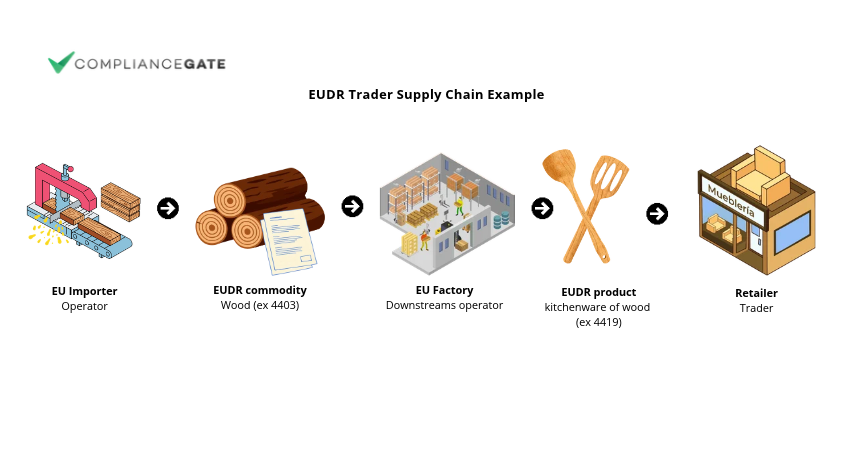
The EUDR classifies certain companies as traders, which in turn triggers certain obligations. For example, wholesalers and retailers that are only reselling existing products are generally defined as traders.
This guide explains how you can determine if your company is truly defined as a trader, and the resulting obligations.
Key points
- Traders do not change or process products
- Traders do not import products from outside the EU
- Wholesalers and retailers are often defined as traders
- SME traders are exempt from certain requirements
Content Overview

View Future Regulations for Your Product Free
Estimated time: 2 to 3 minutes
 Covered markets:
.png)
.png)
.png)


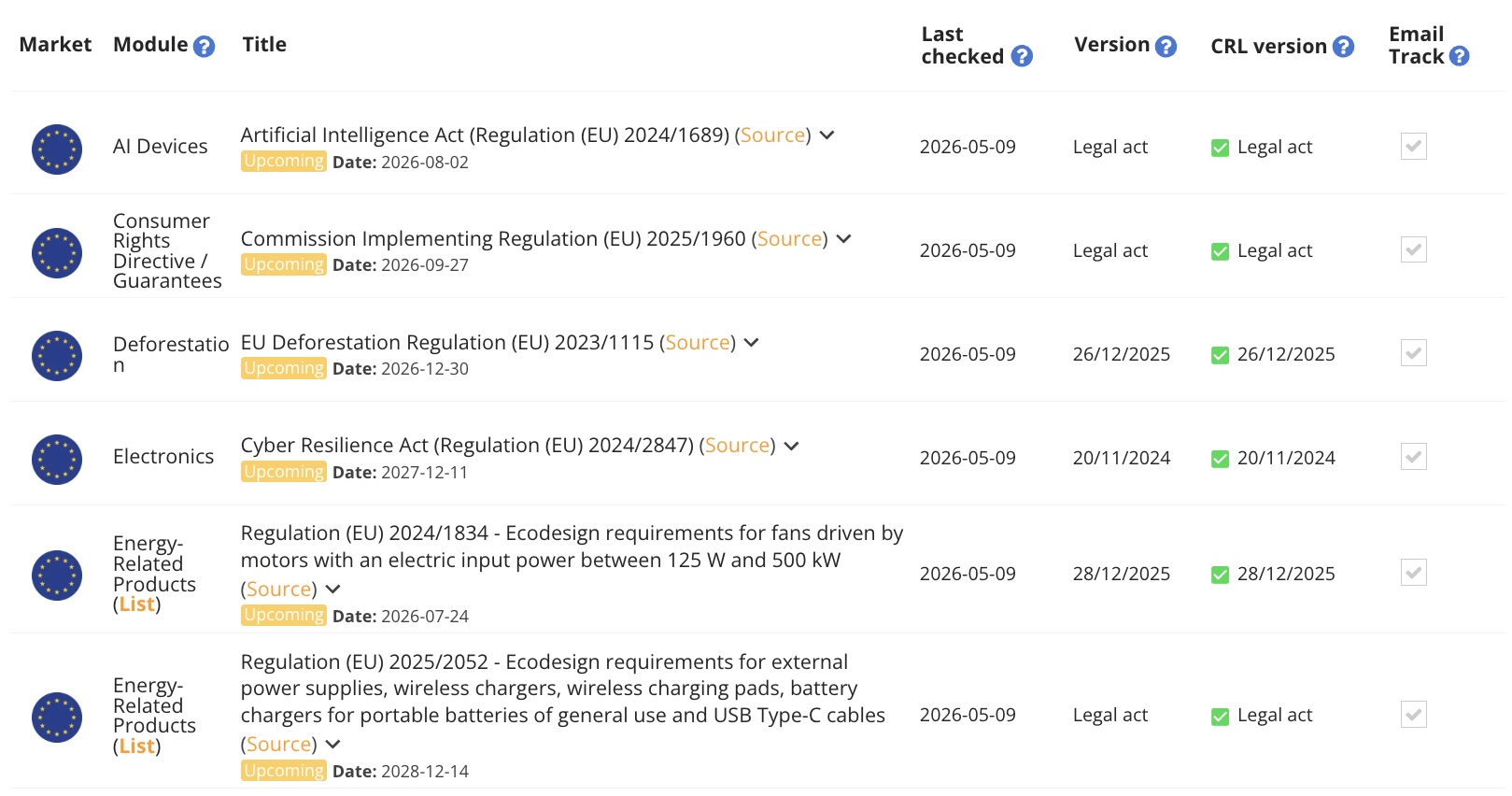
- Track future and recently updated regulations
- Setup email alerts
 Data: Primarily based on official legislation databases (Learn >)


Free Consultation (30 min)
Do you have questions about US, EU, or UK product compliance requirements?
Who is a trader under the EUDR?
Traders are defined as follows in the EUDR:
‘Trader’ means any person in the supply chain other than the operator or downstream operator who, in the course of a commercial activity, makes relevant products available on the market;
Essentially, a trader is a company involved in the supply chain that is not an operator or downstream operator. It is therefore essential to rule out that you are an operator or a downstream operator.
The operator is generally the first entity introducing a product covered by the EUDR in the European Union. A downstream operator is any of the subsequent entities that process such EUDR commodities into EUDR products.
As such, the trader neither introduces nor processes products covered by the EUDR.
Overview
| Activity | Operator | Downstream operator | Trader |
| Importing products covered by the EUDR | ✅ | ❌ | ❌ |
| Processing wood into wooden furniture | ❌ | ✅ | ❌ |
| Buying and reselling finished wooden furniture | ❌ | ❌ | ✅ |
SME Traders
‘Micro, small and medium-sized enterprises’ or ‘SMEs’ means micro, small and medium-sized undertakings, irrespective of their legal form, within the meaning of Article 3(1), Article 3(2), first subparagraph, and Article 3(3), respectively, of Directive 2013/34/EU;
SME traders are traders that fall below certain thresholds in terms of the balance sheet total, net revenue and the average number of employees. Such traders are exempt from certain requirements set by Article 5.
Directive 2013/34/EU
Article 3 of Directive 2013/34/EU states that small and medium-sized enterprises, by definition, cannot exceed the thresholds set out in two of the following three criteria:
- Balance sheet total
- Net turnover
- Employees*
Overview
| Entity | Balance sheet total | Net turnover | Employees* |
| Micro | EUR 450 000 | EUR 900 000 | 10 |
| Small | EUR 5 000 000 | EUR 10 000 000 | 50 |
| Medium | EUR 25 000 000 | EUR 50 000 000 | 250 |
*Average number of employees during the financial year
EUDR Trader Checklist
The following checklist is based on Article 5, which sets out the obligations for traders under the EUDR.
✅ Traders can only sell products if they have obtained the information under point 3 below
✅ Traders that are not SMEs must register in the TRACES system
✅ Traders must obtain and maintain the following information:
Supplier information
- Operator / downstream operators / trader name or trade mark
- Operator / downstream operators / trader address
- Operator / downstream operators / trader email and website
- Reference numbers of the due diligence statements*
*If you buy from an operator.
Buyer information
- Downstream operators / trader name or trade mark
- Downstream operators / trader address
- Downstream operators / trader email and website
✅ Traders must maintain the information specified above for at least 5 years
✅ Traders must inform national authorities and their customers (downstream operators and traders) if they are made aware of non-compliance with the EUDR for products they have sold
✅ Traders that are not SMEs must provide information if they are made aware of non-compliance with the EUDR before certain products have been introduced on the market
✅ Traders must cooperate with national authorities if they request documentation or require access to premises to verify EUDR compliance
FAQ
Can there be more than one trader in an EUDR supply chain?
Yes, there could be several traders in a single EUDR supply chain. For example, a furniture wholesaler may buy furniture from an EU-based factory and then resell the goods to several retailers in the EU. The wholesaler and their customers would all be traders under the EUDR.
Do traders need to submit a due diligence statement?
No, this is done by the operator, not by the trader. That said, traders buying directly from operators need to obtain the DDS number.
Are companies importing products defined as traders?
No, companies importing from outside the EU are generally defined as operators, as they are the first to introduce the goods. This triggers entirely different obligations, which you can find under Article 4.
Are manufacturers defined as traders?
No, a company manufacturing products is more likely to be defined as either an operator or a downstream operator.


