





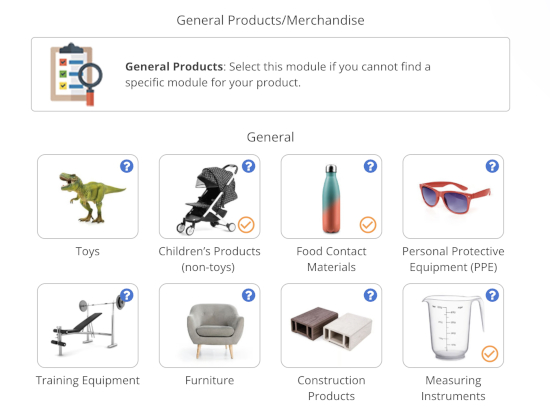
 Find US, EU, UK, CA, & AU requirements











Both electrical and non-electrical kitchen appliances are covered by various regulations and standards in the United States. The compliance requirements range from chemicals in food containers to energy efficiency and battery safety.
This is a relatively complex area, were requ9rements are largely decided by the type of kitchen appliance and its components. This guide serves as an introduction to many of the key regulations and standards that you need to be aware of in this industry.
Content Overview

FREE CONSULTATION CALL (30 MIN)
 Ask questions about compliance requirements
- Countries/markets:
.png)
.png)
.png)


- Learn how we can help your business
You will speak with:Ivan Malloci
Food Contact Materials
Food contact materials are subject to various regulations under Title 21 Code of Federal Regulations. These regulations set substance restrictions and migration limits for plastics and other materials in contact with food and beverages.
Note that FCM regulations apply to both electrical and non-electrical kitchen appliances. Here are examples of the latter:
- French presses
- Meat grinders
- Mortars
- Garlic presses
- Can openers
- Hand-powered pasta makers
- Hand-powered juicers
Examples
In the context of kitchen appliances, the following components may be deemed to be food contact materials:
- Plastic blender pitchers
- Stainless steel blender blades
- Kettle interior materials
- Kettle lids (interior materials/parts)
- Internal toaster trays
FCM Regulations
FCM regulations are generally applicable to particular types or groups of materials. Below follows an overview of such regulations under Title 21:
- Part 170 Food Additives 170.3 – 170.285
- Part 174 Indirect Food Additives: General 174.5 – 174.6
- Part 175 Indirect Food Additives: Adhesives and Components of Coatings 175.105 – 175.390
- Part 176 Indirect Food Additives: Paper and Paperboard Components 176.110 – 176.350
- Part 177 Indirect Food Additives: Polymers 177.1010 – 177.2910
- Part 178 Indirect Food Additives: Adjuvants, Production Aids, and Sanitizers 178.1005 – 178.3950
- Part 179 Irradiation in the Production, Processing and Handling of Food 179.21 – 179.45
- Part 181 Prior-Sanctioned Food Ingredients 181.1 – 181.34
- Part 182 Substances Generally Recognized as Safe 182.1 – 182.8997
- Part 184 Direct Food Substances Affirmed as Generally Recognized as Safe 184.1 – 184.1985
- Part 186 Indirect Food Substances Affirmed as Generally Recognized as Safe 186.1 – 186.1839
Lab testing
Compliance with applicable FCM regulations must generally be verified through substance and migration testing. For example, a blender pitcher made of plastic may need to be tested according to restrictions under Part 177.
Testing may be needed even if a particular material is deemed to be safe, in order to verify that the components are made of the material you expect. For example, blender blades made of stainless steel may, after testing, turn out to be made of an alloy that contains excessive amounts of restricted heavy metals.
Electrical Kitchen Appliances
Electrical kitchen appliances are subject to a complex mix of regulations and voluntary (sometimes recommended) standards.
47 CFR Part 15 – FCC Requirements
Part 15 sets requirements for radio frequency devices. This includes kitchen appliances of various types, including those containing WiFi or Bluetooth modules. Most devices are either classified as intentional or unintentional radiators.
Unintentional radiators
1. Unintentional radiators are generally devices that
- Coffee pots
- Electrical ovens
- Kettles
- Toasters
3. You can find key requirements for unintentional radiators in this guide.
Intentional radiators
1. Unintentional radiators are generally devices that emit radio frequency by radiation or induction in an intentional fashion (e.g., via Wi-fi or Bluetooth modules).
2. The following kitchen appliances may be defined as unintentional radiators:
- Smart air fryers
- Smart refrigerator
- Smart coffee machine
- Smart kettles
3. You can find key requirements for intentional radiators in this guide.
Energy-Efficiency Standards
Certain kitchen appliances are subject to DoE energy efficiency requirements. For example, consumer water heaters must meet energy conservation requirements defined under 10 CFR 430.32(d):
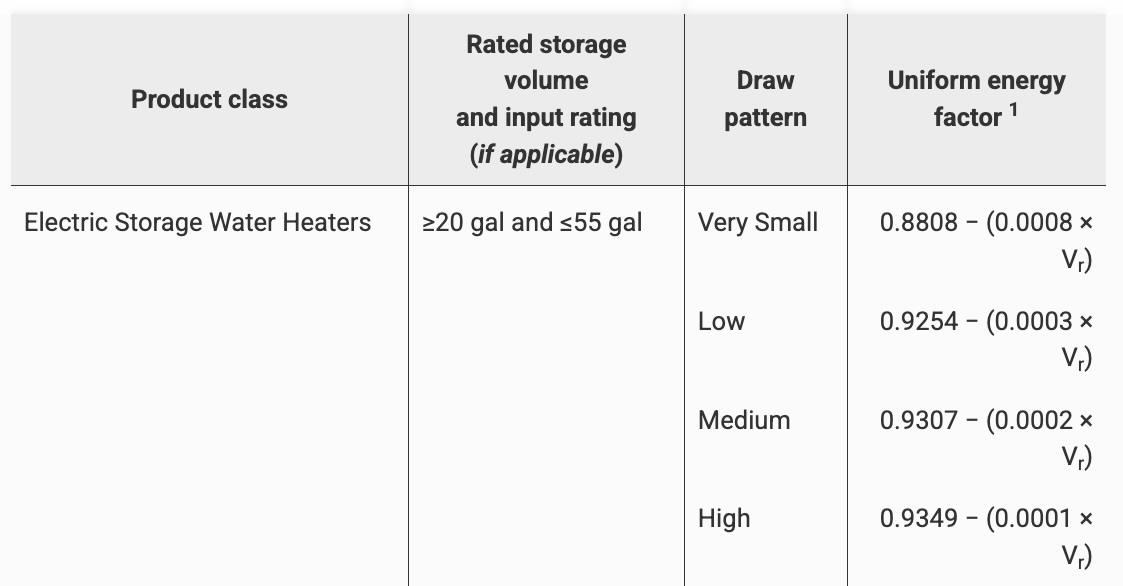
Below follows an overview of kitchen appliances listed on the DoE website:
10 CFR PART 430 – ENERGY CONSERVATION PROGRAM FOR CONSUMER PRODUCTS
- Ovens
- Cooking tops
- Microwave Ovens
- Refrigerators
- Freezers
10 CFR PART 431 – ENERGY EFFICIENCY PROGRAM FOR CERTAIN COMMERCIAL AND INDUSTRIAL EQUIPMENT
- Commercial refrigerators
- Commercial freezers
- Walk-in coolers
10 CFR PART 429 – CERTIFICATION, COMPLIANCE, AND ENFORCEMENT FOR CONSUMER PRODUCTS AND COMMERCIAL AND INDUSTRIAL EQUIPMENT
- Ovens
- Cooking tops
- Commercial freezers
- Walk-in coolers
16 CFR PART 305 – ENERGY AND WATER USE LABELING FOR CONSUMER PRODUCTS UNDER THE ENERGY POLICY AND CONSERVATION ACT (“ENERGY LABELING RULE”)

- Refrigerators
- Freezers
- Kitchen ranges
- Kitchen ovens
UL Standards
UL standards are generally voluntary. That said, ensuring compliance with UL standards can help you verify that your product is safe and meets requirements concerning electrical safety and other areas.
Here are examples of UL standards relevant to kitchen appliances:
- UL 923 – Microwave Cooking Appliances
- UL 1026 – Household Electric Cooking and Food Serving Appliances
- UL 197 – Commercial Electric Cooking Appliances
- ULE 7004 – Household Cooking Appliances
Compliance with UL standards must normally be verified through product testing.
Battery-Powered Kitchen Appliances
Battery-powered kitchen appliances, such as hand mixers and electric knives, are also subject to mandatory and voluntary compliance requirements.
16 CFR Part 1263
Products containing button cell batteries must comply with the requirements under 16 CFR PART 1263. It mandates that products containing such batteries are safely designed and specifically meet requirements under ANSI/UL 4200A.
CPSC Recommendations
Most battery-powered kitchen appliances contain lithium battery packs rather than button cell batteries. Not all lithium batteries are subject to mandatory safety standards. Due to the risks associated with selling (potentially) unsafe batteries, it is strongly recommended to comply with voluntary standards.
The CPSC provides recommendations that can serve as a good starting point. Here are some of the recommended battery standards:
- ANSI/NEMA C18
- UL 1642
- UL 2054
- UL 2595
Product testing
Testing is generally necessary before selling kitchen appliances in the United States, regardless of whether you are an importer or manufacturer. Here are some types of tests that may be applicable:
1. Food contact materials testing (substance contents and migration)
2. Electrical safety testing
3. Electromagnetic compatibility testing
4. Energy efficiency testing
5. Radio frequency testing
6. Battery safety testing




Your compliancegate.com blog post offers a thorough overview of “Kitchen Appliance Regulations in the United States.” The information covered in the piece ensures that kitchen appliances meet safety and quality requirements. Langley Oven RepairThe data is thoroughly researched, giving readers a comprehensive knowledge of the topic.
Hi Fredrik,
We are producing refrigerators, freezers etc. in Turkey. We want to sell our products to USA/Canada markets. Should the interior of a refrigerator be considered as a material in contact with food? And is it mandatory to compliance to Title 21 of the Code of Federal Regulations ( 21 CFR) for refrigerator products?
Best Regards.
Hi Fredrik,
Thanks for useful information posted. we have car portable charger without wireless functions would like to export to US. could you help advise which requirements the product must be complied?
Dear Fredrik,
thank you for your information.
we want to sell handmade brass coffee/ black pepper grinders on amazon usa,
do we need any tests or proposition 65?
They are manual (not electrical devices).
thank you and best regards
Hi Seda,
Probably, but ask a lab. Also, you’ll need food contact materials testing in this case too.
Dear Fredrik Gronkvist,
My name is Oytun and work in BiggBrands Inc. We are a Turkish Company and we also established a new company in New York. We are looking for a consultant about these issues and we are serious. We are producing Turkish Coffee Makers in China and planning to sell in USA. Can you help us? Will be waiting for your reply. Regards,
Hi Oytun,
I suggest you book a call here: https://www.compliancegate.com/book-demo/
Hello! I am planning to sell an instant hot water dispenser from China to the USA using Amazon platform. Do you know what certificates will be required from my supplier? And will it suffice if I can obtain those certs from them? Is it FCC and UL?
Hi Lexi,
I don’t think you will obtain any certificates from your supplier
Hi,
Thanks for this article, great help
I am like Anna and I would like to import MIELE items from Europe into the US for my own use. I am trying to figure out what testing and certification they need to have for the US market.
I believe to understand that the UL is optional (preferred but optional), FCC is optional. The 21 FCR is that required?
Thanks fr any info on what would be required to bring in personal Miele appliances
Hello, thank you for this useful post!
Do you know if any testing/certification is necessary to sell digital food scale?
Thanks
Hi Claire,
I can imagine that FCM, battery and RoHS testing is relevant
Hi Vincent,
Thank you for the article. It’s very interesting. I would like to import a non electric kettle from China to US and sell through Amazon but I’m very confused about certifications. Do you think if the certification is necessary for this kind of product? I don’t think so. Most of the product need unless CE certification but I don’t know in this case.
I will appreciate your answer.
Cordially,
Percy
Hi Percy,
Food contact materials regulations still apply. Further, CE marking is only applicable in the EU, not the United States.
Hello, I plan to import MIELE induction stove and oven for my own use. It will be part of building materials that I will be importing from Europe.
If Miele is recognized and sold in USA brand do I still need to check all the requirements? It is not product for resale, it is for my own use. Please advice.
Hi Anna,
Yes, because it could be that the specific model is not tested and certified for the US. Brands like Miele should be able to provide that if they have it.
Hi Vincent,
Thanks for posting a very helpful blog article about importing the kitchen stuff to USA. I’m residing in Canada and planning to import a product from South Korea to sell through Amazon or online to the USA and Canada. Briefly speaking, my item is a sink faucet water controlling kit just including a piece of hose, a small electric controller box and some valve adapters (not the faucet parts). The electricity could be supplied either by AC/DC adapter or AA batteries. In this case, do you think what kind of regulations will be applied so that I need to take action to get the approvals.
Will appreciate your answer.
Cheers,
Ray
Hi Ray,
I suggest you try our compliance info tool: https://www.compliancegate.com