




 Product assessments in 2 minutes


















Yes, you can self-manage CE marking. In fact, the company defined as the manufacturer must CE mark their product and cannot delegate this to anyone else.
That said, you will likely need to involve third-party testing companies as part of the process. You may also be required to involve a notified body.
In this guide, I explain which parts of the CE marking process you can handle yourself, and which parts you will likely need outside help to complete.
Content Overview

Find Requirements for Your Product Free
Estimated time: 2 to 3 minutes
 Step 1: Select market
.png)
.png)
.png)


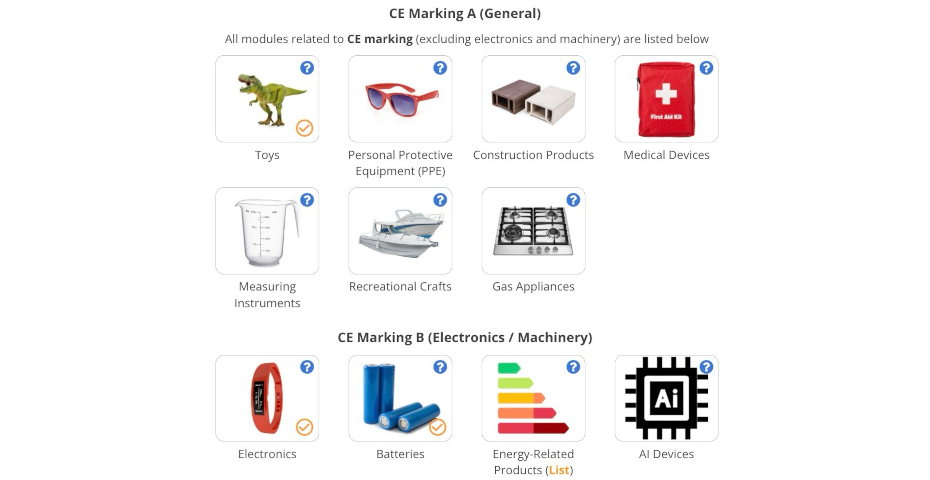
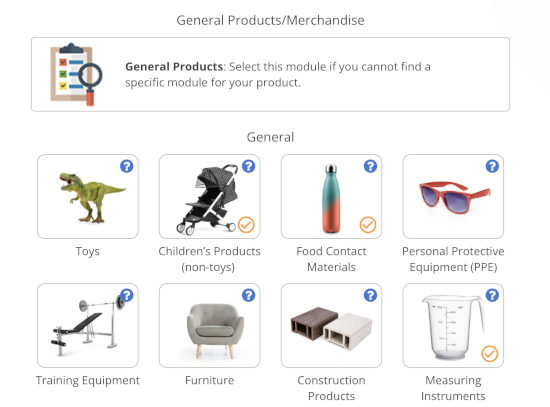
- Step 2: Select product/material modules
- Step 3: Compliance Requirements List Created View Sample >
 Data: Primarily based on official legislation databases (Learn >)
How can I CE mark my product by myself?
Yes, if you are defined as the manufacturer, then you must CE mark the product yourself.
That said, third parties may need to be involved with certain parts of the process.
| CE marking process | Self-managed? |
| 1. Research applicable EU regulations and directives | ✅ Yes |
| 2. Identify harmonised standards | ✅ Yes |
| 3. Implement harmonised standards | ✅ Yes |
| 4. Product safety testing | ⚠️ Third-party lab often required |
| 5. EC-type examination certificate (if required) | ⚠️ Notified body required (for certain products) |
| 6. Create Declaration of Conformity | ✅ Yes |
| 7. Create technical documentation/risk analysis | ✅ Yes |
| 8. Create user instructions | ✅ Yes |
| 9. Affix CE marking and other label information | ✅ Yes |
Why do I need a third-party lab?
You need to verify compliance with applicable harmonised standards. Many EU regulations and directives do not explicitly state that you must involve a third-party lab.
But unless you have the expertise and equipment to carry out testing according to harmonised standards (and the testing procedures that must be followed), then you will likely need to involve a third-party lab.
Why do I need a notified body?
Because certain products are subject to conformity assessment procedures that in turn require an examination followed by certification from a notified body.
This is not the case for all CE-marked products, though.
How do I know if self-managed CE marking is accepted?
You can CE mark a product if:
✅ You are defined as the manufacturer
✅ The product is subject to at least one CE marking regulation and directive
✅ The product does not require a notified body
Note that a manufacturer can be the factory, but it can also be a company that sells products under their own brand. This is the case even if the brand owner uses other companies to make their products.
Who is not allowed to CE mark a product?
You cannot CE mark a product that is not subject to one or more EU regulations or directives which mandate CE marking.
Further, you cannot CE mark a product if you are only defined as the following:
⚠️ Importer (but not a manufacturer)
⚠️ Distributor
As such, you cannot really CE mark a product owned by another brand.
Which CE-marked products can I self-certify?
The applicable conformity assessment procedure determines if you can self-certify or if you need to involve a notified body.
This in turn depends on the product type and other conditions.
The table below provides examples:
| Product type | ✅ Can self-certify | ⚠️ Requires notified body |
| Toys | If harmonised standards followed | If you invent your own standards |
| Electronics | EMCD, LVD, RoHS | RED (in some cases) |
| PPE | PPE Category I | PPE Category II and III |
| Medical devices | Class I (excluding devices in sterile condition, with a measuring function and reusable surgical instruments) | Class I (only devices in sterile condition, with a measuring function or reusable surgical instruments) Class IIa Class IIb Class III |
| Machinery | Category of machinery or related product not listed in Annex I, Part A | Category of machinery or related product listed in Annex I, Part A |
| Batteries | Batteries with the requirements laid down in Articles 6, 9, 10, 12, 13 and 14 | Batteries with requirements laid down in Articles 7 and 8 – That is, some types of:
|
Do I need a permit to CE mark my product?
No, not in the sense that you need to obtain authorisation from the state or another public authority. However, for certain products, it is a requirement that a notified body be involved in the process.
In such cases, they must issue an approval, in the form of a certification or other documentation, before the product in question can be CE-marked and sold.
Can I self-manage product testing?
Yes, at least in theory.
Many CE marking regulations and directives do not explicitly state that you must obtain a test report from a third-party lab.
However, what you must do is the following:
✅ Identify applicable harmonised standards for your product
✅ Ensure that your product is designed to comply
⚠️ Verify compliance through testing
Most companies do not have the in-house expertise and equipment to carry out and document testing according to harmonised standards.
As such, it is often a practical necessity to work with a third-party company like QIMA or TÜV Rheinland to verify compliance.
Yes, even if this is not an explicit requirement for the product in question.
Which parts of the CE marking process can I self-manage?
You can and must manage the following parts of the CE marking process:
- Identify standards
- Product engineering
- Create label files
- Create documentation
Which parts must be managed by third parties?
Anything that requires the involvement of a notified body must be managed by, well, a notified body.
This can include an examination of documentation and the issuance of a certificate before you can sell the product.