




 Find US, EU, UK, CA, & AU requirements













Some products can only be sold in Canada if certain product standards are met. In this guide, we explain what these standards are and how you can identify applicable standards for your products.
Content Overview

FREE CONSULTATION CALL (30 MIN)
 Ask questions about compliance requirements
- Countries/markets:
.png)
.png)
.png)


- Learn how we can help your business
You will speak with:Ivan Malloci
What are Canadian product standards?
Canadian product standards are primarily developed by the Canadian Standards Association (CSA), and formerly the Canadian General Standards Board (CGSB).
Product standards define safety and performance criteria in technical terms. For example, ice hockey helmets must be designed to meet certain requirements in the following areas:
- Materials
- Design and construction
- Size and protected area
- Impact resistance
- Penetration resistance
- Strength and durability
- Labelling and marking
These are outlined in standard Z262.1. Note that some product standards are mandatory, while others are voluntary.
Note that Canadian regulations frequently reference international standards, or those originating in the United States and elsewhere. These standards are not developed by the CSA or defined as Canadian standards per se – but are still mandatory.

Mandatory Product Standards

Many Canadian regulations reference specific product standards. The image above comes from Ice Hockey Helmet Regulations, which mandates compliance with standard Z262.1.
As such, you can only sell ice hockey helmets in Canada compliant with standard Z262.1. Similar requirements exist for many other products.
The following section lists examples of product standards mentioned in Canadian regulations for specific product types and related test methods. Note that this list is not exhaustive.
Toy standards
CSA C22.2 No. 149-1972 – Electrically Operated Toys
CSA C22.2 No. 122-M1989 – Hand-Held Electrically Heated Tools
ISO 8124–2 – Safety of toys — Part 2: Flammability
ASTM F963 – Standard Consumer Safety Specification for Toy Safety*
*Note that this is a US standard. However, it is referenced in the Toys Safety Regulations in the context of safety requirements for magnetic toys.
Children’s product standards
ASTM F1169 – Standard Consumer Safety Specification for Full-Size Baby Cribs
CAN/CGSB-4.2 No. 27.5 – Textile Test Methods: Flame Resistance — 45° Angle Test — One-Second Flame Impingement
ASTM F833 – Standard Consumer Safety Performance Specification for Carriages and Strollers
ASTM F 1004-86 – Standard Consumer Safety Specification for First-Generation Standard Expansion Gates and Expandable Enclosures
Textile standards
CAN/CGSB-4.2 No. 27.6-2015 – Textile Test Methods – Flame Resistance — Methenamine Tablet Test for Textile Floor Coverings
CAN/CGSB-4.2 No. 30.2-M90 – Textile Test Methods – Procedure for the Removal of Non-Permanent Flame-Retardant Treatments on Textile Floor Coverings
CAN/CGSB-4.155-M88 – Flammability of Soft Floor Coverings — Sampling Plans
Furniture standards
ASTM F1169 – Standard Consumer Safety Specification for Full-Size Baby Cribs
Voluntary Product Standards
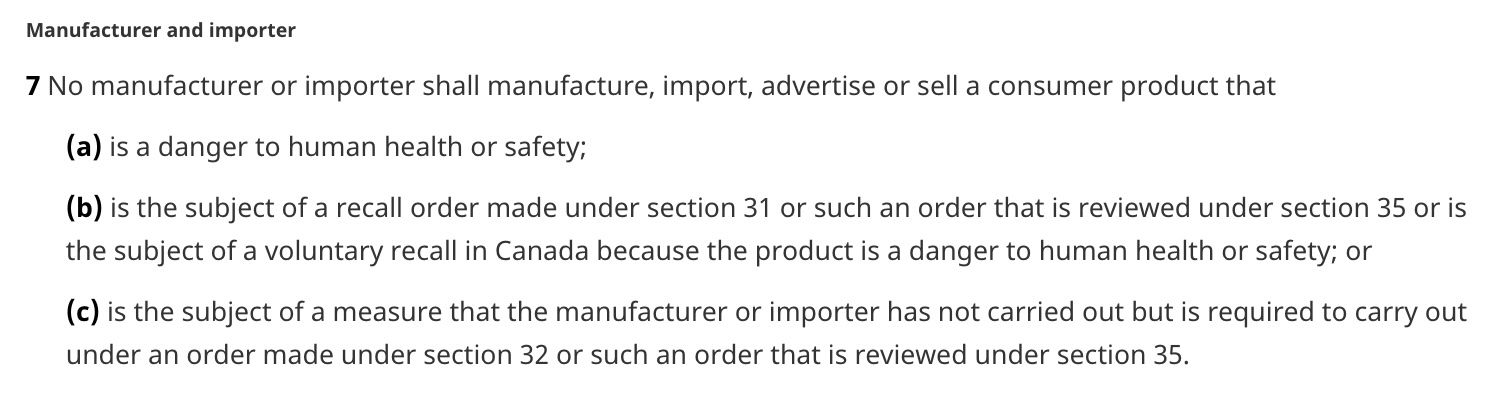
Far from all Canadian product standards are mandatory. That being said, the Canada Consumer Product Safety Act (CCPSA) prohibits the sale of unsafe products, or those subject to recalls (which are usually triggered by safety issues).
As a seller, it is in your best interest to ensure that your product is safe, which can, in many cases, be achieved by:
a. Identifying applicable product standards
b. Ensuring that your product is designed to meet relevant technical requirements
c. Arrange testing according to the applicable standards and test methods
You may also need to consider applicable ISO, ASTM or EN standards, in case you cannot find a relevant Canadian standard for your product.
Amazon Requirements
Amazon requires that all products sold on its marketplace in Canada comply with all applicable regulations. At a minimum, this means that you must comply with mandatory standards referenced in Canadian regulations. Amazon can also request test reports to verify compliance.
Note that Amazon also mandates compliance with standards that may not be referenced in regulations.
For example, the following requirements apply to certain electronics sold in Canada:
Amazon requires that all electrical products and electronics which receive power through a power outlet or connect directly to the electrical grid, be tested to the relevant CSA 22.2 series or harmonized UL standard and have been certified by an SCC-accredited certification body.
FAQ
Is it sufficient to comply with US standards when selling in Canada?
Yes, in some cases, US standards are not only sufficient but required to ensure compliance with particular regulations. That being said, you cannot assume that ASTM or other US standards are always a path to compliance. You must ultimately follow the requirements outlined in applicable Canadian regulations.
What is the difference between a regulation and a standard?
In the context of product compliance, a regulation is a piece of legislation that sets certain requirements for products within its scope. Some regulations provide detailed requirements concerning chemicals, mechanical safety, labelling and other aspects.
Certain regulations also mandate compliance with product standards, which means that compliance with the regulation can only be achieved if the product is also compliant with the referenced standard.
Is compliance with Canadian product standards mandatory?
Yes, if your product is covered by a regulation that in turn references one or more standards.
How do I know which standards apply to my product?
You must first identify all applicable Canadian acts and regulations for your product. You can then read the legislation text to find out if compliance with standards is required.
Is testing required?
Yes, testing is generally required to verify compliance with a particular product standard. Some standards also contain specific test methods that must be followed.
Are Canadian product standards available for free?
Some standards can be accessed for free via the CSA group website. You can learn more in the CSA OnDemand Standards Access Quick User Guide.
Where can I buy Canadian product standards?
You can buy Canadian product standards on the CSA Group website.