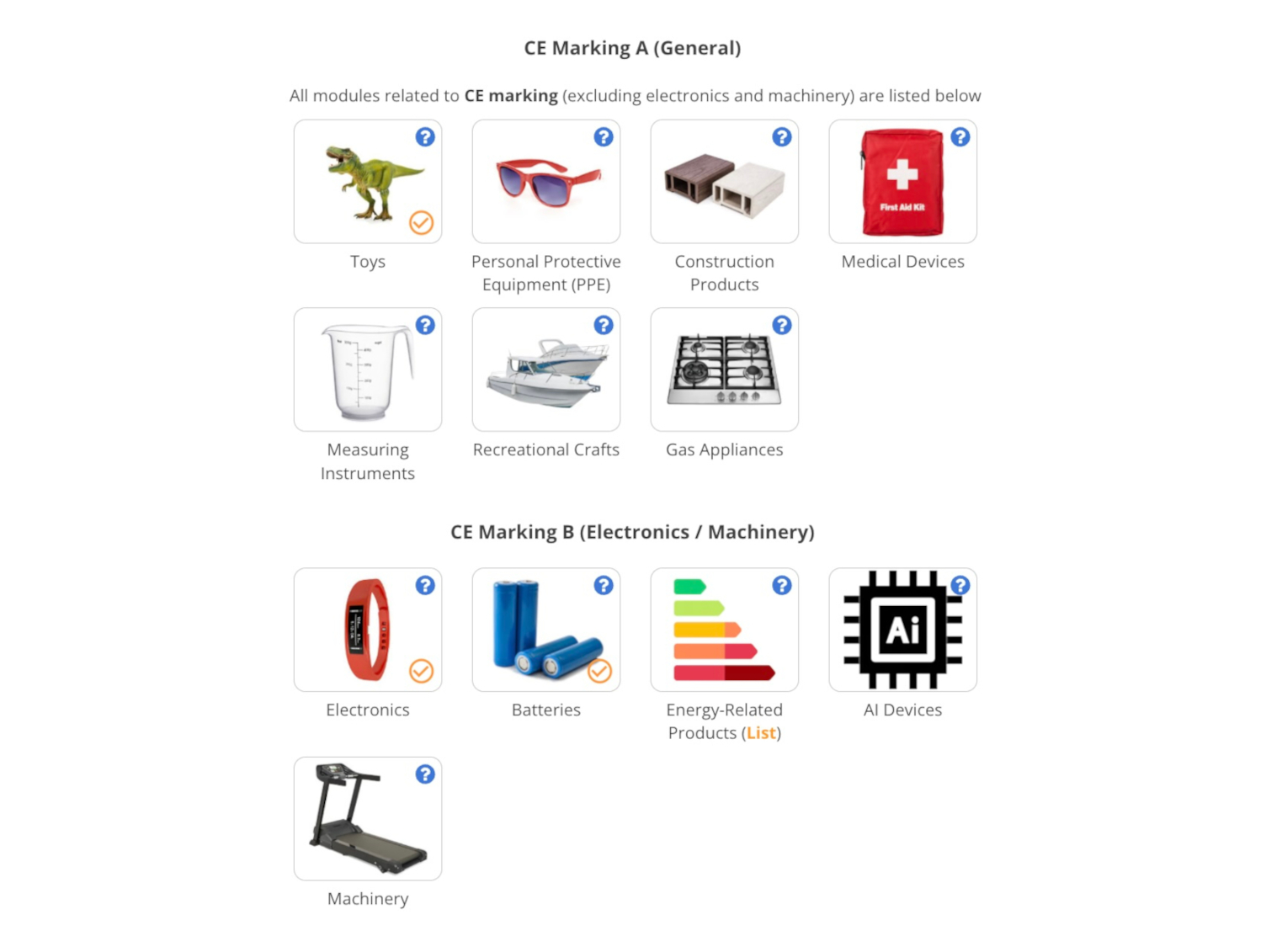




Product lab testing is generally required for electronics, batteries, toys, PPE, machinery, and other products which require CE marking. This guide serves as an introduction to testing requirements, processes, and costs relevant to CE-marked products.
- You can only CE mark products that comply with harmonised standards
- Testing is necessary to validate compliance with said harmonised standards
- CE marking testing often starts from around 1000 USD or EUR
Note: Are you trying to determine if an existing product which requires CE marking has valid test reports? Then I suggest that you read this guide as well.
Content Overview
FREE CONSULTATION CALL (30 MIN)
Ask questions about compliance requirements
Countries/markets:
Learn how we can help your business
You will speak with:Ivan Malloci
What is CE testing?
CE marking is mandatory for products covered by one or more CE marking regulations or directives. Here are a few examples:
- RoHS Directive
- Low Voltage Directive
- Toy Safety Directive
- Personal Protective Equipment (PPE) Regulation
- Medical Devices Regulation
These regulations and directives set general safety and performance requirements for covered products. These are generally met by ensuring that a product is compliant with applicable harmonised standards. Testing in the context of CE marking often refers to testing based on such harmonised standards.
Example: Toy
The Toy Safety Directive mandates that all toys are CE marked. However, a toy can only be CE marked if compliant with certain harmonised standards. Here are two examples:
EN 71-1 – Mechanical and physical properties requirements for toys
EN 71-2 – Flammability requirements for toys
As such, EN 71 testing is generally required for toys before they can be CE marked and thus allowed to enter the EU market.
Is lab testing mandatory when CE marking products?

Yes, lab testing is generally mandatory when CE marking products for the following reasons:
1. Verify product safety and compliance
You must verify that your product complies with applicable harmonised standards. Without testing, you cannot truly know if your product is compliant. This is also explicitly stated in various regulations and directives, such as the Toy Safety Directive:
When deemed appropriate with regard to the risks presented by a toy, manufacturers shall, to protect the health and safety of consumers, carry out sample testing of marketed toys, investigate, and, if necessary, keep a register of complaints, of non-conforming toys and toy recalls, and shall keep distributors informed of any such monitoring.
2. Declaration of Conformity
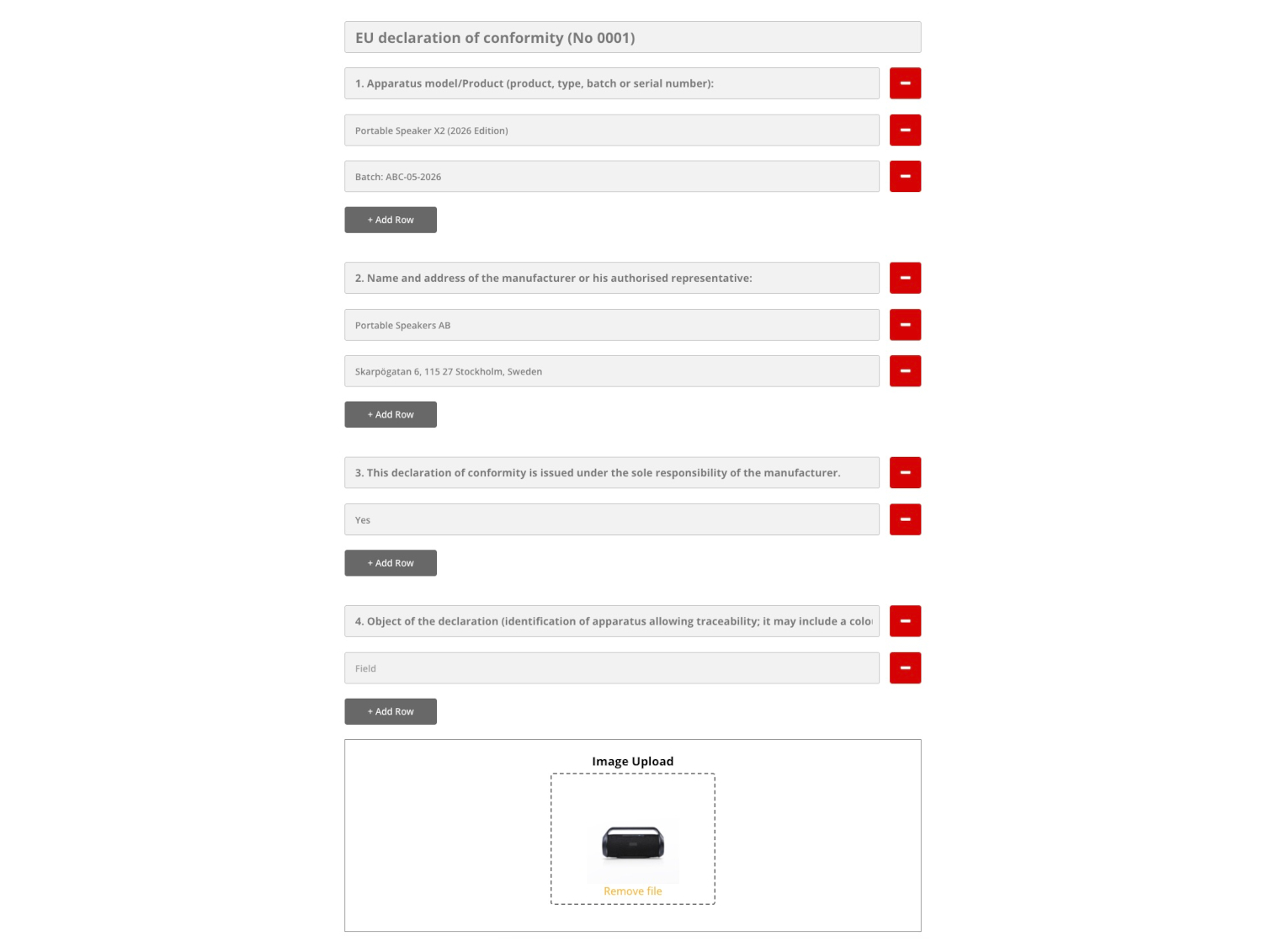
You must include the list of harmonised standards that your product complies with in its Declaration of Conformity. This cannot be based on guesswork. As such, a DoC must be supported by some sort of evidence.
3. Technical documentation
Many EU regulations and directives mandate the inclusion of test reports in the technical documentation.
4. Compliance checks
Market surveillance authorities routinely request test reports when carrying out compliance checks. It is very unlikely that they would, for example, allow a toy to be sold in the EU without any lab test reports indicating compliance with EN 71 parts.
Testing process
This section describes how the testing process can work in the context of CE-marked products.
Step 1: Confirm applicable EN standards
The first step is to identify applicable harmonised standards. For example, the following may be relevant for battery powered speakers:
- EN IEC 62368-1
- EN IEC 62485-1
- EN 50760
Step 2: Design for compliance
EN standards set technical requirements that must be incorporated into your product’s design and functionality. This can involve the following steps:
- Adjust product design to ensure mechanical safety
- Design PCBs and circuits to ensure electrical safety and EMC compliance
- Use materials and components compliant with substance restrictions
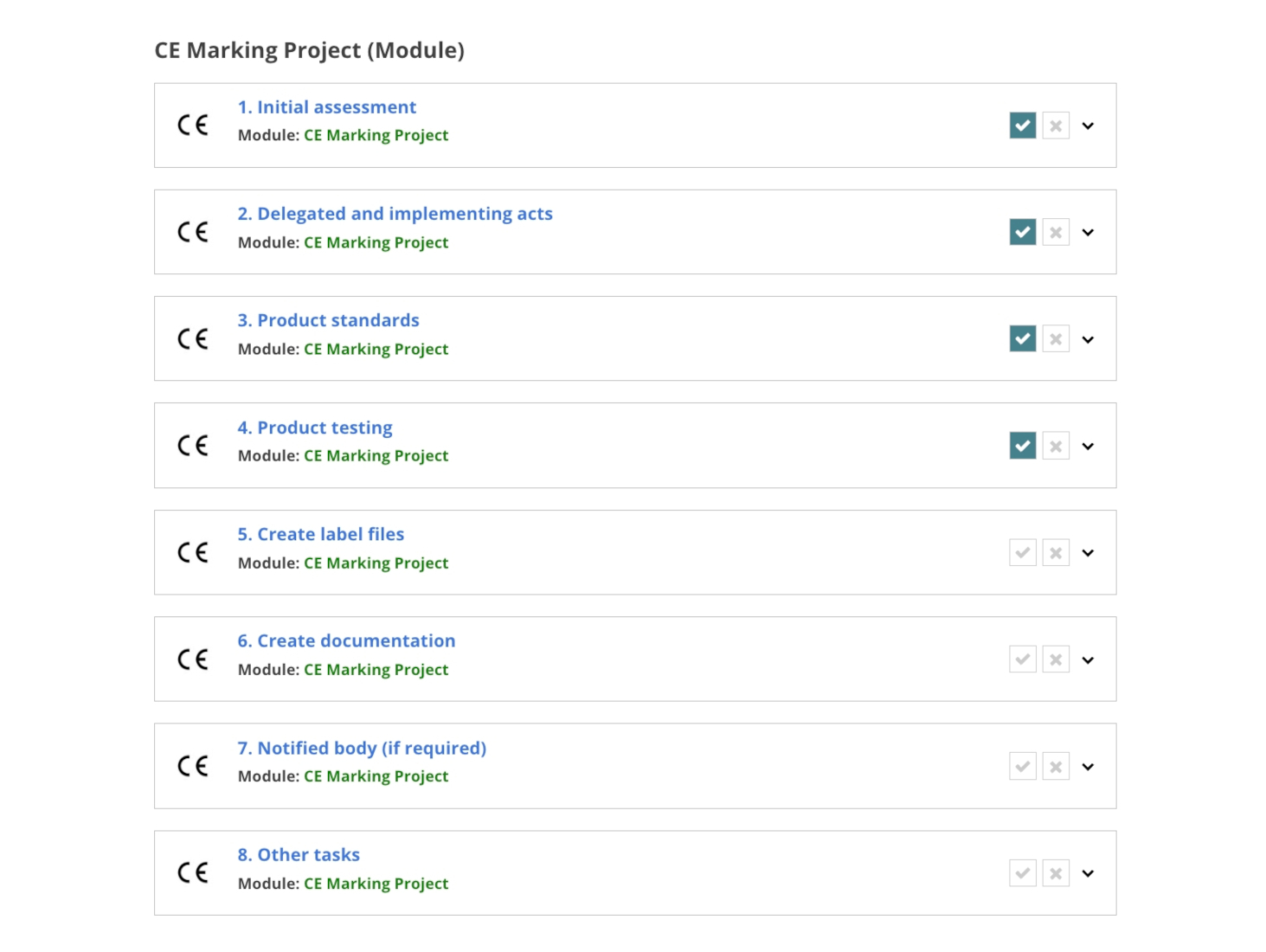
- Create label files
- Write firmware in compliance with certain cybersecurity principles
Some companies skip this step and let the test result speak for itself. That said, testing inherently non-compliant products can be very costly and time-consuming.
Step 3: Request a lab test quote
Next, you need to contact at least one lab to request a testing quotation. It is essential that you share all the information the lab needs to assess which tests are necessary.
- Product type
- Functionality
- Components
- Age group
- Technical specifications
Further, list all identified relevant EU regulations, directives, and harmonised standards. I also suggest that you include statements that convey the following messages:
a. The lab must also assess if any other regulations, directives, and harmonised standards may apply and include these in the testing quotation
b. The lab must disclose if they have excluded any relevant regulations, directives, and harmonised standards on the basis that they lack testing capabilities
Step 4: Submit product samples or prototypes
Once the quote is confirmed, you will be requested to submit product samples to the lab. These samples must match the final product in the following ways:
- Design
- Functionality
- PCBs and wiring
- Bill of materials
- Firmware
Submitting samples that don’t match the final product could result in the test reports not being valid as a basis for CE marking.
Step 5: Obtain test reports
You will receive a test report once the testing process is complete. Assuming the result is pass, you can then proceed to:
a. Create a Declaration of Conformity which references the harmonised standards
b. Include the test reports in the technical documentation
CE Marking Testing Cost Examples
There is no fixed cost or established price range for lab testing according to CE marking standards. Instead, the final cost depends on the following factors:
- Product complexity
- Functionality
- Components
- Identified risks
- Number of applicable EN standards
- Age group
Examples
| Product | Cost range |
| Plush toy | 1200 to 2000 USD or EUR |
| Sunglasses | 1500 to 2200 USD or EUR |
| Power bank | 2500 to 3500 USD or EUR |
| Medical devices | 4000 to 12000 USD or EUR |
How to reduce CE marking testing costs
Here are some methods that can be considered for the sake of reducing testing costs:
1. Use components that are already compliant with EN standards and substance restrictions
2. Eliminate unnecessary design complexity (which can require additional tests)
3. Limit components and functionality
4. Reduce the number of different materials and colour variations
CE Marking Test Report Sample
The image above shows a sample test report for toys. This particular product passed all tests deemed applicable by the testing company (and can therefore be used as the basis for CE marking).
P = Pass
NA = Not applicable (determined by the testing company)
FAQ
Which lab testing companies can test products that require CE marking?
Here are examples of companies offering testing for products that require CE marking:
- TUV Rheinland
- Bureau Veritas
- SGS
- Intertek
- CMC
- QIMA
- STC Group
- Eurofins
- TUV SUD
- TUV Nord
Note that these companies may not necessarily cover every single product type which requires CE marking.
Do CE marked products need to be tested in the EU?
No, not all products that require CE marking must be tested by a lab located in the EU. That said, some products can only be CE marked once evaluated and certified by a Notified Body. This is, for example, the case for certain medical devices or PPE. Notified bodies are generally located in the EU.
Can CE marked products be tested in China?
Yes, many products that require CE marking are manufactured in China and tested by labs in the same country. Whether or not this is acceptable depends on the applicable conformity assessment procedure and whether a Notified Body must be involved (and their requirements for testing).
Do we need to test each product model?
Yes, at least in the sense that each product model or SKU needs to comply with harmonised standards, which must be verified through testing. That said, you may not necessarily need to apply all tests to every single SKU.
For example, substance tests are often done at a component level. If you have several products using the same components and materials, then you potentially test these once and assume that the result is valid for all other SKUs.
Do we need to test if each component is individually CE marked?
As mentioned above, some tests can be done at a component or material level. But compliance with certain EN standards can only be validated for the final product.
It is ultimately the final product that is CE marked. A product does not automatically comply with CE marking requirements even if every single component is individually tested and CE marked.
You could, for example, use components that are compliant individually, but integrate these in such a way that the final product is unsafe and non-compliant.
How often do we need to test CE marked products?
I am not aware of any EU regulation or directive setting a specific test frequency. Still, this does not mean that you can test a product only once and then rely on that test report forever.
Here are some scenarios in which you would need to re-test your CE marked product:
a. Your product becomes subject to a new or updated regulation/directive
b. Your product becomes subject to a new harmonised standard
c. The version of the harmonised standards your product was tested for is replaced by a newer version
d. You make changes to the product’s design, components, materials or functionality
Can we test the products ourselves before CE marking?
In theory, self-testing is accepted for many products. This is sometimes referred to as internal production control or self-verification. That said, you must still validate compliance with the requirements set by harmonised standards and follow the referenced test methods.
The problem many companies face is a lack of equipment and expertise to carry out testing according to applicable EN standards while also following and documenting according to the applicable test procedures.
The result of this is that most companies must still involve third-party testing companies, even if doing so is not an explicit requirement.
In any case, self-verification is not a free ticket to arbitrarily deciding that a product is compliant based on your gut feeling.
How do I know which standards and tests apply to my product?
You can find lists of harmonised standards on this website. You can also ask a lab to provide an assessment. Labs often provide a list of standards that they deem applicable, as part of a lab test quotation.
At what stage should we arrange lab testing?
Lab testing can either take place before mass production or after production (batch sample testing). Sometimes you may need to arrange to test for both pre-production and batch samples.
Pre-production samples
It’s often necessary to verify compliance with the applicable EN standards before you enter mass production. Without verifying compliance, you run the risk of mass-producing a product that is inherently non-compliant by design.
Pre-production testing, therefore, serves as a safety check before it’s too late to correct technical compliance issues. For example, it’s always necessary to verify electrical safety and mechanical design safety before mass production.
This only applies as long as the pre-production samples are exactly the same as the final mass-produced product.
Batch sample
Batch samples, unlike pre-production samples, represent the products you’re actually placing on the market. As such, batch testing is often required for the sake of ensuring that the final product is compliant.
Further, there can be differences in terms of components, materials, and paints between prototypes and final products, which is why batch sample testing is needed.
What can happen if we CE mark products without testing?
CE marking a product without any testing means that you have not verified compliance with applicable harmonised standards. This means that you have failed to verify compliance with the applicable CE marking regulations and directives and have thus incorrectly CE marked the product.
What can happen if I don’t have a valid lab test report?
Then you do not have any evidence to back up that your product is compliant with applicable harmonised standards. You could face a sales ban or recall if your product were to become subject to compliance checks.
Who will check our test reports and when?
Test reports can be requested by the customs authorities and market surveillance authorities in EU member states. They often request the following when checking CE marking compliance:
- Test reports
- DoC
- Label files
- Instructions
I have never seen a case in which EU market surveillance authorities accepted a CE marked product without valid test reports.
Why do I need lab testing if my product is already CE marked?
Because you have a responsibility to not just determine that the product has the CE marked affixed, but also vet the documentation behind the CE mark.
Obtaining and verifying test reports is necessary even if the product has a printed CE mark.
Can I ask our supplier to manage testing?
You can, but I strongly advise against doing so. It is essential that you work directly with the lab to understand what sort of tests they recommend, and for what reason. I have seen many cases in which companies let their suppliers manage testing entirely on their own, which sometimes results in the following:
a. The supplier only arranged partial testing (knowingly or unknowingly)
b. The supplier purchased fake test reports or certificates (to save money)
Testing is too important to hand over to a supplier or any middleman for that matter.
Can I use test reports from our suppliers instead of testing?
Yes, in some cases. But, this can only be done if the test reports are:
a. Valid for the same product model
b. Fairly recent and based on current standards versions
c. Covering all applicable EN standards
The test report must also be held by the supplier, and not one of their buyers.
In short, the planets must truly align before you can actually use an existing test report as the basis for CE marking. It happens, but is relatively rare.
Can I use certificates from our suppliers instead of testing the product?
No, a CE certificate is not a substitute for obtaining actual test reports. In fact, many certificates are fake in the sense that they do not have any supporting evidence in the form of test reports.
How do I check if a CE test report is valid?
You must check the following information to determine if a test report is valid for CE marking:
- Is the manufacturer name matching?
- Is the product model/SKU matching?
- Is the product photo matching?
- Are all applicable EN standards listed?
- Are the EN standards versions still valid?
Is a lab test report sufficient when selling CE marked products?
No, a lab test report alone is not sufficient to CE mark a product. Here are some other documents you need to create when CE marking a product as a manufacturer:
- Declaration of Conformity
- Technical documentation
- Instructions
You must also affix traceability label information.
Do we need to test products if similar CE marked products are already sold in the EU?
Yes, failing to arrange testing on the basis that “similar products are sold in the EU” is almost guaranteed to result in a sales ban or recall if you are ever subject to a compliance check.
Further, you cannot know if a “similar product” is the same as yours just by looking at it. Two products can have the same external design but have different components, materials, and functionality.


Hi, we are a manufacturer and installer of access systems across the UK and Europe. At a project in Spain we have been asked to provide proof of compliance to EN13637. We only manufacture the Card reader and PSU/control unit which have both been tested to IEC 62368-1 & ETSI EN 300 330. I cannot find anywhere that specifically test to the EN 16367 standard and nothing states that this certification relates to the Reader and control unit. Any advise/knowledge you can share on EN 13637 would be greatly appreciated.
I am making a custom toy plush (OEM) from China, and will get it CE EN71 certified for it’s mass production batch of 50. I want to ask you: Do I have to get it certified again (paying a hefty fee for the lab test & report) if I want the manufacturer to make say, a batch of 100 in the future?
Would the obtaining of factory acceptance testing on power generators in the EU be the same as obtaining CE certification
Hey,
Can you send me the list of tests required for CE marking?
Hi Saba,
There is no such list. That depends on the applicable regulations/directives and by extension the applicable EN, IEC, and other standards.
The EN standards and corresponding lab tests applied to a toy are very different compared to, say, a power bank.
And for medical devices as well. Right?
We don’t cover medical devices
my supplier has recommended a lab, their certificate says they are CNAS and ILAC accredited, are there any more checks i need to do before using this lab? I tried using Qima, they quoted $1k then doubled it to $2k once receiving an expensive amount of samples.
Hi Kevin,
Not sure how relevant CNAS and ILAC are in this case.
Dear Fredrik,
It is stated that we are manufacturer of N95 Mask and we have tested our product is tested as per EN-149 standard. Now we want CE Certificate for our product. Please help us to apply CE certification of CAT-II N95 mask according to FFP2 class.
your kind favour will be highly appreciated.
Hello Sir,
I need a quotation to get CE certification for NFC reader product.
Also if you can provide FCC quotation for the same product it would be appreciated.
Here are some details about the product:
The product is NFC reader/writer with USB interface to PC
Power Supply: USB powered
Interfaces: 1 x USB
Case: ABS plastic
Dimensions: 80mm x 40mm x 12mm
internal chipset: RFID chip coming from NXP and it is CE and FCC marked
Regards,
Mohamed Ahmed.
And if selling a bluetooth handsfree Item? I need the Bluetooth report from the Supplier?
And I need to sign up on the bluetooth website for the free account?
And then what document do I need to draw up for the supplier, Bluetooth Co. and I? Stating what?
And am I aloud to have the bluetooth Logo on my website or marketing Material?
and I do know that my product should be marked with the bluetooth symbol on the product and if not on the packaging forsure with the FCC and CE as well??
And Does a Bluetooth Chip Roda 1536U have the same regulations as the Bluetooth speaker?
Is it a real bluetooth Chip? And this might be a stupid question but if its not by Bluetooth then do I still need to go through Bluetooth or just the FCC and CE?
Thanks!
Hello Jennifer,
Bluetooth is licensed technology. I know they charge fees, ranging from 2500 up to 8000 USD per SKU or something like that. Not sure if that only applies to the chip makers or also end products.
Do you have a list of labs in the EU or UK that can do testing to EN14605?
What are mandatory lab tests required for a dehumidifer which has CE Marking in order to meet Machinery and Low Voltage Directives
You need to ask a lab to help you assess applicable EN, IEC and ISO standards
So far as I read your articles and others in the internet, may you pls. clarify if there is an EU database which can check whether a manufacturer is qualified to affix CE mark ? Besides, is there an EU Authorised Representative which based in Asia ?
Hi Maggie,
I don’t think this such a database exists. For most products, the CE mark is “self affixed”.
No, I don’t think an EU authorized representative can be based in Asia, or anywhere outside the EU for that matter. That would defeat the entire purpose of having a European representative.
Can you give me the company ho make CE test report for non medcical KN 95
KN 95 is a Chinese standard. It has nothing to do with CE marking.