





 Find US, EU, UK, CA, & AU requirements














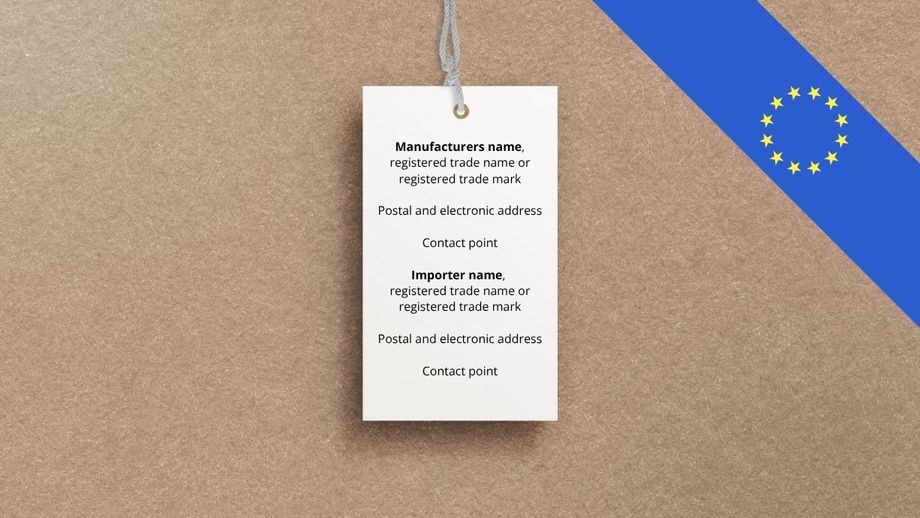
Several EU regulations and directives mandate that the manufacturer and importer are specified on the product, packaging or accompanying documentation.
Failing to correctly declare the manufacturer and importer (if any) can result in recalls or costly relabelling. Despite this, many companies selling in the EU keep getting this wrong and end up wasting money on incorrectly labelled inventory.
Methodology
This article is based on the following EU regulations and directives:
- General Product Safety Regulation (EU) 2023/988
- Packaging and Packaging Waste Regulation (EU) 2025/40
- EMC Directive 2014/30/EU
Note that identical requirements can be found in many other EU regulations and directives, but do not intend to cover them all, as the basic principle is the same.
Content Overview

FREE CONSULTATION CALL (30 MIN)
 Ask questions about compliance requirements
- Countries/markets:
.png)
.png)
.png)


- Learn how we can help your business
You will speak with:Ivan Malloci
Manufacturer information
The manufacturer name and address must generally be specified on:
- Consumer products (mandated by the GPSR)
- Products that require CE marking
- Packaging
As such, a manufacturer must be present on most products sold in the European Union.
Definitions
The first step is to identify which company is defined as the manufacturer. This is not necessarily the factory making the products.
Let’s take a look at the definition of a manufacturer under the GPSR:
‘manufacturer’ means any natural or legal person who manufactures a product or has a product designed or manufactured, and markets that product under that person’s name or trademark;
This definition tells us that the following companies can be defined as manufacturers:
a. Companies manufacturing products
b. Companies designing and branding products made by external factories
Generally speaking, the company that takes the initiative to bring a new product to market by design and/or branding a product is deemed to be the manufacturer.
This could be the factory, but it can also be a company which imports private label products from suppliers in China.
Labelling requirements
The table below summarises manufacturer labelling requirements under three EU regulations and directives.
| Regulation / Directive | Requirements |
| General Product Safety Regulation (EU) 2023/988 | Manufacturers shall indicate their name, their registered trade name or registered trade mark, their postal and electronic address and, where different, the postal or electronic address of the single contact point at which they can be contacted. That information shall be placed on the product or, where that is not possible, on its packaging or in a document accompanying the product. |
| Packaging and Packaging Waste Regulation (EU) 2025/40 | Manufacturers shall indicate on the packaging or on a QR code or another data carrier their name, registered trade name or registered trademark as well as the postal address at which and, where available, the electronic means of communication by which they can be contacted. Where that is not possible, the required information shall be provided as part of the information through the QR code or other type of standardised, open, digital data carrier as referred to in Article 12(1), (2), (4) or (5) or in a document accompanying the packaged product. The postal address shall indicate a single point at which the manufacturer can be contacted. |
| EMC Directive 2014/30/EU | Manufacturers shall indicate, on the apparatus, their name, registered trade name or registered trade mark and the postal address at which they can be contacted or, where that is not possible, on its packaging or in a document accompanying the apparatus. The address shall indicate a single point at which the manufacturer can be contacted. The contact details shall be in a language easily understood by end-users and market surveillance authorities. |
While the specifics differ slightly, the following is generally required in terms of manufacturer labelling:
- Manufacturer name, registered trade name or registered trade mark
- Manufacturer postal address
- Manufacturer electronic address and contact point
Importer information
EU regulations and directives which set requirements concerning manufacturer labelling generally require that importer information is also present.
Note that this is only applicable if there is an importer, which is not always the case.
Definitions
Importers are generally defined as the first EU entity which introduces a product originating from a country outside the European Union. As such, there can only be one importer.
This definition can be found in the GPSR:
‘importer’ means any natural or legal person established within the Union who places a product from a third country on the Union market;
The following entities are generally not considered importers:
a. Non-EU companies
b. EU companies buying from other companies established within the EU
Labelling requirements
The table below summarises labelling requirements for importers under three EU regulations and directives.
| Regulation / Directive | Requirements |
| General Product Safety Regulation (EU) 2023/988 | 3. Importers shall indicate their name, their registered trade name or registered trade mark, their postal and electronic address and, where different, the postal or electronic address of the single contact point at which they can be contacted. That information shall be placed on the product or, where that is not possible, on its packaging or in a document accompanying the product. Importers shall ensure that any additional label does not obscure any information required by Union law on the label provided by the manufacturer. |
| Packaging and Packaging Waste Regulation (EU) 2025/40 | 3. Importers shall indicate on the packaging their name and their registered trade name or registered trademark as well as the postal address at which and, where available, the electronic means of communication by which they can be contacted. Where it is not possible to indicate that information on the packaging, it shall be provided via standardised, open, digital data carrier as referred to in Article 12 or in a document accompanying the packaged product. |
| EMC Directive 2014/30/EU | 3. Importers shall indicate on the apparatus their name, registered trade name or registered trade mark and the postal address at which they can be contacted or, where that is not possible, on its packaging or in a document accompanying the apparatus. The contact details shall be in a language easily understood by end-users and market surveillance authorities. |
This information is generally required in terms of importer labelling:
- Importer name, registered trade name or registered trade mark
- Importer postal address
- Importer electronic address and contact point
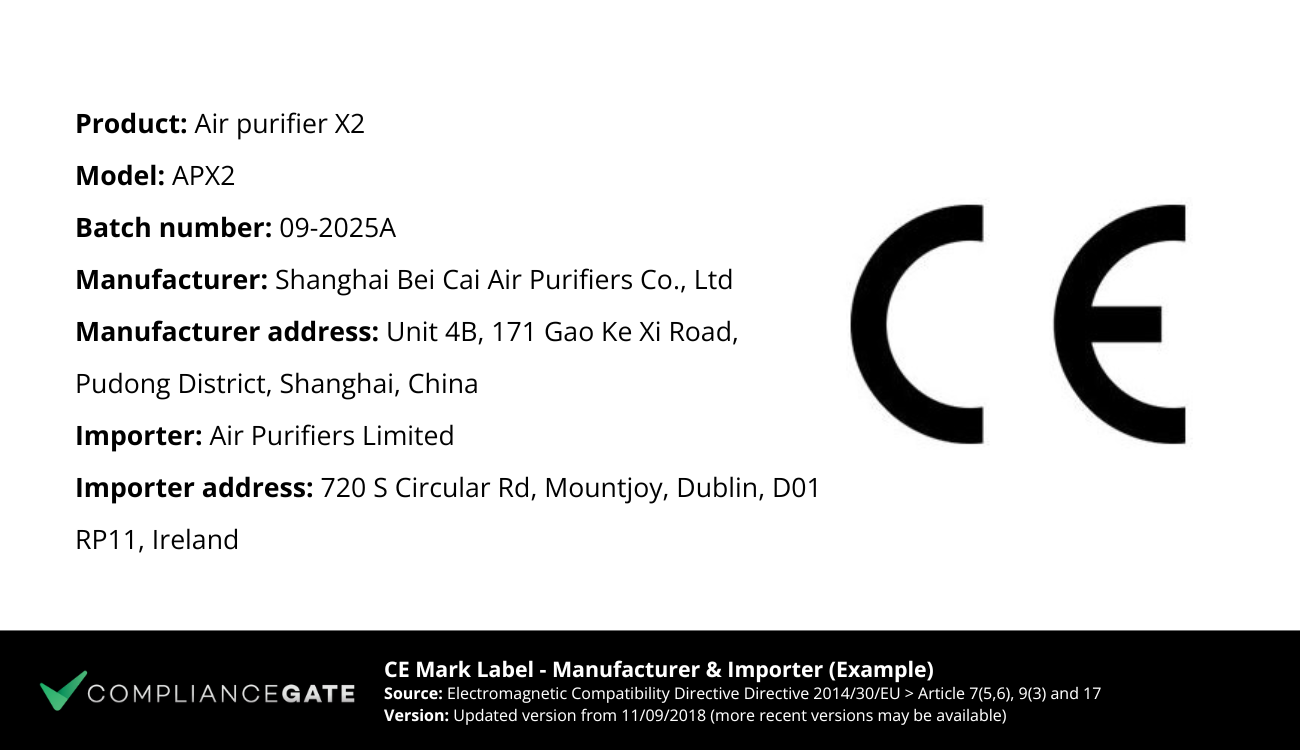
Label Example
FAQ
Is it mandatory to specify the manufacturer when selling products in the EU?
Yes, specifying a manufacturer name, address and contact point is required for most products (and now also packaging) sold in the EU.
Is it mandatory to specify the importer when selling products in the EU?
Yes, but only if there is a separate importer. I explain this below:
a. There is no importer if the product was made in the EU
b. If the company importing the products designed and/or branded the product, then they are likely already declared as the manufacturer
Which products require manufacturer and importer information?
Most, if not all, regulations and directives which mandate CE marking require that manufacturer and importer information is present on labels. Here are some of the product categories which require CE marking:
- Toys
- Electronics
- Batteries
- PPE
- Medical devices
- Construction products
Further, the GPSR and PPWR extend this requirement to:
- Consumer products
- Packaging
Do we need to include both manufacturer and importer information on labels?
Yes, but only if the manufacturer and importer are separate entities. This is not always the case, as many companies importing products are defined and declared as manufacturers.
This is explained in the table below:
| Company | Scenario A | Scenario B |
| Shenzhen Widget Company Limited (China) | Manufactures based on design specifications provided by the customer | Factory and brand owner |
| Sehr Gut Products GmbH (Germany) | Designs products to sell under its own brand | Imports and resells the Chinese brand |
| Result | Manufacturer and importer = Sehr Gut Products GmbH | Manufacturer = Shenzhen Widget Company Limited
Importer = Sehr Gut Products GmbH |
Can we specify the importer instead of the manufacturer?
No, the GPSR, PPWR and many CE marking regulations mandate that a manufacturer name, address and contact point are specified.
This is a baseline requirement, and the presence of importer information is not a substitute for the corresponding manufacturer details.
Importer information is generally only added in addition to the manufacturer information.
Where should manufacturer and importer information be placed?
The default option is to include manufacturer and importer information on the product. If this is not possible, then you may have these options:
a. Print on packaging
b. In a document accompanying the product
Most EU regulations and directives do not specify when printing on the product is not possible.
What can happen if no manufacturer is declared?
Then you can face a product recall. The first thing EU market surveillance authorities tend to check is whether a manufacturer name, address and contact point are specified on the label.
What can happen if no importer is declared?
You can face a recall or sales ban if the importer is not declared (assuming there is an importer).
Can the manufacturer be located outside the EU?
Yes, a manufacturer does not have to be located within the EU. If the company defined as the manufacturer is in fact outside the EU, then the name of the non-EU manufacturer must be specified.
Do we need to specify the name of our factory?
Yes, if the company defined as the manufacturer (which is not always the factory) is your factory, then you will need to specify its name, address and contact details.
What if the manufacturer and importer are the same company?
As mentioned, it is common that the importer is defined as the manufacturer. Thus, the importer and manufacturer can be the same company.
In these cases, the company acting as the importer and manufacturer is generally specified once.
Do we need to include information about distributors on the label?
For most products, the name, address and contact point of companies defined as distributors is not required.