






 Find US, EU, UK, CA, & AU requirements













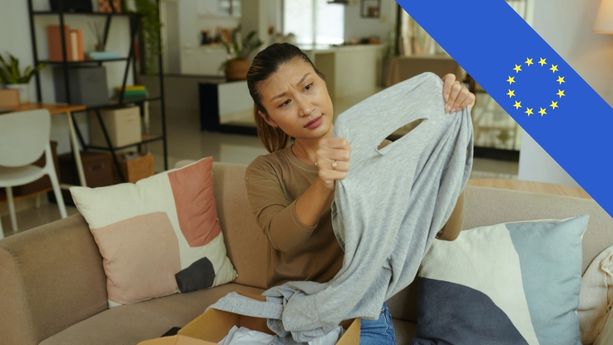
Companies selling products to consumers in the EU must provide a 2-year legal guarantee. In short, products are expected to meet reasonable and expected quality standards at the time of delivery.
If this fails, then the consumer can be entitled to a free repair, replacement or even a refund (full or partial).
But this should not be understood as an unconditional warranty or money-back guarantee. There are conditions that apply to both sellers and consumers under the Sale of Goods Directive (EU) 2019/771.
This guide provides the following:
1. A breakdown of articles under the Sale of Goods Directive (EU) 2019/771 that set requirements concerning the 2-year legal guarantee
2. Case studies explaining when a consumer can and cannot make a claim:
- Wristwatch
- Espresso machine
- T-shirt
3. Frequently asked questions
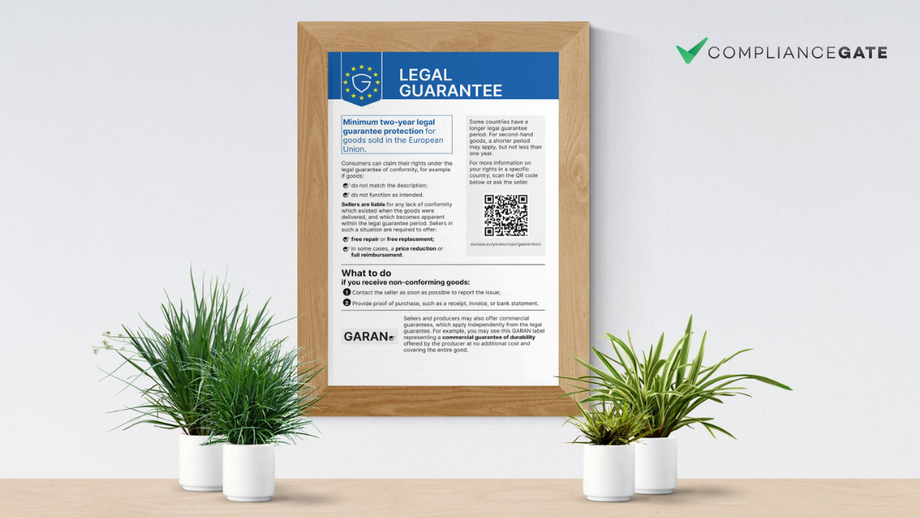
Note: Starting on 27 September 2026, sellers must inform consumers about their right to a 2-year legal guarantee using a harmonised notice. This notice must be present in online stores and in physical stores.
Content Overview

FREE CONSULTATION CALL (30 MIN)
 Ask questions about compliance requirements
- Countries/markets:
.png)
.png)
.png)


- Learn how we can help your business
You will speak with:Ivan Malloci
Sale of Goods Directive (EU) 2019/771
The 2-year legal guarantee is established under the Sale of Goods Directive (EU) 2019/771. Key articles of the directive are explained below, in the order that I find most logical.
| Article 3 > | Article 10 > | Articles 5, 6, 7 & 8 > | Article 11 > | Article 13 |
| Applies to sales contracts between a consumer and a seller | The seller is liable for “lack of conformity” | Defines what lack of conformity means | Explains who must provide evidence | Explains how the seller can “compensate” the buyer. |
Article 3 – Scope
Article 3(1) states that the directive applies to sales contracts between a consumer and a seller.
Article 10 – Liability of the seller
1. The seller shall be liable to the consumer for any lack of conformity which exists at the time when the goods were delivered and which becomes apparent within two years of that time. Without prejudice to Article 7(3), this paragraph shall also apply to goods with digital elements.
Article 10(1) states that:
a. Sellers are liable “for any lack of conformity” when the goods were delivered
b. Which become apparent within 2 years
This is also the basis for the 2-year legal guarantee. Note that the focus is on non-conformity that exists at the time of delivery.
Article 5 – Conformity of goods
The seller shall deliver goods to the consumer that meet the requirements set out in Articles 6, 7 and 8, where applicable, without prejudice to Article 9.
The seller must deliver products that conform to what is written in Articles 6, 7 and 8.
These articles provide more concrete information about what conformity means.
Article 6 – Subjective requirements for conformity
Article 6 essentially states that delivered products must conform to what is written in a sales contract. Depending on what is defined in the sales contract, the product must conform to the following aspects:
- Description, type, quantity and quality, functionality, compatibility, interoperability and other features
- Particular purpose demanded by the customer and for which the seller has given acceptance
- Delivered with all accessories and instructions
- Supplied with updates (as stipulated by the sales contract)
For context, the following definition is provided:
‘sales contract’ means any contract under which the seller transfers or undertakes to transfer ownership of goods to a consumer, and the consumer pays or undertakes to pay the price thereof;
Article 7 – Objective requirements for conformity
Article 7 sets general principles that are not directly controlled by terms in a sales contract, but must still be met. Here are some examples:
a. Products must be “fit for the purposes” for which products of the same type would normally be used
b. Products must be of the same quality and meet descriptions of samples presented to the customer
c. Be delivered with presented accessories
d. Come with sufficient instructions (which must also explain installation)
e. A product must match the standard quality, functionality, and performance that could reasonably be expected from comparable products and advertising. The following aspects are mentioned:
- Durability
- Repairability
- Functionality
- Compatibility
- Security
Note that many of these aspects are already covered by other EU regulations and directives. Here are two examples:
Article 8 – Incorrect installation of the goods
Lack of instructions or insufficient instructions leading to the correct installation of a product is covered by Article 8.
In short, if you fail to provide sufficient installation instructions and the product breaks or is degraded as a result, then that’s on you.
Article 11 – Burden of proof
1. Any lack of conformity which becomes apparent within one year of the time when the goods were delivered shall be presumed to have existed at the time when the goods were delivered, unless proved otherwise or unless this presumption is incompatible with the nature of the goods or with the nature of the lack of conformity. This paragraph shall also apply to goods with digital elements.
Non-conformity which appears within 1 year from the delivery date of the product is presumed to have been present on delivery.
The burden of proof is on the seller within the first year.
Article 13 – Remedies for lack of conformity
1. In the event of a lack of conformity, the consumer shall be entitled to have the goods brought into conformity or to receive a proportionate reduction in the price, or to terminate the contract, under the conditions set out in this Article.
Article 13 presents ways that sellers can compensate consumers when a product is found to be non-conforming. Here are some key points:
a. The consumer may choose between repair and replacement (unless impossible or if the costs for the seller are disproportionate).
b. The seller shall inform the consumer about the consumer’s right to choose between repair and replacement
c. The consumer is entitled to either a full or partial refund (depending on what is proportionate) or the termination of the sales contract in any of the following cases:
- The seller has not completed repair or replacement
- The seller has refused to bring the goods into conformity
- The product fails to conform (i.e., breaks) even after repairs or replacement
- The lack of conformity is particularly serious
- The seller will not ensure conformity within a reasonable time or causes significant inconvenience
d. The consumer is not entitled to terminate the contract if the lack of conformity is only minor.
Article 14 – Repair or replacement of the goods
Product repairs and replacements must be provided free of charge and within a “reasonable timeframe”.
Further, the seller cannot make the repair or replacement process unreasonable and difficult for the customer.
Case Studies
Here are some examples of scenarios where products could be considered non-conforming at the time of delivery.
| Case study | Defect description | Present at delivery? |
| Wristwatch | The brand stated that the watch was rated as 5 ATM and should therefore be able to withstand water from a tap or shower.
Despite this, the watch case was filled with water when the customer either showered or washed her hands. |
It is clear that this was an issue present at delivery, caused by poor design or a manufacturing defect.
It directly contradicts the marketing, which states 5 ATM. |
| Espresso machine | A glass part in the machine broke due to heat from the machine itself. Everyone knows that coffee is hot, and the machine should use materials that can withstand heat. | This was an inherent quality issue caused by poor design and material choices and was certainly present at the time of delivery.
It was only a matter of time before the glass part cracked from the heat. |
| T-shirt | Holes appeared after 2 washes. The customer followed the care instructions on the label. | While not indestructible, a T-shirt should not break apart after two washes when the customer follows the specified care instructions. |
Here are some counterexamples for when a customer would likely not be able to make a claim under the Directive:
Watch: The customer broke the watch while using a gym machine, which later resulted in water entering the case.
Espresso machine: The machine was placed in a closed compartment, which caused overheating. The instruction manual provided clear information about:
- Storage
- Operational temperature
- Precautions
The glass part broke because the consumer did not follow clear instructions. Espresso machines and glass parts are not indestructible.
T-shirt: The viscose material required washing at 30 degrees and is specified in the care instructions. The customer washed the T-shirt at 60 degrees, which resulted in considerable shrinkage.
Legal Guarantee Notice
Starting on 27 September 2026, sellers must inform consumers about their right to a 2-year legal guarantee using a harmonised notice. This notice must be present in online stores and in physical stores.
FAQ
Are sellers required to offer a 2-year guarantee for products sold in the EU?
Yes, but only under certain conditions. This should not be understood as an unconditional warranty where consumers can freely ask for their money back a day before the 2-year period is up.
The emphasis is on delivering products that meet reasonable standards.
What is reasonable generally depends on:
a. Quality and functionality expected from similar products within a price range
b. What is advertised
c. What is written in sales contracts
This puts an emphasis on product quality and reasonable durability.
Which products are covered by the 2-year guarantee?
The Sale of Goods Directive (EU) 2019/771 applies to sales contracts between a consumer and a seller. For example, the 2-year guarantee can apply to the following products sold to consumers:
- Textiles
- Toys
- Accessories
- Watches and jewellery
- Electronics
- Machinery
It does not provide a specific list of products or categories covered.