






 Product assessments in 2 minutes



















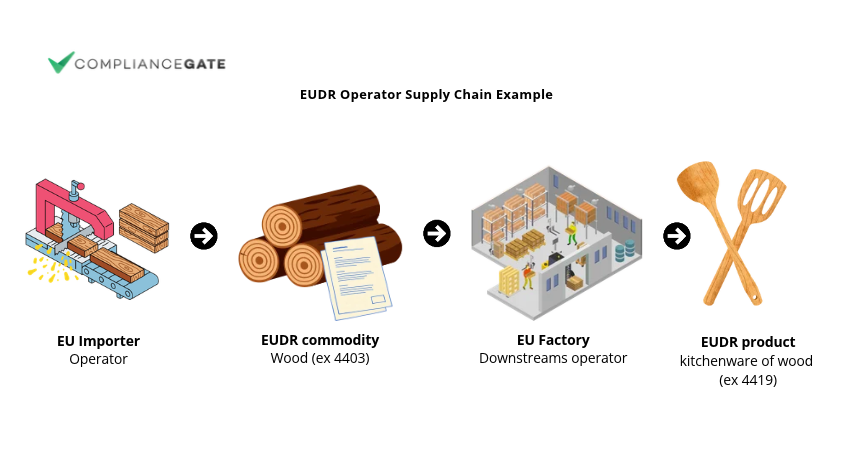
Under the EUDR, a timber importer could be defined as an operator. Next, a furniture factory turning that timber into wooden chairs would likely be defined as a downstream operator.
The requirements that apply to these two entities, the operator and the downstream operator, differ significantly.
In this guide, I explain how you can determine which type of operator applies to your company, and what the requirements are for operators and downstream operators.
Process
Step 1: Determine if you are an operator or a downstream operator
Step 2: Operators must comply with requirements under Article 4
Step 3: Downstream operators must comply with requirements under Article 5
Content Overview

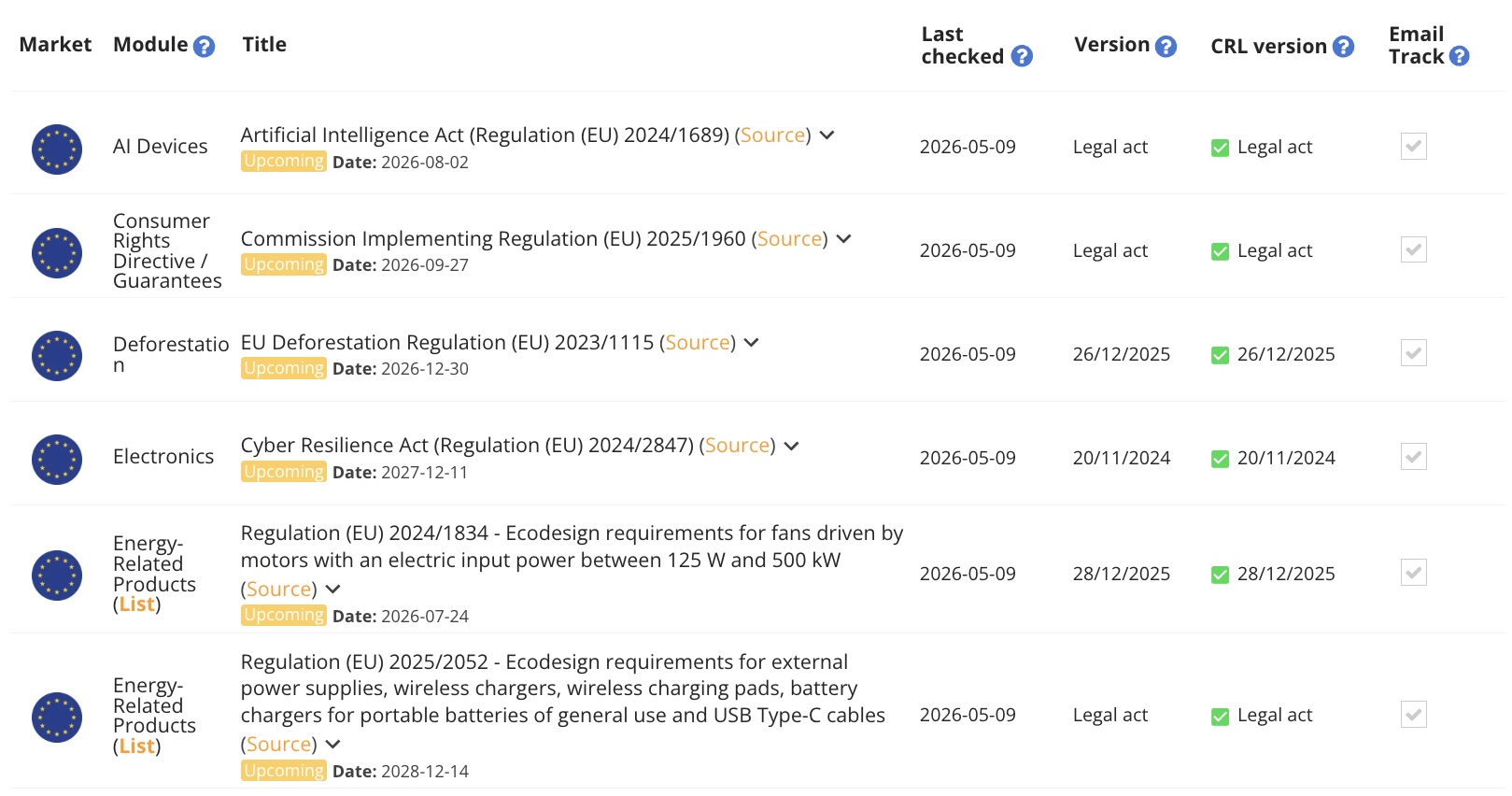
View Future Regulations for Your Product Free
Estimated time: 2 to 3 minutes
 Covered markets:
.png)
.png)
.png)


- Track future and recently updated regulations
- Setup email alerts
 Data: Primarily based on official legislation databases (Learn >)


Free Consultation (30 min)
Do you have questions about US, EU, or UK product compliance requirements?
Who is an operator under the EUDR?
The operator is the first company to introduce a product covered by the EUDR in the European Union. A downstream operator procures products covered by Annex I from an operator, and then processes these into another product covered by Annex I.
Generally speaking, the operator is primarily responsible for carrying out the due diligence process under EUDR. If, for example, an EU company imports timber, then it must check documentation to ensure that the wood is EUDR compliant.
The downstream operator must, in turn, obtain certain information from the operator.
Examples
The table below explains how you can differentiate between an operator and a downstream operator.
| Scenario | Operator | Downstream operator |
| A company in Spain imports finished kitchenware of wood (ex 4419) from a supplier in China. They sell directly to retailers. | Company in Spain | None |
| A company in Spain imports wood (ex 4403) from Canada, which it processes into kitchenware (ex 4419). | Company in Spain | Same company |
| A company in Spain buys wood (ex 4403) from a saw mill in Italy, which it processes into kitchenware (ex 4419). | Italian saw mill | Company in Spain |
Types of EUDR operators
The definitions can be found below.
Operators
‘Operator’ means any natural or legal person who, in the course of a commercial activity, places relevant products on the market or exports them, excluding downstream operators;
✅ The first entity that introduces an EUDR commodity or product on the EU market
✅ For example, a company importing wooden furniture from Vietnam may be considered an operator
✅ An EU-based furniture manufacturer importing timber from outside the EU could also be considered an operator
Micro or small primary operator
Operators that meet the following criteria can be defined as micro or small primary operators:
✅ Natural person or a micro-undertaking within the meaning of Article 3(1) and Article 3(2), first subparagraph, respectively, of Directive 2013/34/EU
✅ Established in a country classified as low risk
✅ Places on the market or exports relevant products that this operator itself has grown, harvested, obtained from or raised on relevant plots of land, or, as regards cattle, on establishments located in that country
The benefit is that this type of operator is subject to certain simplified measures.
Downstream operators
‘Downstream operator’ means any natural or legal person who, in the course of a commercial activity, places on the market or exports relevant products made using relevant products, all of which are covered by a due diligence statement or by a simplified declaration;
✅ This is an entity which uses EUDR-covered commodities or products to make other EUDR-covered goods
✅ For example, a Portuguese company manufacturing wooden chairs (covered by EUDR) using timber (also covered by EUDR) purchased from a Spanish wholesaler could be a downstream operator
Note: Downstream operators that are also defined as SMEs are exempt from certain requirements.
EUDR Operator Requirements
The table below breaks down responsibilities specific to operators, as specified under Article 4 of the EUDR.
The table also specifies exemptions for micro or small primary operators.
| Article 4 | Key Requirements | Operators | Micro or small primary operators |
| 1. Operators shall exercise due diligence in accordance with Article 8 prior to placing relevant products on the market or exporting them in order to prove that the relevant products comply with Article 3. | Operators must:
1. Collect information, data and documents (Article 9) 2. Perform risk assessment measures (Article 10) 3. Perform risk mitigation measures (Article 11) |
Yes | No exemption mentioned |
| 2. Operators shall not place relevant products on the market or export them without prior submission of a due diligence statement. Operators who, on the basis of the due diligence exercised in accordance with Article 8, conclude that the relevant products comply with Article 3 shall, before placing the relevant products on the market or exporting them, make available a due diligence statement to the competent authorities through the information system referred to in Article 33. Such electronically available and transmittable due diligence statement shall contain the information set out in Annex II for the relevant products and a declaration by the operator that the operator exercised due diligence and that no or only a negligible risk was found. | The operator must submit a due diligence statement containing the information in Annex II of the EUDR | Yes | No |
| 3. By making the due diligence statement available to competent authorities or, in the case of micro or small primary operators, by submitting the simplified declaration referred to in Article 4a, the operator shall assume responsibility for the compliance of the relevant product with Article 3. Operators shall keep a record of the due diligence statements for five years from the date the statement is submitted through the information system referred to in Article 33. | 1. Operators ensure that a product is compliant by submitting a due diligence statement
2. The operator must maintain a 5-year record of due diligence statements |
Yes | Partial
5-year requirement does not apply |
| 4. Operators shall not place relevant products on the market or export them where one or more of the following cases apply:
(a) the relevant products are non-compliant; (b) the exercise of due diligence has revealed a non-negligible risk that the relevant products are non-compliant; (c) the operator was unable to fulfil the obligations referred to in paragraphs 1 and 2. |
The operator should not introduce products to the EU market covered by the EUDR if the due diligence procedure indicates that the products are non-compliant or if this is confirmed to be the case | Yes | Partial
Point c does not apply |
| 5. Operators that obtain or are made aware of relevant new information, including substantiated concerns, indicating that a relevant product that they have placed on the market is at risk of not complying with this Regulation shall immediately inform the competent authorities of the Member States in which they placed the relevant product on the market, as well as downstream operators and traders to whom they supplied the relevant product. In the case of exports, the operators shall inform the competent authority of the Member State which is the country of production. | If the operator finds out that their products are non-compliant with the EUDR, then the following must be informed:
|
Yes | No exemption mentioned |
| 6. Operators shall offer all necessary assistance to the competent authorities to facilitate the carrying out of the checks under Article 18, including access to premises and the making available of documentation and records. | National authorities may request documentation or on-site access to verify EUDR compliance (and the operator is obliged to cooperate with such requests). | Yes | No exemption mentioned |
| 7. Operators shall communicate to downstream operators and to traders further down the supply chain of the relevant products they placed on the market or exported the reference numbers of the due diligence statements or, if applicable, the declaration identifiers associated to those products. | Operators must submit the due diligence statement reference number for products they have supplied to downstream operators and to traders | Yes | No exemption mentioned |
Micro or small primary operators
As you can see above, certain exemptions apply to micro or small primary operators. Article 4a also states the following:
1. They only need to submit a one-time simplified declaration (see Annex III)
2. They can use a postal address instead of the geolocation
EUDR Downstream Operator Requirements
The following requirements apply to downstream operators, as specified in Article 5.
| Article 5 | Key Requirements |
| 1. Downstream operators and traders shall place or make available on the market or export relevant products only if they are in possession of the information required under paragraph 3. | |
| 2. Downstream operators that are not SMEs (‘non-SME downstream operators’) and traders that are not SMEs (‘non-SME traders’) shall register in the information system referred to in Article 33 prior to placing or making available on the market or exporting relevant products. | Downstream operators must register in the TRACES system |
| 3. Downstream operators and traders shall collect and keep the following information relating to the relevant products they intend to place or make available on the market or export:
(a) the name, registered trade name or registered trade mark, the postal address, the email address and, if available, a web address of the operators, downstream operators, or the traders who have supplied the relevant products to them, as well as, only in the event that their supplier is an operator, the reference numbers of the due diligence statements or the declaration identifiers associated to those products; (b) the name, registered trade name or registered trade mark, the postal address, the email address and, if available, a web address of the downstream operators, or the traders to whom they have supplied the relevant products. |
Supplier information
Downstream operators must collect the following information: 1. Operator / downstream operators / trader name or trade mark *If you buy from an operator. Buyer information Downstream operators must also maintain the following information of companies that they sell to: 1. Downstream operators / trader name or trade mark |
| 4. Downstream operators and traders shall keep the information referred to in paragraph 3 for at least five years from the date of the placing or making available on the market or export, and shall provide that information to the competent authorities upon request. | The information above must be maintained for 5 years |
| 5. Downstream operators and traders that obtain or are made aware of relevant new information, including substantiated concerns, indicating that a relevant product that they have placed or made available on the market is at risk of not complying with this Regulation shall immediately inform the competent authorities of the Member States in which they placed or made available on the market the relevant product as well as downstream operators and traders to whom they supplied the relevant product. In the case of exports, downstream operators shall inform the competent authority of the Member State which is the country of production. | Products have already been supplied
If the downstream operator is made aware of non-compliance, then they must also inform their buyers (i.e., other downstream operators and traders) and national authorities. |
| 6. If non-SME downstream operators and non-SME traders obtain or are made aware of relevant information indicating that a relevant product is not in compliance with the requirements set out in this Regulation, prior to placing or making available on the market or exporting relevant products, they shall immediately inform the competent authorities of the Member States in which they intend to place or make available on the market or from which they intend to export those relevant products. In the case of substantiated concerns, they shall verify that due diligence was exercised and that no or only a negligible risk was found. They shall not place or make available on the market or export relevant products unless the verification demonstrates no or only a negligible risk of non-compliance. | Before products are supplied
Downstream operators that are non-SMEs must also provide information about compliance issues (that they become aware of) before a product is supplied |
| 7. Downstream operators and traders shall offer all necessary assistance to the competent authorities to facilitate the carrying out of the checks under Article 19, including access to premises and the making available of documentation and records. | Downstream operators must cooperate with national authorities when they need documentation, or even access the premises, to check EUDR compliance |
FAQ
What are SME downstream operators?
Downstream operators that fall under the definition of an SME in Directive 2013/34/EU are exempt from certain requirements under Article 5.

What is the difference between an operator and a downstream operator?
An operator is the first entity to introduce a product covered by the EUDR in the EU. A downstream operator is a subsequent operator in the same supply chain.
There is generally a first (actual) operator, but there can be many downstream operators.
Example
- Operator = EU timber importer
- Downstream operator 1: Processes timber into planks
- Downstream operator 2: Makes finished goods using planks
Are importers defined as operators under the EUDR?
Yes, a company importing products are generally placing products on the EU market and can therefore be defined as an operator.


