




 Find US, EU, UK, CA, & AU requirements














The EU Packaging and Packaging Waste Regulation (PPWR) 2025/40 sets requirements concerning the design and materials of packaging. The purpose of testing is to validate that a particular packaging type is technically compliant with these requirements.
This guide explains when testing is required to validate PPWR compliance, and to what extent you can use existing documentation and self-assessments.
Content Overview

FREE CONSULTATION CALL (30 MIN)
 Ask questions about compliance requirements
- Countries/markets:
.png)
.png)
.png)


- Learn how we can help your business
You will speak with:Ivan Malloci
What sort of testing is needed to comply with the PPWR?
Below follows an overview of several PPWR requirements that may need to be validated through testing.
Substance testing
Article 5 of the PPWR restricts certain heavy metals and PFAS in packaging materials. Substance testing is often necessary to verify compliance with these restrictions.
A summary can be found in the table below.
| Substance | Limit | Covers |
| Lead* | 100 mg/kg | Packaging or packaging components |
| Cadmium* | 100 mg/kg | Packaging or packaging components |
| Mercury* | 100 mg/kg | Packaging or packaging components |
| Hexavalent chromium* | 100 mg/kg | Packaging or packaging components |
| PFAS as measured with targeted PFAS analysis** | 25 ppb | Food-contact packaging |
| PFAS measured as the sum of targeted PFAS analysis** | 250 ppb | Food-contact packaging |
| PFASs (including polymeric PFAS): if total fluorine exceeds 50 mg/kg*** | 50 ppm | Food-contact packaging |
*The sum of lead, cadmium, mercury and hexavalent cadmium concentrations should not exceed 100 mg/kg
**Polymeric PFAS excluded from quantification
***Additional documentation requirements are specified in Article 5(5c)
Packaging design and material properties
The PPWR also sets requirements directly impacting packaging design and function. Such areas include the following:
| Element | Testing process (example) |
| Recyclability | Material test / design assessment |
| Recycled content | Material test |
| Compostability | Material test |
| Minimisation | Assess if the packaging meets the size requirements (based on its measurements) |
| Reusability | Design / functionality assessment |
Some of these requirements are expected to be clarified in future delegated acts and harmonised standards. That said, testing is necessary in many cases to verify compliance.
It should also be noted that not all packaging covered by the PPWR is subject to the exact same requirements. Hence, testing requirements also differ.
Is PPWR testing mandatory?
I have not found any statement in the PPWR that explicitly declares that testing is always a strict requirement. That being said, compliance with PPWR substance and design requirements must be validated one way or another.
You may, for example, be able to obtain substance content and recycled content test reports from your material supplier. At the same time, some aspects (i.e.., packaging minimisation) may be something you can assess internally.
But if you cannot validate PPWR compliance using existing documentation and in-house assessments, then testing is likely necessary.
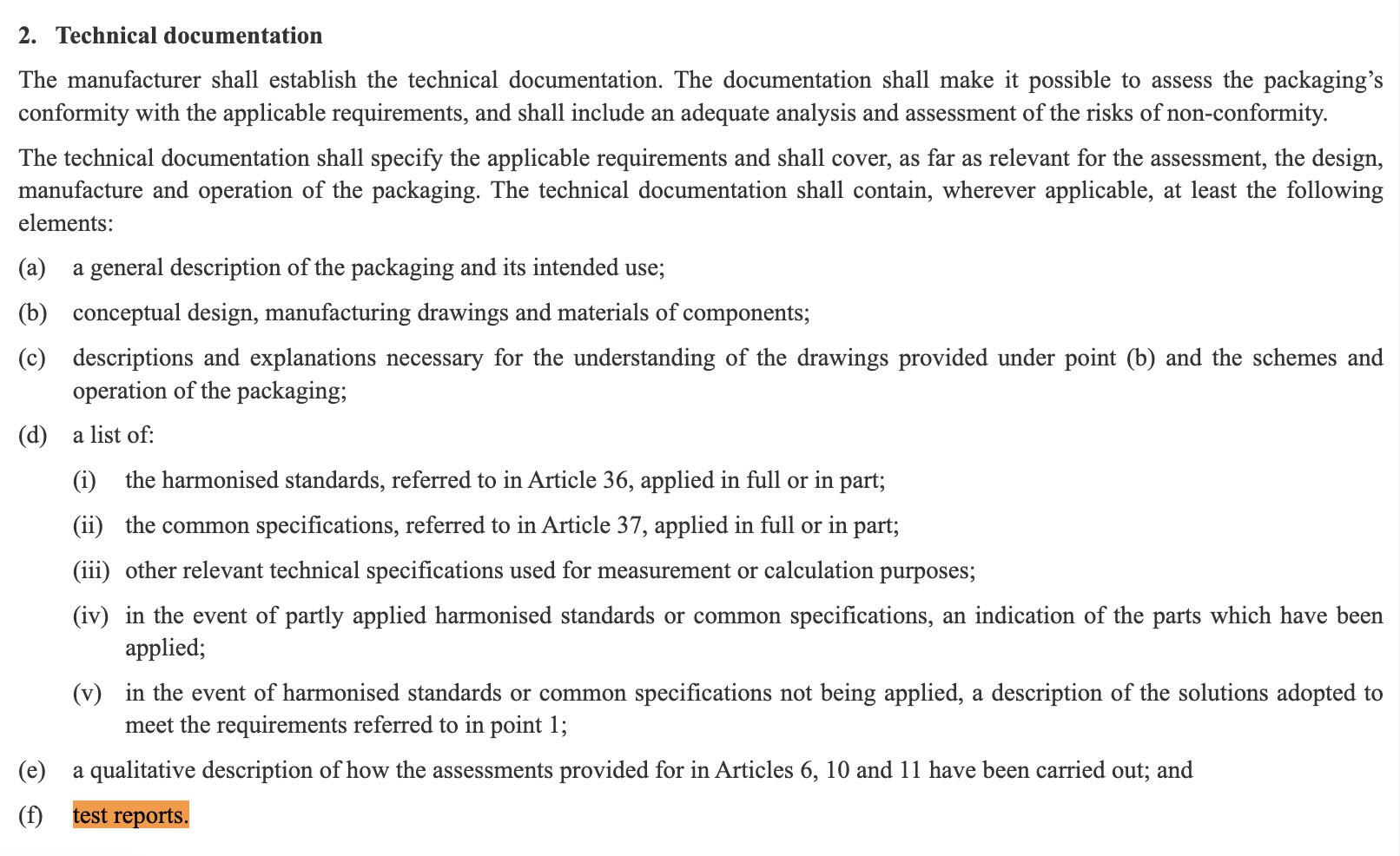
It should also be noted that test reports are a required item in the PPWR technical documentation.
Can we use test reports from our supplier?
Yes. Article 16 states that suppliers of packaging materials are obliged to provide documentation that helps the manufacturer (often the brand owner) determine if the packaging is compliant.
This could, for example, take the shape of heavy metals and PFAS test reports, or documents that indicate recycled content in plastic materials.
Now, it should be noted that many packaging suppliers outside the EU do not have such test reports.
This is also why third-party testing is often necessary.
How much does PPWR testing cost?
So far, many of the PPWR requirements are yet to be defined, and thus, I do not have a complete picture of what it will cost to test for all areas covered by the PPWR.
That said, heavy metals testing tends to cost around 50 EUR or USD per material. I contacted both QIMA and SGS to confirm testing fees for other aspects of the PPWR, but was informed that they need a specific packaging design before they can present a quote.
I do, however, have some experience with compostability testing (long before the PPWR arrived), and the fees ranged between 300 and 500 EUR or USD.
Do we need to test every single packaging design?
It depends. Some requirements concern materials rather than the packaging design. As such, it would likely be unnecessary to arrange full testing of every single packaging design.
That said, some aspects (i.e., packaging minimisation) are impacted by the design of the packaging and may need to be part of a test process or other assessment.
Who is responsible for testing?
In theory, the packaging supplier is supposed to provide documentation (including test reports) to ensure that the company defined as the manufacturer can create a DoC and compile the technical documentation. The latter should, as mentioned, contain test reports.
Ultimately, it tends to fall on the manufacturer to ensure that the packaging is compliant with the PPWR.
As such, it generally falls on the manufacturer to:
a. Obtain the test reports and other documents that exist
b. Fill all remaining gaps (if any) through testing and compliance assessments
Which companies provide PPWR testing?
Here is a list of companies that provide PPWR testing services:
- QIMA
- TUV Rheinland
- Intertek
- SGS
- Bureau Veritas
- Eurofins