





 Product assessments in 2 minutes

















On 29 October 2026, the FCC adopted a rule that limits the FCC’s recognition of labs that can test electronic products for the United States market to laboratories that are either:
a. Located in the United States, or
b. Located in countries and regions that grant United States laboratories reciprocal recognition, for example via a Mutual Recognition Agreement (MRA)
According to a news release by the FCC, nowadays less than 4% of all electronic devices are tested in facilities located in the United States. Also, most of the tests occur in countries or regions that do not operate a reciprocal economy.
As a result of this new rule, starting on December 1, 2028, “all testing, certifying, and accreditation activities will occur in the U.S. or a Reciprocal Economy”. The action seeks “fair and reciprocal treatment in international commerce”.
Content Overview

Find Requirements for Your Product Free
Estimated time: 2 to 3 minutes
 Step 1: Select market
.png)
.png)
.png)


- Step 2: Select product/material modules
- Step 3: Compliance Requirements List Created View Sample >
 Data: Primarily based on official legislation databases (Learn >)


Free Consultation (30 min)
Do you have questions about US, EU, or UK product compliance requirements?
Which products are subject to the test ban?
According to the document “FCC Proceeds on Device Test Lab Onshoring, Reciprocity Rules” published by the FCC on 29 October 2026, the FCC adopted a final rule that changes the testing requirement for electronic devices intended for the United States.
The document also explains that this action aims to ensure fair and reciprocal treatment for United States industries.
Specifically, before a electronic device can be used or marketed in the United States, it must be tested by an FCC-recognized lab.
According to the Final Rules published in the “THIRD REPORT AND ORDER AND THIRD FURTHER NOTICE OF PROPOSED RULEMAKING” that amends 49 CFR Part 2, the FCC will no longer recognize laboratories that are located in, or that conduct FCC-recognized covered activity from within, a non-Reciprocal Economy.
The Final Rules also provide a definition of “Non-Reciprocal Economy” and “Reciprocal Economy”:
Non-Reciprocal Economy. The territory of an economy that is not:
(1) The United States; or
(2) A Reciprocal Economy.
Reciprocal Economy. The territory of an economy with which the United States has a MRA or comparable government-to-government reciprocity agreement with respect to equipment authorization, such as a Free Trade Agreement or Agreement on Reciprocal Trade.
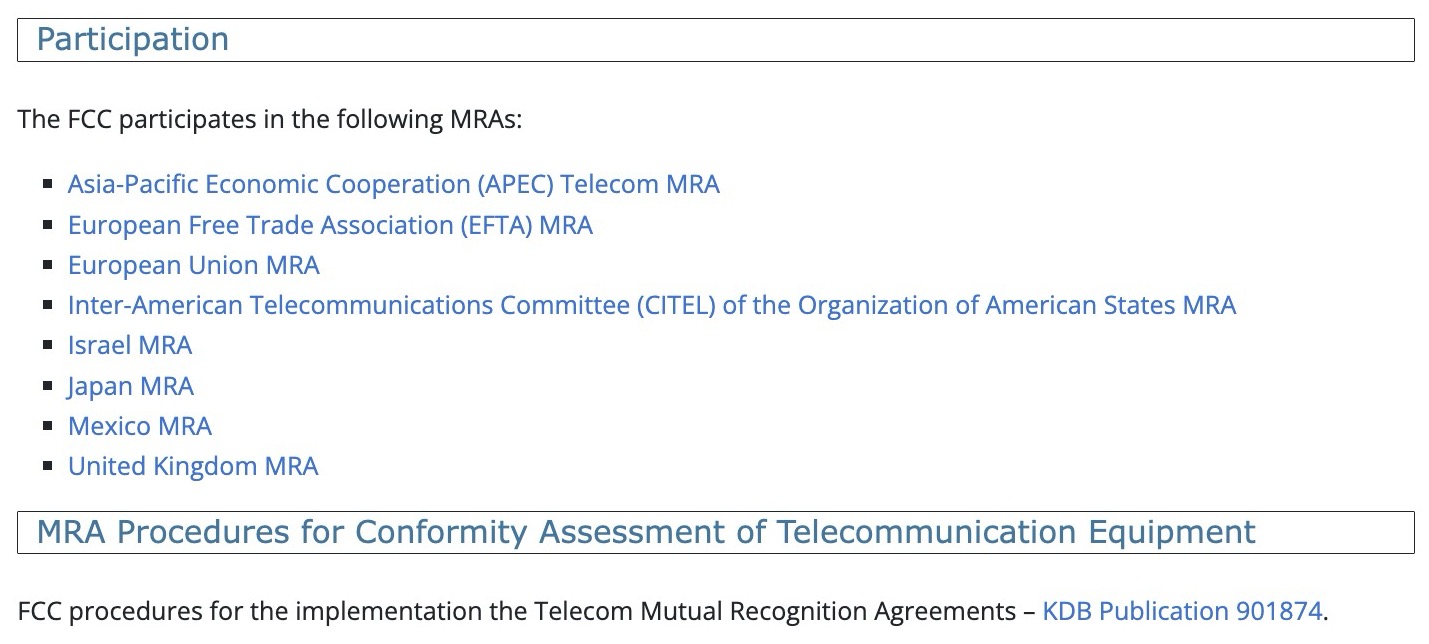
The report also has a section called “Reciprocal Agreements” where it explains that “MRAs are government-to-government trade facilitating measures aimed at a global approach to conformity assessment”.
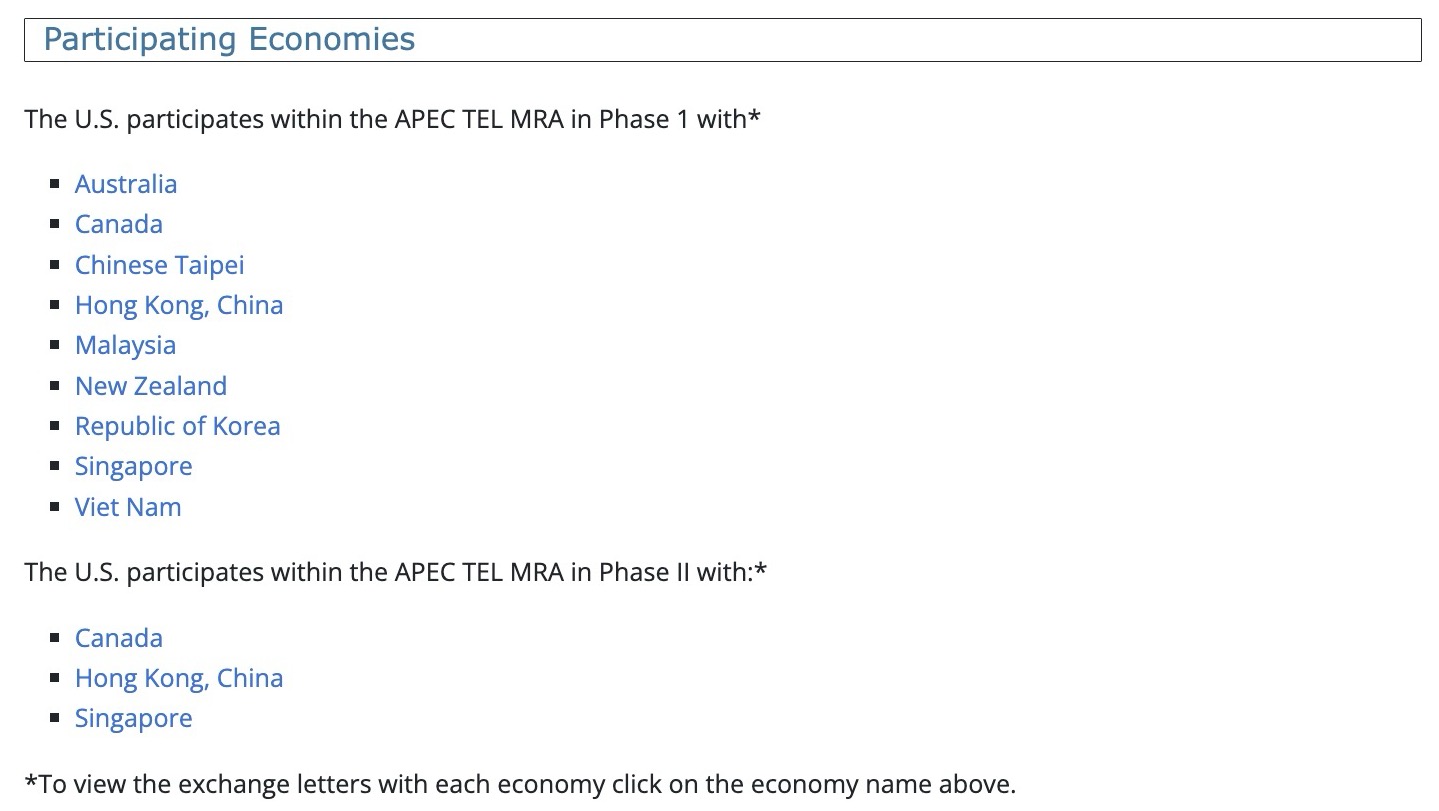
It refers to the FCC.gov page “Equipment Authorization – Mutual Recognition Agreements”, which lists the MRA in which the FCC participates:
When does the ban apply?
I found the following information in the report:
105. Reliance interests are also less substantial here, because Test Lab recognition only lasts for two years. The Commission has always had the ability to deny recognition to any Test Lab when it comes up for re-recognition every two years. We have had a long-standing practice of denying renewals of recognition, such as when a Test Lab fails to comply with our rules because it is no longer accredited. Given the transition period we adopt today, the Commission will not withdraw recognition from a single Test Lab as a direct result of this Order. The Commission will simply cease to renew recognition for these Test Labs after December 1, 2028.
Does the ban invalidate existing FCC test reports issued by Chinese labs?
I did not find any evidence that the ban will invalidate existing FCC test reports issued by any labs. What I found is that the FCC will stop the renewal of recognition for affected labs after December 1, 2028.
Is the ban permanent or temporary?
I could not find any information claiming that the ban is temporary or transitory. As such, I must assume that the ban is permanent, unless the rule is further amended.
Does it apply to all labs in China?
I found that Chinese Taipei and Hong Kong, China have an MRA with the United States. Thus, I understand that the ban would not apply to laboratories that are located there.
Can electronic products still be tested elsewhere in Asia?
I found that, once the ban takes place, electronic products can be tested in FCC-recognized labs that are based in reciprocal economies. This includes countries and regions that have an MRA with the United States.
The following Asian countries and regions participate in the Asian Pacific Economic Cooperation (APEC) MRA for Conformity Assessment of Telecommunications Equipment:
- Chinese Taipei
- Hong Kong, China
- Malaysia
- Republic of Korea
- Singapore
- Viet Nam
Also, Japan and Israel have their own separate MRAs with the United States.


