





 Find US, EU, UK, CA, & AU requirements














Undergarments sold in the European Union are subject to various chemical restrictions and labelling requirements. Some of these requirements apply due to the fact that undergarments are in direct contact with the skin, while others are relevant to specific types of undergarments, such as menstrual underwear.
Related products
This guide is relevant to the following types of products:
- Women’s underwear
- Men’s underwear
- Children’s underwear and socks
- Socks
- Bras
- Corsets
- Period underwear
- Hosiery and stockings
- Tops
Content Overview

FREE CONSULTATION CALL (30 MIN)
 Ask questions about compliance requirements
- Countries/markets:
.png)
.png)
.png)


- Learn how we can help your business
You will speak with:Ivan Malloci
Labelling Requirements
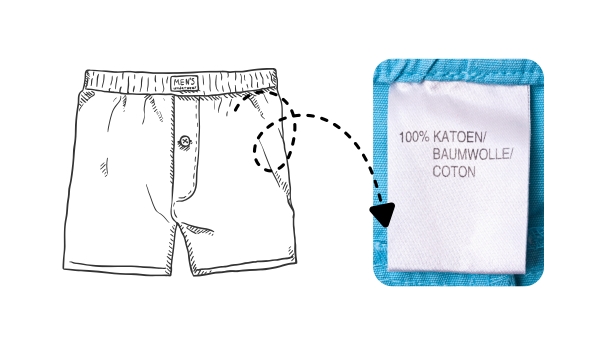
Underwear, bras and undergarments are subject to labelling requirements. That said, there are some differences when it comes to placement, and exemptions also apply.
Textiles Labelling
Regulation (EU) No 1007/2011 sets labelling requirements for textile products sold in the European Union, including many types of undergarments. The textile fibre or fibres must be specified.
Examples
- Pure cotton
- 100% cotton
- 100% polyester
Covered products
The regulation covers products containing at least 80% by weight of textile fibres. This means that most undergarments fall within the scope. However, some undergarment products are subject to special provisions listed in Annex IV.
| Product type | Label required | Special provisions |
| Underwear | Yes | |
| Socks | Yes | |
| Bras | Yes | 1. The fibre composition shall indicate the composition of the whole product or components listed respectively:
2. The labelling shall indicate which part of the product the information on the label refers to |
| Corsets | Yes | 1. The fibre composition shall indicate the composition of the whole product or components listed respectively:
2. The labelling shall indicate which part of the product the information on the label refers to |
| Hosiery/stockings | Yes | |
| Tops | Yes |
Placement
Textile labels must be affixed to the garment (or printed on the fabric directly) when this is possible. However, affixing the label directly to the textile product is not often practical.
- Underwear: Textile label is normally printed on the product
- Socks: Textile label is often printed on the packaging
GPSR Labelling
The General Product Safety Regulation (GPSR) 2023/988 sets labelling requirements for consumer products, to which undergarments generally belong. Below follows an overview:
- Product type
- Batch or serial number
- Manufacturer name
- Manufacturer postal address and electronic address
- Importer name
- Importer postal address and electronic address
- Authorised representative name
- Authorised representative postal address and electronic address
- Age group
- Safety information and warnings
Note that the GPSR also sets requirements concerning product safety, technical documentation and testing. You can learn more in this guide.
Substance Regulations
Undergarments sold in the EU are subject to various substance restrictions, which are summarised below.
REACH Regulation
The REACH Regulation 1907/2006 restricts substances in articles, which essentially means physical products. Hence, REACH is also applicable to underwear, socks and other undergarments.
Any article containing substances restricted under Annex XVII above the set limits cannot be sold in the EU. The table below lists substance restrictions that specifically mention:
a. Undergarments
b. Textile articles intended to come into contact with the skin
c. Textile articles
| Substance | Limit | Annex XVII condition |
| Tris (2,3 dibromopropyl) phosphate | Prohibited | Shall not be used in textile articles, such as garments, undergarments and linen, intended to come into contact with the skin |
| Tris(aziridinyl)phosphinoxide | Prohibited | Shall not be used in textile articles, such as garments, undergarments and linen, intended to come into contact with the skin |
| Polybromobiphenyls; Polybrominatedbiphenyls (PBB) | Prohibited | Shall not be used in textile articles, such as garments, undergarments and linen, intended to come into contact with the skin |
| Dioctyltin (DOT) compounds | 0,1% by weight of tin | Textile articles intended to come into contact with the skin |
| Nonylphenol ethoxylates (NPE) | 0,01% by weight of that textile article | Textile articles which can reasonably be expected to be washed in water during their normal lifecycle |
Note that additional substance restrictions under Annex XVII apply to undergarments. My recommendation is that you ask a testing company to determine which chemicals to include in your REACH test plan.
Persistent Organic Pollutant (POP) Regulation
The Persistent Organic Pollutant (POP) Regulation 2019/1021 restricts PFAS and other chemicals classified as persistent organic pollutants. Fabrics used to make undergarments can sometimes contain such chemicals as a result of pesticides used during the production process.
PFAS and related substances have, for example, been found in menstrual underwear. Testing is therefore necessary to verify compliance with the Persistent Organic Pollutant (POP) Regulation.
Examples
Perfluorooctanoic acid (PFOA)
Polychlorinated naphthalenes
Hexabromobiphenyl
Biocidal Products Regulation 528/2012
The Biocidal Products Regulation 528/2012 sets requirements concerning the use of biocides in products. So, how does this relate to undergarments, you may wonder?
Some brands sell undergarments that are supposedly antibacterial or have other claimed parameters that fall within the scope of the EU Biocidal Products Regulation.
Such claims cannot be made arbitrarily. Instead, the following must be taken into account:
1. Only “approved” biocidal products can be used
2. Any claims regarding the biocidal properties of a product must be supported
In short, you cannot make claims that are not supported, and you cannot use biocidal products that are not approved under the regulation.
In 2023, the Swedish Chemicals Agency audited several companies selling menstrual underwear on the basis that they made claims concerning antibacterial properties. This indicated that their products were treated with a biological product. The investigation revealed that several brands made unsupported claims, which resulted in recalls.
FAQ
Do underwear and socks require textile fibre labels in the EU?
Yes, both underwear and socks are textile products and therefore covered by the EU Textiles Labelling Regulation. We could not find any exemption either for underwear or socks.
Do underwear and socks require care labels in the EU?
The EU Textile Labelling Regulation does not set requirements concerning washing or other care instructions. That said, most brands choose to provide care instructions on the basis that not doing so could result in products being destroyed and thus trigger returns.
Do underwear and socks require CE marking?
Most types of underwear and socks should not be CE marked. However, products defined as medical devices or personal protective equipment should be CE marked.
For example, compression socks generally fall under the Medical Devices Regulation, which requires CE marking. This may also be the case for certain types of undergarments that are intended to be used for protection, and thus within the scope of the Personal Protective Equipment (PPE) Regulation.
That said, undergarments for everyday use do not fall within these regulations and should therefore not be CE marked.