



 Product assessments in 2 minutes

















Product testing costs can range from a few hundred dollars or euros to tens of thousands. There are many factors that determine the final bill, including regulatory requirements, standards, product complexity, age group, and more.
This guide provides examples of testing costs for various products in the United States, European Union, and the United Kingdom.
How are the cost ranges estimated?
The cost examples provided in the tables are based on quotations we have received directly from testing companies or through our customers. Testing fees are always specific to a particular product, which is why we specify the product type in addition to the cost range.
Content Overview

Find Requirements for Your Product Free
Estimated time: 2 to 3 minutes
 Step 1: Select market
.png)
.png)
.png)


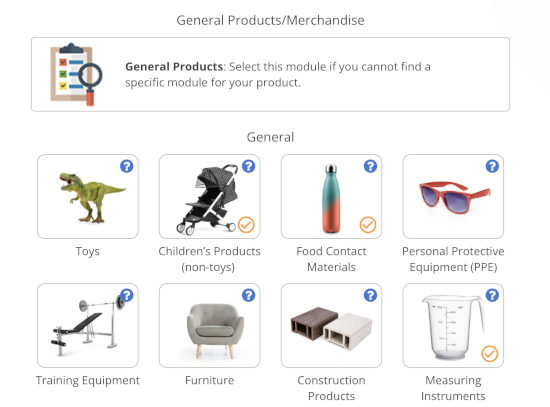
- Step 2: Select product/material modules
- Step 3: Compliance Requirements List Created View Sample >
 Data: Primarily based on data from official legislation databases (Learn >)
US Cost Examples
| Product category | Example | Cost range (example) |
| CPSC – Children’s Products | Plush toy (0 – 3) | 1100 to 1600 USD |
| California Proposition 65 | 100% cotton t-shirt, 2 colours | 300 – 600 USD |
| Flammability – Apparel | 100% cotton t-shirt, 2 colours | 90 – 250 USD |
| UL 1642 – Battery safety | Lithium battery | 1500 – 3000 USD |
| Food Contact Materials | PE-coated coffee cup with lid | 900 – 1700 USD |
| TPCH – Packaging | Product box | 30 – 100 USD |
| Cosmetics – Substances | Face paint | 700 – 1100 USD |
EU / UK Cost Examples
| Product category | Example | Cost range (example) |
| REACH – Annex XVII | 100% cotton t-shirt, 2 colours | 300 – 600 EUR |
| REACH – SVHCs | 100% cotton t-shirt, 2 colours | 700 – 1100 EUR |
| POPs Regulation | 100% cotton t-shirt, 2 colours | 400 – 600 EUR |
| PPWR – Packaging | Product box | 40 – 80 EUR |
| GPSR – Consumer Products | Baby bottle | 400 – 800 EUR |
| EN 71 – Toy Safety | Teddy bear (EN 71-1, 2 & 3) | 400 – 2000 EUR |
| EMC Directive | Bluetooth speaker | 600 – 1000 EUR |
| Low Voltage Directive | Air purifier | 1200 – 2000 EUR |
| RoHS Directive | 1 – 50 components | 250 – 700 EUR |
| Radio Equipment Directive | Bluetooth speaker | 1200 to 2000 EUR |
| BAT – Battery safety | Lithium battery | 700 – 1000 EUR |
| Food Contact Materials | PE-coated coffee cup with lid | 1200 – 1800 EUR |
| Personal Protective Equipment (PPE) | Sunglasses | 1200 – 1600 EUR |
| Machinery | Coffee machine | 1900 – 3500 EUR |
| Medical Devices Regulation | Medical gloves | 1500 – 3000 EUR |
What determines product testing costs?

The total testing cost is normally decided by the following:
☑️ Applicable regulation/s and standards
1. Some regulations and standards set stricter and more costly testing requirements than others
2. Which regulations apply depends on the product type, age group, functionality, and other factors
3. Complex products tend to fall within the scope of many different regulations and standards, which results in higher testing fees.
4. Some regulations also mandate specific tests, while others leave it up to the manufacturer or importer to decide what testing is needed based on their own risk analysis.
☑️ The number of materials and components
1. Substance testing can be applied to each individual material type and colour
2. Products that contain many different materials and components are therefore more expensive to test
☑️ Your risk tolerance
Compliance often comes down to cost versus risk.
It is simply not the case that every single button, lace, or zipper entering the US, EU or UK is fully lab tested.
While some regulations strictly mandate safety and chemical testing, it is sometimes up to the manufacturer or importer to decide what to test for.
Ultimately, testing is done to verify compliance, but this can only be done to the extent that it is economically viable. Some companies, therefore, focus on more high-risk-related tests while they may decide to skip others.
☑️ Lab assessment
Not all labs operate the same way. Some are more strict in their interpretation of which standards and substance tests apply, while others are less so.
As such, two testing companies can provide different quotations for the same product.
I have encountered situations where labs in Asia have listed anything that they deem applicable, while their counterparts in the EU offered a lower cost based on their assessment that some tests were not necessary for that particular material.
Case Study: Speaker (EU)
| Feature | Speaker A | Speaker B |
| Electronic | Yes (EMC Directive + RoHS) | Yes (EMC Directive + RoHS) |
| Input | USB Type-C (RED) | USB Type-C (RED) |
| AC adapter | No | Yes (LVD) |
| Bluetooth | No | Yes (RED) |
| Connects to other devices | No | Yes (CSA) |
| Testing cost | 1100 EUR | 3700 EUR |
How to reduce product testing costs
I have managed to drastically reduce testing costs for companies many times. This is what I look for:
☑️ Did the lab quote tests that are not mandatory?
☑️ Is it possible to remove certain components or functionality?
This can reduce the number of regulations and standards applicable to the product
☑️ Can the number of materials and colours be reduced?
This means fewer colours and materials to test, and therefore a reduced lab test quote.
☑️ Use components that are already tested and compliant
This is perhaps the most effective way to cut testing costs, especially if you cannot remove components, materials, or colour variations.
So, what do I mean by this?
Many companies sell materials and components that are already compliant with US and European regulations and standards. By selecting such materials and components, you may not need to pay for additional testing.
At least not for the same material or component in isolation.
For example, why buy a no-brand zipper and then pay for testing when you can buy a compliant zipper from YKK? Even if you can find a cheaper part, it will likely end up costing you much more when factoring in compliance testing fees. Then there is the risk that the test will fail, and you end up spending money for nothing.
Likewise, you can save a lot of money by using lithium batteries and AC adapters that are already compliant with UL standards.
This strategy does, however, require that you control your own supply chain and can be certain that the YKK zipper actually comes from YKK.
I should also mention that you may not be able to rely entirely on test reports valid for materials and components. Final testing may still be needed, so discuss that with your lab.
Examples
| Component | Example | Cost saved |
| Quartz movement | Use RoHS-compliant Miyota movements (Example) | 300 – 400 USD |
| Zippers | Use REACH and OEKO Tex Standard 100-compliant zippers from YKK (Example) | 100 – 200 USD |
| Packaging | Use PPWR- and THCP-compliant paper and print inks | 50 – 100 USD |
| Plastic granulate | Use REACH-compliant plastic granulate from BASF (Example) | 300 to 1000 USD |
| Lithium battery | Use UL 1642-tested batteries (Example) | 1200 – 1600 USD |
| AC adapters | Use a CE-marked and LVD-tested AC adapter | 900 – 1200 USD |
| Eyewear | Use PPE-regulated and FDA-compliant lenses from ZEISS (Example) | 700 – 1000 USD |
FAQ
Can I ask my supplier to cover the lab testing costs?
Third-party lab testing is almost always paid for by the buyer. If we assume that the supplier would actually cover this cost, then the result would be a higher unit price.
Keep in mind that manufacturers are not compliance experts. They are not obliged to cover or subsidise the lab testing fees for the same reasons they don’t cover your shipping costs.
Further, it’s essential that you book testing directly. Otherwise, you’ll receive lab test reports in your supplier’s company name, which can be problematic.
What is the cheapest lab testing company?
There are no “cheap” lab testing companies that I would trust. If you truly want to reduce your product testing costs, then you will get much better results following my recommendations in this guide.
Why is lab testing so expensive?
Conducting third-party testing requires access to both expensive equipment and qualified personnel. Further, the testing processes can often be both time-consuming and complicated.
When all is considered, I don’t think that testing fees are outrageously expensive. As explained in this article, there are also many ways to reduce your testing costs.