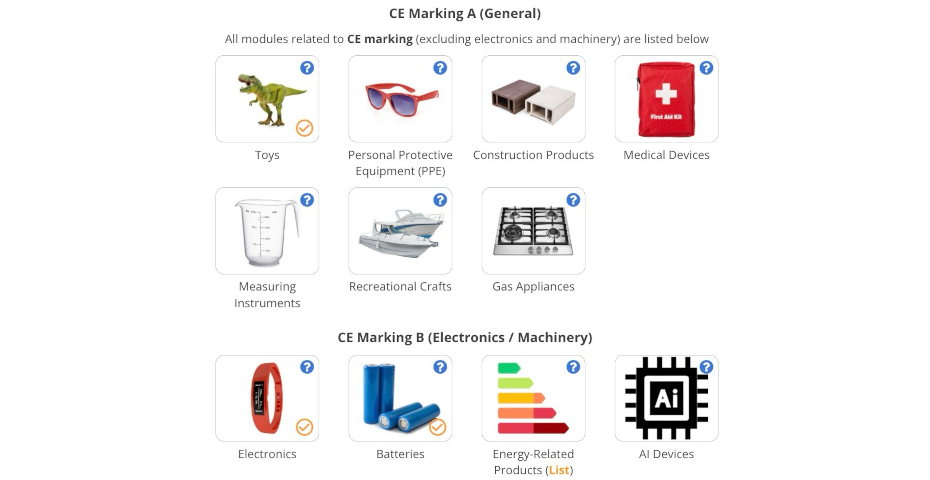





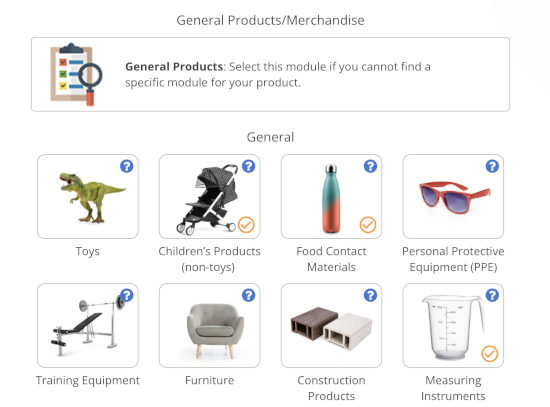
 Product assessments in 2 minutes

















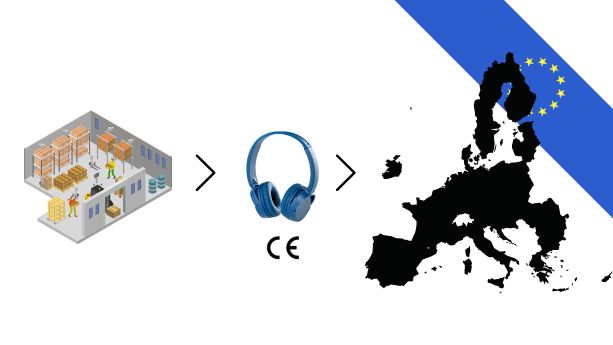
Yes, you will either need to CE mark the product if you are selling it under your brand or verify existing CE marking documentation if you are reselling another brand.
What you cannot do is assume that you can safely rely on the CE marking status of existing products, even if these are already sold in the EU at the present moment.
Content Overview

Find Requirements for Your Product Free
Estimated time: 2 to 3 minutes
 Step 1: Select market
.png)
.png)
.png)


- Step 2: Select product/material modules
- Step 3: Compliance Requirements List Created View Sample >
 Data: Primarily based on official legislation databases (Learn >)
Why do I need to CE mark a product if it’s currently sold in the EU?
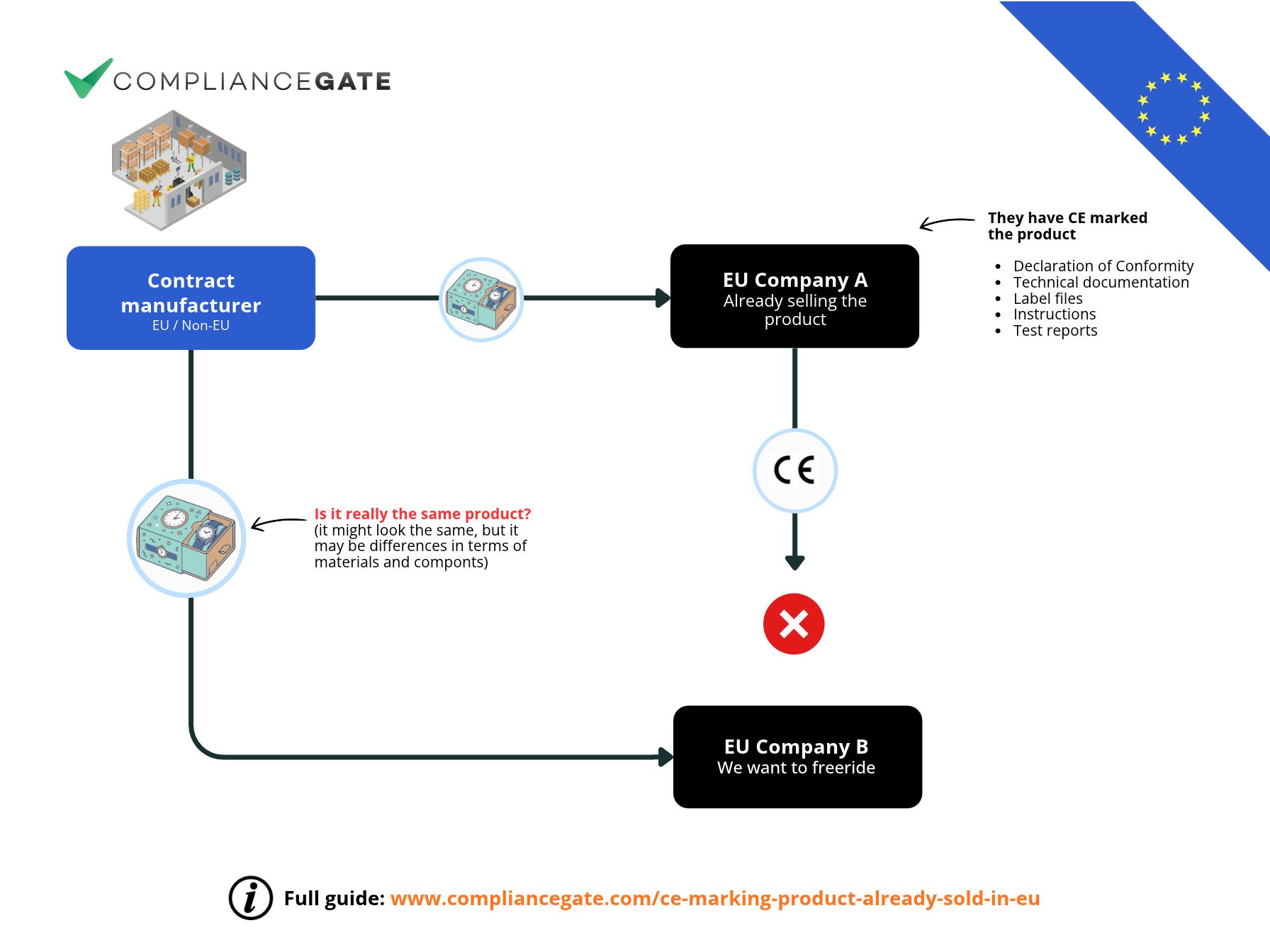
The reason is that CE marking must either be affixed or verified on a per-product basis. This is necessary even if you buy “the same product” from the exact same supplier as the other seller.
CE marking regulations and directives simply do not provide an automatic pathway to compliance on the basis that “the product is already sold in the EU”.
Instead, there are well-established CE marking obligations that must be followed depending on whether you are defined as a manufacturer or importer.
Further, you do not know if the product you see on the market is the same. It may look the same, but it may have different functionality, components and materials. This would invalidate any existing CE marking even if a “transfer” was allowed.
Scenario A: You want to sell the same product under your brand
Imagine that you have found a product on Alibaba that you want to sell under your brand. But you also happen to know that many other companies are selling the “same product”.
Do you really need to go through the hassle of CE marking?
Yes, because you are likely the manufacturer and are therefore responsible for CE marking the product.
Example
Process
✅ Comply with harmonised standards
✅ Create the DoC and technical documentation
✅ Create user instructions
✅ Affix CE marking and labels under your company name
✅ Obtain EC-type examination certification (if required)
Important information
⚠️ The CE mark, labels, and documentation are tied to a single manufacturer.
⚠️ CE marking is valid for a certain product specification – you do not truly know if other companies are selling the exact same product in terms of functionality, components, and materials.
⚠️ It does not matter if the product is the same and from the same supplier – the CE marking is not “transferred” from one manufacturer to another.
⚠️ You do not know if the “other company” actually CE-marked the product
Scenario B: You want to sell a brand from a non-EU company
Now, let’s imagine that you have found a product owned by a brand in, say, the UK or Japan and you wish to resell this in the EU.
You also happen to know that another company in the EU already does that. Does this mean that you can consider CE marking as already validated?
No. This likely makes you an importer, which means that you must verify if the product is correctly CE marked and documented.
Process
✅ You must obtain and verify test reports
✅ You must obtain and review the DoC and technical documentation
✅ You must obtain user instructions (and maybe translate)
✅ You must check the CE mark and other labels
✅ You must check the certification (if required)
Important information
⚠️ You must affix the importer name and address (you cannot use the information from another importer).
⚠️ Each individual importer must check the documentation and labels.
⚠️ You do not really know if the other importer is buying the exact same product in terms of functionality, materials, and components.
Do I need to CE mark products that are already sold on Amazon?
Yes, you can never rely on the presumed CE marking status of a product sold on Amazon. There are many reasons for this:
⚠️ It may look the same, but you do not know if it is the same product in terms of functionality, materials, and components
Note: A difference in product specification would invalidate the existing CE marking status in any case
⚠️ It may come from a different factory
Note: It cannot be the same product if the origin differs (even in the highly unlikely case that they happen to use the same components and materials).
⚠️ You cannot use CE marking documents from a company you are not buying a product from either way
⚠️ Amazon would never accept the explanation that “the same product is already sold” for the reasons above
Can I use the CE marking of other brands?
Yes, but only if you buy directly from the company defined as the manufacturer. For example, if you are a reseller of Mattel toys or Nintendo products, then you can rely on their existing CE marking.
But you cannot buy products directly from a supplier of a brand and then use the brand’s labels, DoC, or technical documentation and other documentation.
CE marking simply does not transfer that way. Neither can you CE mark a product based on a series of assumptions.
If you wish to rely on existing CE marking, then you must buy directly from the brand owner.
Can I use test reports and certificates held by other companies?
You may be able to do so if these are held by the supplier or brand owner you are buying from.
For example, you could use existing test reports for components, and sometimes even finished goods, if these are held by the factory.
But you generally cannot use test reports or certificates held by another EU company if you are not buying their product.
For instance, you cannot use a DoC held by Matell to prove CE marking simply because you use the same factory as they do (which is a highly theoretical scenario to begin with).