






 Find US, EU, UK, CA, & AU requirements














FCC 47 CFR Part 15 sets labeling requirements that are applicable to most electronics in the United States. In this guide, we provide an introduction to some of the key labeling requirements for both unintentional and intentional radiators:
- Compliance statement
- FCC logo
- Identification information
- FCC ID
- Labeling specific to certain devices
Note: Some information is required to be presented on or accessible via the product. That said, some information is only to be provided with the product (i.e., as part of instructions or other documentation).
Content Overview

FREE CONSULTATION CALL (30 MIN)
 Ask questions about compliance requirements
- Countries/markets:
.png)
.png)
.png)


- Learn how we can help your business
You will speak with:Ivan Malloci
General labeling requirements
Devices subject to one of the following authorization procedures should be labeled according to the requirements set in 47 CFR Part 15.19:
a. Supplier’s Declaration of Conformity (SDoC) authorization procedure, which applies to most unintentional radiators – that is, most electronics that do not have wireless capability
b. Certification authorization procedure, which applies to most intentional radiators, that is, mainly products that have wireless capability
Thus, these requirements generally apply to both unintentional and intentional radiators. On top of that, there are additional requirements that are specific to the different types of radiators, and we cover these in the following sections of this guide.
Overview
| Label information (quoted from Part 15.19) | Devices |
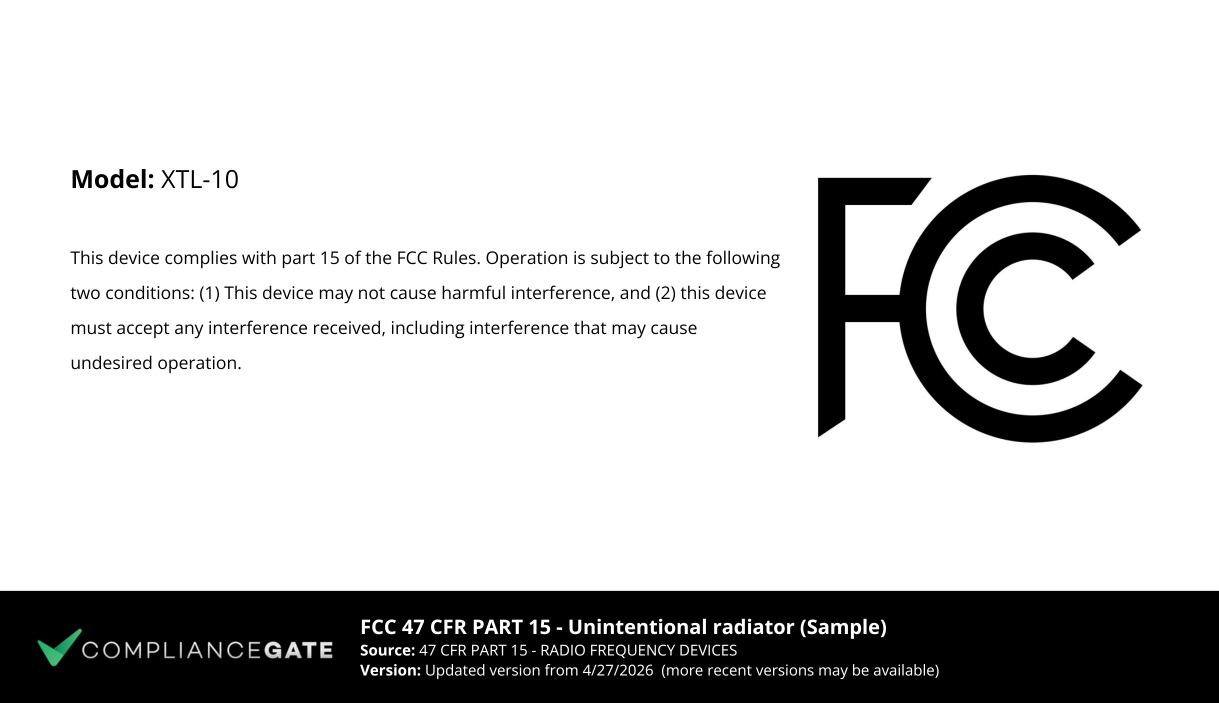
| This device complies with part 15 of the FCC Rules. Operation is subject to the following two conditions: (1) This device may not cause harmful interference, and (2) this device must accept any interference received, including interference that may cause undesired operation. | All devices, excluding the ones listed in the following rows of this table |
| This device complies with part 15 of the FCC Rules. Operation is subject to the condition that this device does not cause harmful interference. | Receivers that are associated with the operation of a licensed radio service |
| This device complies with part 15 of the FCC Rules for use with cable television service. | Stand-alone cable input selector switches |
Placement
In general, the label information should be affixed in a conspicuous location on the device itself.
However, for devices composed of several parts that are connected by wires, you are allowed to affix the label information only to the main control unit.
Also, in the cases in which the device is so small that it is not possible to affix the label information using a font that is four-point or larger, and it does not have a display to show the label electronically, it is possible to affix the label information in the packaging, a paper insert, or a removable label that is attached to the device.
Products composed of both radio transmitters and digital circuitry
According to the FCC website, for products that are composed of both radio transmitters and digital circuitry, the SDoC procedure may be used for the digital circuitry part of the product, while the certification procedure can be used for the radio transmitters.
An example of such a product could be a laptop, as it contains both wi-fi and Bluetooth modules and digital circuitry.
However, you can choose to use the certification procedure to demonstrate the compliance of the whole device.
Unintentional radiators
Certain labeling requirements apply specifically to devices deemed to be unintentional radiators,for which the SDoC authorization procedure applies. Examples of products falling within this category are listed below:
- Wired mouses
- Wired printers
- USB sticks
- Wrist watches
Note that we are assuming that the above products do not include Bluetooth or other wireless capabilities. Products that have wireless capability are generally classified as intentional radiators.
Overview
| Label item | Part |
 |
47 CFR Part 2.1074 |
| Identification | 47 CFR Part 2.1074 |
| Labeling specific to certain devices | Examples can be found on:
47 CFR Part 15.123 – Labeling of digital cable ready products 47 CFR Part 15.115 – TV interface devices, including cable system terminal devices However, other labeling requirements may also exist. |
FCC logo
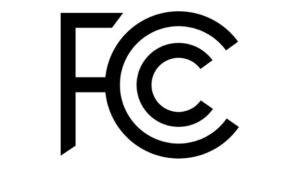
The FCC logo can be applied to devices subject to the SDoC authorization procedure on a voluntary basis, to indicate that the device complies with the relevant FCC requirements.
Identification
Devices that are only subject to the SDoC authorization procedure should be uniquely identified with information that allow to associate the device with the relevant test reports and records, such as:
- Trade name and type number, or
- Model number, or
- Serial number
Such identification should not be on a format that could be confused with an FCC identifier, which must be used for products that are authorised using the certification authorization procedure.
Placement
As explained above, the FCC logo may be voluntarily affixed to the device. It may also be included in the instructions or an e-label.
We could not find any information concerning the placement of the identification information (e.g., trade name). However, you must ensure that the device can be identified. Thus, ideally, the information should be placed in the device itself.
Compliance information statement
You will also have to provide a compliance information statement with the product. This document should include some of the above-mentioned labeling information and info concerning the responsible party:
- Identification of the product (e.g., name and model number)
- Compliance statement
- Name, address, and phone number or internet contact info of the responsible party
Intentional radiators
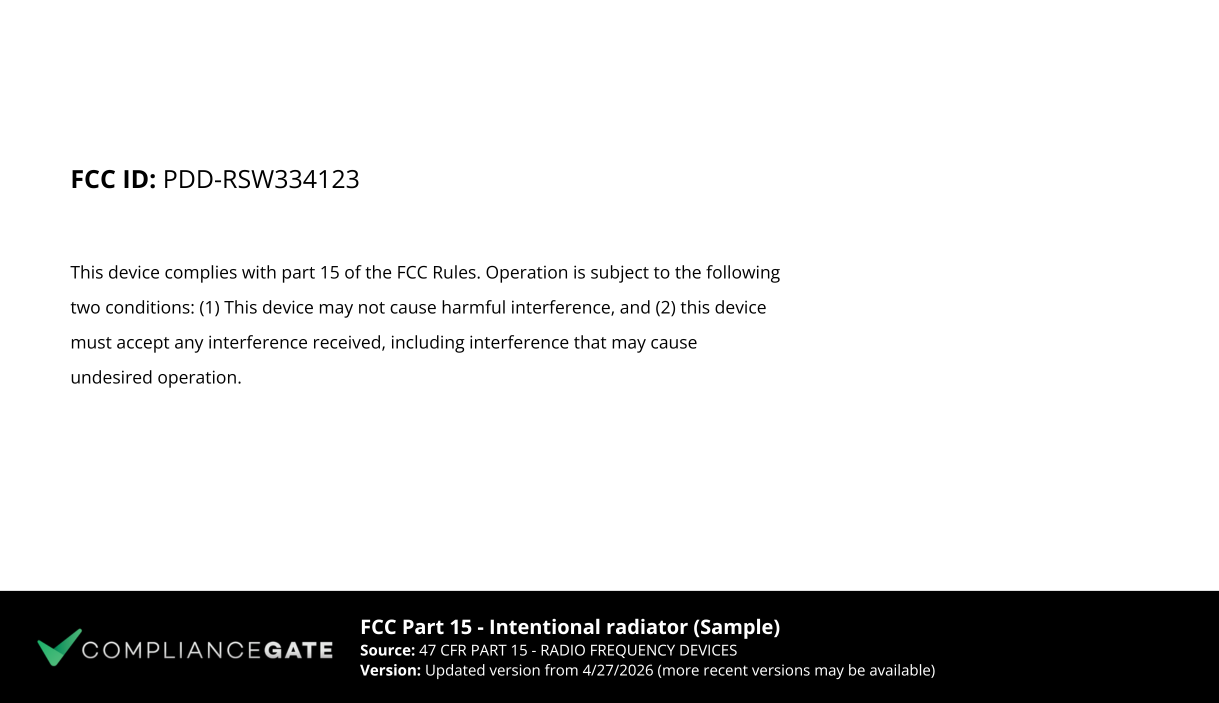
Products defined as intentional radiators are subject to specific labelling requirements. Examples of products generally considered to be intentional radiators can be found below:
- Wireless microphones
- Wireless earbuds
- Wi-fi transmitters
- Bluetooth radio devices
Overview
| Label item | Part |
| FCC Identifier (or FCC ID) | 47 CFR Part 2.925
47 CFR Part 2.926 |
| Any other statements or labeling requirements imposed by the rules governing the operation of the specific class of equipment | 1. 47 CFR Part 2.925
2. An example can be found on: 47 CFR Part 15.251 – Operation within the bands 2.9-3.26 GHz, 3.267-3.332 GHz, 3.339-3.3458 GHz, and 3.358-3.6 GHz However, other labeling requirements specific to some class of equipment may also exist. |
FCC ID
The FCC ID includes two parts:
a. The grantee code assigned permanently by the FCC, which consists of three or five alphanumeric characters, and allows to identify the responsible party (e.g., the manufacturer)
b. The equipment product code assigned by the grantee, which may consist of alphanumeric characters and other characters, and allows to identify the product
Placement
According to the FCC, the FCC ID must always be accessible when using the device. This goal can be achieved by using a physical label or an e-label (for products that have a screen):
a. Physical labels must be permanently affixed either on the product or in a nondetachable compartment accessible by the user (e.g., a battery compartment).
If the device is too small to allow the placement of the FCC ID with a font size that is four points or larger (and it does not have a screen to provide an e-label), then the FCC ID should be placed in the user manual, and in the device packaging or a removable label attached to the device.
b. According to 47 CFR Part 2.935, devices that display the FCC ID or other information (e.g., warnings) in an e-label, must also include the same information either on the device or the packaging. The part mentions the following options:
- Stick-on label
- Printing on the packaging
- Label on a protective bag
Although this is not specified, this may be necessary because people shipping and handling the product must be able to identify the product, even when the screen is turned off.
Finally, we found that, according to 47 CFR Part 2.925, other statements may appear on a separate label from the one that features the FCC ID.
FCC ID requirements for modular transmitters
According to 47 CFR Part 15.212, modular transmitters must be equipped with either a permanently affixed label or an e-label:
a. When using a physical label, the transmitter must have its own FCC ID. If the FCC ID is not visible when the module is installed on a device, then the outside of the device should also feature the FCC ID of the transmitter. Example: “Contains Transmitter Module FCC ID: XYZMODEL1” or “Contains FCC ID: XYZMODEL1.”
b. If an e-label is used, then the FCC ID of the modular transmitter must be visible on either the transmitter itself (if possible) or the device in which the transmitter is installed. In this case, the exterior label should contain information such as “Contains FCC-certified transmitter module(s).” Note that the user manual should include instructions on how to access the e-label.
Incidental radiators
Incidental radiators are devices that may generate radio frequency energy when they are used, even though they are not designed to generate such energy. Here are some examples of incidental radiators:
- AC motors
- DC motors
- Mechanical light switches
Incidental radiators are regulated under 47 CFR Part 15, and for example, Part 15.13 states that manufacturers should employ good engineering practices aiming at minimizing the risk of harmful interference.
However, according to the FCC website, such radiators are not required to obtain any equipment authorization (e.g., SDoC, Certification).
As such, we were not able to find any FCC labeling requirements for such products. Having said that, it may still be advisable to provide at least identification information (e.g., model number) that allows for identifying the product.
FAQ
Is the FCC logo mandatory?
No, the FCC is optional. It can be affixed to products that have been authorized under the SDoC authorization procedure to indicate that the product complies with the applicable requirements.
Is the FCC logo applicable to unintentional radiators?
Yes, the FCC logo can be affixed to unintentional radiators if they are authorized using the SDoC authorization procedure.
Note that, optionally, you can also decide to authorize your unintentional radiator using the certification procedure, instead of the SDoC authorization procedure. In this case, you cannot use the FCC logo.
Is the FCC logo applicable to intentional radiators?
No. The reason is that intentional radiators must generally be authorized using the certification procedure. In this case, you cannot affix the FCC logo.
Which products require the FCC logo?
As already explained, the logo is not mandatory. It can only be affixed to products that are authorized using the SDoC authorization procedure, that is, unintentional radiators such as wired mouses.
Note that the logo can only be used if the product has been tested and deemed compliant with the SDoC authorization procedure.
Where should the FCC logo be placed?
According to the FCC guidance document on labeling requirements, the FCC logo may be placed on the product, the instructions, or an e-label.
Can the FCC logo be displayed digitally instead of on the product?
Yes, the FCC logo may be affixed on an e-label if the product includes a digital display.