




 Find US, EU, UK, CA, & AU requirements














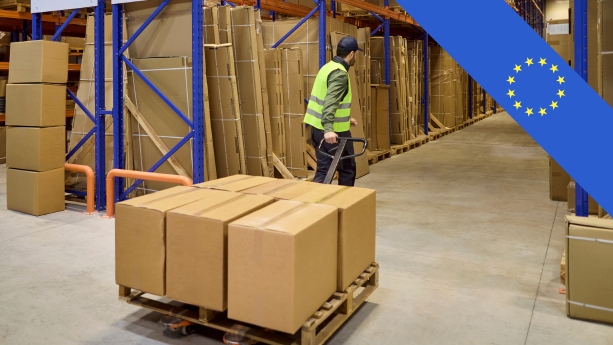
The Packaging and Packaging Waste Regulation (PPWR) 2025/40 sets requirements for packaging used for handling and delivery of products. This includes shipping cartons, pallets, protective plastic and other packaging used for transporting cargo.
Does this mean that you now need to create or obtain a DoC and other documentation for every single cardboard box arriving in your warehouse? The answer is that it depends.
This is a complex area, and this guide is our effort to piece together what we could find about transportation packaging in the PPWR text. It may not cover everything, and it will likely be updated, but it can hopefully help you understand some areas.
- The PPWR covers packaging used for transportation
- Transportation packaging is defined under Article 3
- Specific requirements apply to certain types of transportation packaging
- Transport packaging is exempt from some PPWR requirements
- EPR obligations also apply to transportation packaging
Content Overview

FREE CONSULTATION CALL (30 MIN)
 Ask questions about compliance requirements
- Countries/markets:
.png)
.png)
.png)


- Learn how we can help your business
You will speak with:Ivan Malloci
Does the PPWR cover transportation packaging?
Yes, the PPWR applies to packaging, which is defined as follows:
‘packaging’ means an item, irrespective of the materials from which it is made, that is intended to be used by an economic operator for the containment, protection, handling, delivery or presentation of products to another economic operator or to an end user, and that can be differentiated by packaging format based on its function, material and design, including:
As you can see above, packaging is defined as an item (of any material) that can be used in the following ways:
- Contain products
- Protect products
- Handling products
- Delivery products
The PPWR also provides definitions specific to transport packaging and e-commerce packaging:
‘transport packaging’ means packaging conceived so as to facilitate the handling and transport of one or more sales units or a grouping of sales units, in order to prevent damage to the product from handling and transport, but which excludes road, rail, ship and air containers;
‘e-commerce packaging’ means transport packaging used to deliver products in the context of sale online or through other means of distance sales to the end user
Examples
We found mentions of the following types of packaging, which may be used for transportation in the PPWR on EUR Lex:
Annex II: Table 1
- Paper/cardboard boxes
- Paper/cardboard trays
- Paper/cardboard grouped packaging
- Paper/cardboard wrappers
- Metal boxes, trays, drums, tubes
- Plastic containers
- Plastic film
- Plastic containers, bottles, trays, pots and tubes
- Plastic crates and pallets
- Plastic fish boxes
- Plastic intermediate bulk containers, drums
- Plastic pouches, blisters, thermoformed packaging, vacuum packaging, modified atmosphere/modified humidity packaging, including flexible intermediate bulk containers,
- Plastic bags
- Plastic stretch films
- Wood and cork pallets, boxes, and crates
Article 29 – Re-use targets
- Pallets
- Foldable-plastic boxes
- Boxes
- Trays
- Plastic crates
- Intermediate bulk containers, pails, drums and canisters
- Pails
- Drums and canisters of any size or material
- Pallet wrappings or straps for stabilisation and protection of products put on pallets during transport
Note that these are mentioned in the context of specific requirements concerning recyclability and reuse targets. As such, this is not a definitive list of all types of transportation packaging covered by the PPWR. The lists do, however, provide some context.
Who is responsible for PPWR obligations for transportation packaging?
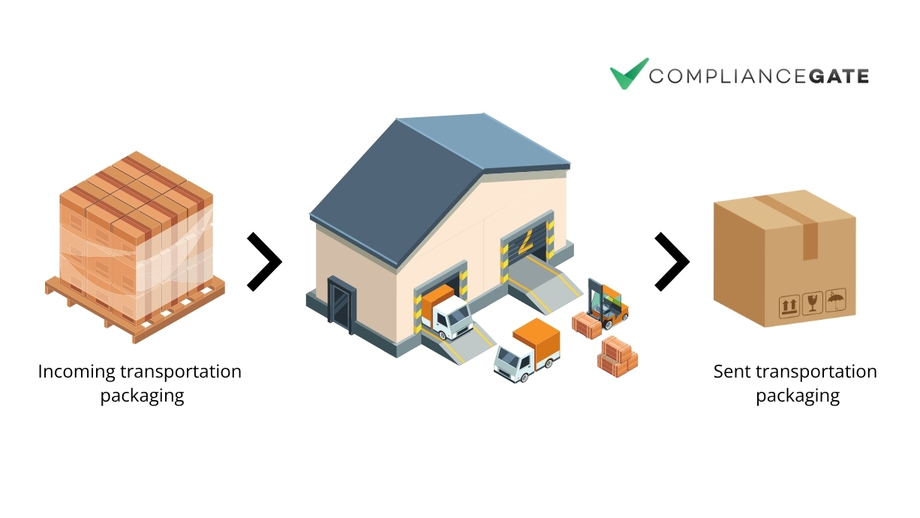
The manufacturer is generally deemed responsible for ensuring that packaging meets the following requirements:
- Material and design requirements
- Labelling requirements
- Documentation requirements
- Testing requirements
In short, the company, defined as the manufacturer, must ensure compliance with the PPWR, create a DoC, technical documentation, and affix labels. Hence, the manufacturer (which may not actually manufacture any packaging) must be identified in the supply chain.
Does this mean that you need to repeat this process for every single box, pallet and plastic wrapper you receive from suppliers? Doing so would be extremely burdensome, considering that, unlike product packaging, transportation packaging can change over time and even from order to order.
While exemptions apply to transportation packaging (see below), we could not find any exemption to PPWR requirements for transportation packaging in general.
Manufacturer
The manufacturer can be:
A: The company that manufactures packaging or a packaged product
B: The company that has packaging or a packaged product designed or manufactured under its own name or trademark
C: The packaging supplier of the packaging, if:
i. The company that has packaging or a packaged product designed or manufactured under its own name or trademark is a micro-enterprise.
ii. The packaging supplier is located in the same member state as the company mentioned above (i).
If we go strictly based on the definition, then the following may be true:
| Scenarios | Examples |
| Packaging factories that sell ready-made transportation packaging may be considered manufacturers | Packaging factories that design and sell transportation packaging |
| Companies that design and/or brand transportation packaging may be manufacturers (i.e., a brand with custom transportation packaging). | 1. Packaging wholesalers developing packaging that they sell under their brand
2. Product brands that order transportation packaging with their brand and/or their design |
Note that an EU importer is still responsible for vetting the PPWR compliance status of the packaging, even if they are not deemed the manufacturer of the transport packaging. This is also where things can get complicated.
Potential issues
The issue I can see is that the vast majority of manufacturers of boxes, pallets, plastic wrapping and other types of transportation packaging outside the EU cannot demonstrate compliance with the PPWR.
It is extremely unlikely that a small packaging factory supplying local product factories in, for example, Hanoi will demonstrate full compliance with the PPWR. This scenario could result in a situation where there is no packaging manufacturer in the supply chain that ensures PPWR compliance.
It is one thing to invest resources in product packaging (in which case the brand is the manufacturer), but something entirely different for individual cartons, plastic wrapping and pallets that may change from one order to another.
The only solution will likely be for EU importers to only use transportation packaging from larger manufacturers (including in Asia) that can provide a PPWR-compliant packaging catalogue.
This also means that the decision to select suppliers for pallets, corrugated boxes and so on must be made by the EU importer to ensure control in the supply chain. The same transport packaging must then be used for each order to avoid a situation where you need to rework PPWR compliance each time.
In any case, I think the people who draft legislation sometimes envision a supply chain that is far cleaner, more transparent, documented and ordered than it actually is. In reality, the world of manufacturing and shipping is messier and more unpredictable than most might imagine.
Transportation packaging requirements
Manufacturers must comply with the requirements outlined in Article 15 of the PPWR. Examples of key requirements can be found below:
✅ Create a Declaration of Conformity
✅ Crete technical documentation
✅ Affix labelling information
✅ Ensure compliance with substance restrictions (heavy metals) and design requirements
✅ Comply with requirements concerning empty space, recyclability, re-use and other aspects (some requirements are specific to transport packaging).
You can learn more about PPWR requirements in this guide.
Transportation packaging exemptions
We found the following exemptions in the PPWR related to transportation packaging:
| Exemption | Information |
| Harmonised symbols | Considering that transport packaging is not collected through municipal waste collection systems, the use of those symbols should not be mandatory for transport packaging, with the exception of the e-commerce packaging. |
| Re-use targets for cardboard boxes | For certain types of transport or sales packaging, reusable alternatives are not an option. This is the case for cardboard boxes, where the number of rotations is very low, and for packaging used for certain contact-sensitive products, which require special washing between uses. Therefore, such packaging should be exempted from the obligation to meet the re-use targets for transport packaging and sales packaging used for transporting products. |
| Conformity assessment procedure, DoC and technical documentation | Paragraphs 2 and 3 shall not apply to custom-made transport packaging for configurable medical devices and medical systems that are to be used in industrial and healthcare environments. |
| Re-use targets | 4. The obligations set out in paragraphs 1, 2 and 3 do not apply to transport packaging or sales packaging:
(a) used for the transportation of dangerous goods in accordance with Directive 2008/68/EC; (b) used for the transportation of large-scale machinery, equipment and commodities for which packaging is custom-designed to fit the individual requirements of the economic operator that made the order; (c) in flexible format that is used for transportation and that is in direct contact with food and feed as defined in Article 2 and in Article 3, point (4), of Regulation (EC) No 178/2002 or with food ingredients as defined in Article 2(2), point (f), of Regulation (EU) No 1169/2011 of the European Parliament and of the Council (69); (d) in the form of cardboard boxes. |
Who is responsible for the EPR of transportation packaging?
The company, defined as a producer, is generally responsible for extended producer responsibility (EPR) under the PPWR. The following three scenarios are relevant to transportation packaging:
| Case | Example |
| (a) the manufacturer, importer or distributor is established in a Member State and makes available for the first time from within the territory of that Member State and on that same territory transport packaging, service packaging, or primary production packaging, whether as single-use packaging or as reusable packaging; or | A Dutch brand is the producer for cardboard cartons used to deliver products to retailers in the Netherlands |
| (b) the manufacturer, importer or distributor is established in a Member State or in a third country and makes available for the first time on the territory of another Member State, directly to end users, transport packaging, service packaging or primary production packaging, whether as single-use packaging or as reusable packaging; or | A Dutch brand is the producer for padded envelopes used to deliver products to consumers in Germany |
| (e) the manufacturer, importer or distributor is established in a Member State and unpacks packaged products without being an end user, unless another person is the producer as defined in point (a), (b), (c) or (d); | A Dutch company imports goods from the UK and is the producer for the shipping cartons in which they receive the goods (which are also unpacked and then packed in individual parcels) |
First company to introduce transportation packaging
The following section states that:
a. The producer should be the manufacturer, distributor or importer of such packaging
b. that makes the packaging available for the first time from within the territory of the Member State
However, to minimise any unnecessary administrative burden for small businesses that fill transport packaging, primary production packaging or service packaging, whether as a single-use packaging or as reusable packaging, at the point of sale, the producer should be the manufacturer, distributor or importer of such packaging that makes the packaging available for the first time from within the territory of the Member State, since that economic operator is best placed to comply with the extended producer responsibility obligations.
Logistics companies
Logistics companies, which may include freight forwarders and fulfilment centres, may be considered producers for:
- Original transport packaging that comes from outside the EU
- Remains with the logistics company (i.e., after unpacking), and
- Becomes waste in the EU
Logistics companies are companies that receive imported goods from third countries and that conduct handling activities regarding the imported goods (e.g. unpacking and repacking into smaller formats or quantities to comply with clients’ requests) before sending the goods to clients, whether in the same or another Member State, with all, part of or without the original transport packaging. In such cases, a producer should be identified for the original transport packaging that comes from a third country, remains with the logistics company and becomes waste in the Union. Typically, the logistics company will not have ownership of the goods, but should be considered as the producer for packaging that comes from a third country and that it handles during its activity.
Note that not all transport packaging remains with the logistics company. In many cases, freight forwarders simply forward the bulk cargo (complete with original transport packaging added by the supplier) to the importer.
FAQ
Is packaging used for transportation exempt from the PPWR?
No, we cannot find any indication that the PPWR exempts transportation packaging. On the contrary, there are specific requirements for particular types of transport packaging (which is also defined under the PPWR).
Who is responsible for transportation packaging?
The company, defined as the manufacturer, is responsible for ensuring that the transport packaging is compliant in terms of design, materials, labelling, and documentation.
The company, defined as the producer, is responsible for extended producer responsibility (EPR).
Does the PPWR apply to pallets?
Yes, we cannot find any statement that the PPWR exempts pallets. Further, pallets are also mentioned in the PPWR in the context of specific re-use targets that will apply from 2030.
Does the PPWR apply to shipping cartons?
Yes, we did not find any exemption for shipping cartons either.
Does the PPWR apply to e-commerce parcels and envelopes?
Yes, and the PPWR specifically sets requirements for and defines e-commerce packaging.